29 June 2011
south of the border
24 June 2011
correspondence of a square peg

22 June 2011
Legacy Makers

News of the first one's passing came as a shocking sting since I had seen him only the week before and he seemed his normal jovial and mischievous self. Just before attending his funeral, word came of the second one's death. River City lost a couple of greats that week. For me, memories were brought back to mind with tidbits of wisdom sprinkled in.
Bill offered sage advice on politics.....but probably the wisdom imparted that stuck with me the most was his comment that he was so thankful he lost his re-election bid for city council 50+ years ago. I find some comfort in that. He also was a collector-of everything it seemed. Finally when his wife said it was time to clean out the basement and closets, our family was the recipient of many of his archives....well, old magazines and other "treasures". He would show up at my office with a box load of things and say "Betty tells me its time to clean out another closet". This happened every few months over the years and I have to say, we did end up with some pretty cool stuff. I think my favorite was when he showed up with a box of old cassette tapes that his son had recorded Prairie Home Companion shows on from the 1980s.

Jim had so many stories to tell....some of them true. And he wasn't from this politically correct generation, as he referred to me as the "little Hindu". I'm about as Anglo-Saxon as they come, but evidently didn't look so to Jim. I called his office once and complained about how the city fixed the flooding in the viaduct in front of our house. He asked me if it was because I didn't have anywhere for my camel to get a drink. I teared up once when I read a speech for my great aunt upon her being awarded the Sagamore of the Wabash. He took me aside and said he was going to have to toughen me up for politics.
Both were remarkable men of another generation, and different sides of the aisles. Both wanted what was best for River City and offered about all the encouragement I could have asked for. I wonder in those 91 and 83 years if there were rough edges that were worn down, if there were times when hope seemed lost, or opportunities to say "forget this". I mentioned to my wife the other day that for the last 15 years I've lived my life for everyone else and it was time to start thinking about us. She said that was contrary to the message on Sunday. Oh sure, bring God into this.....as if He's not on my case already.
16 June 2011
Sunrise on the Hill
08 June 2011
LaPorte's front door
02 June 2011
One Munster Shrine
We hadn't gotten too far into Indiana from Illinois when this happy steer put a smile on my face despite the gloomy skies above. A bit further down the road my observant driver spotted Calvary on the south side of the road in Munster. What's that doing up there I wondered. Knowing that we were on a tight time frame to make it across the state during daylight hours, of course, we stopped.
And it was the best stop of the day.
We gathered up a few photos, walked briskly through the stations of the cross (backwards I think, and we missed a few....that's the trouble with us Protestants), but we couldn't help but be drawn to the unique material the shrine was made from during the 1950s. Sponge rock from Arkansas. Never heard of it. But it was used in masterful precision. I was headed back to the car when my driver (sounds like I'm Amish) began talking to some older gentlemen who looked like they were heading off to do some important work. They planned to spend the day in the tomb switching light bulbs. What? So they invited us into the tomb below Calvary and it was one of the more impressive places I think I've been in here in ol' Indiana.
Now, my pictures (stupid camera) didn't do this place justice. It was really quite remarkable. I went online and found this link that has a little better photography than my orange blurs, and more history: http://www.roadsideamerica.com/story/11529 . I think what was so amazing was the use of light and stone together in the tomb. And just so that you don't think I wasn't reverent, I asked if it was ok to take pictures, and I did spend a little contemplative time before rolling the stone away and getting back on Route 6.
The one picture that turned out perfectly was the one of my hand. I was inspired with all kinds of thoughts and spiritual applications when I placed my hand on the stone, unfortunately they escape me now. I'll be sure to post more on my travels on Route 6 soon.
25 May 2011
Random things from the Hill
18 May 2011
telling the Hoosier story

09 May 2011
Another trip on Route 6

03 May 2011
Opulence in Hammond
Hohman Avenue in Hammond is a good place to start in uncovering this past. South of downtown an area developed known as Harrison Park. Served by an electric rail line the area south of the center of town became a suburb for the city's burgeoning upper and upper middle classes. Maybe two of the finest buildings constructed during the boom time sit across the street from each other: the Southmoor Hotel and the Northern States Life Insurance Company Building.
The Southmoor represents the height of Hammond’s economic success of the early 20th century and the commercial building boom that ensued. It is considered one of Hammond’s finest early hotels. Prosperity demanded all types of housing; including workers’ homes, shop keeper and other middle income earners’ housing, as well as estate housing for the affluent. Also needed during this time were apartments for Hammond’s many single and newly married populations. The Southmoor itself became a popular place for teachers to live. The Southmoor catered not only to this population, but also upscale lodging needed by visitors to Hammond for business or pleasure.
The Southmoor was positioned well on one of the city’s main thoroughfares with access to the Green Line, taking commuters not only to the downtown districts, but also with connections to other northwest Indiana cities and Chicago. The apartment building provided a more suburban setting than the downtown and had immediate access to Harrison Park. The building provided a few retail necessities, such as a beauty shop, restaurants, and dry cleaners, located in the building’s commercial space to support its residential population. Developer Leo Deutsch contracted with Gary architect L. Harry Warriner to design the five-story building in 1927. Warriner provided initial drawings late in 1927 which were revised and used for construction in March, 1928.
The company originally known as Employee’s Life and Casualty Insurance began in 1910 in a small room in the rear of Hammond Trust & Savings Bank and was born into a well-suited economic climate that would ensure its success. The originators expected it to have great appeal to the “industrial army of this region”. The company was renamed Northern States Life Insurance Company in 1913, the same year it “took its first step in reinsurance, reinsuring $1,700,000 of business of another company.” From that year forward the growth was “steady and without any high pressure…..until 1919 when the year closed with ten millions of business in force.”
27 April 2011
Monterey Bandstand
Communities used the structures for town bands, orators and politicians to entertain or connect with the public. Town bands became particularly popular during the late 1800s and into the early part of the 1900s and drove the need for many of these structures as performance stages in public spaces. The architectural type also followed the garden city, or city beautiful, concept of creating public places of respite or recreation. Such places as parks and public squares required an elevated place for viewing or from which to view the surrounding area. The bandstands were places to see and be seen. No doubt, the burgeoning little town of Monterey needed one of these public spaces and in the early 20th century Adam Kleckner donated a four acre tract of ground to the Town of Monterey for use as a park on the opposite side of the Tippecanoe River. The bandstand quickly followed.
Very little is known about the man who was the builder of the Monterey Bandstand. Abraham R. Hay was born in Indiana in 1852. His father was a native of Pennsylvania and his mother was a native of Germany. Hay was living in Pulaski County when his wife, Isabelle, filed for divorce in 1875; at that time Hay would have been approximately 23 years old. Abraham Hay is listed in the 1910 census for Monterey as a boarder. He was living with Mary Eikelburner, age 65, and her son and his family. Their residence was 52 Main Street. Hay’s marital status is listed as divorced; his occupation is listed as “carpenter of houses” and he was actively working at the time of the census. Abraham Hay died on September 3, 1939.
18 April 2011
Bethel II
15 April 2011
the Bethel Years
When we took over the Bethel Acorn, we inherited the mid-80s logo and never changed it. The upside down pink triangle? I know, makes me wonder what they were thinking too. That's my buddy Mark & I revamping the place. Yes, that's a near-mullet I have. 13 April 2011
Putting the Sycamore in Sycamore Hill
That tom-foolery by Mother Nature convinced me that this past weekend was the time to plant trees. Again asserting the honorable role the sycamore tree should have in the Hoosier state, and wanting our place to live up to its name, I began the hunt for sycamore trees last fall by contacting the state tree nursery. I would have to buy 100 trees. They were out of sycamores. My dad had a catalog of native trees in which I could order 25. The cost was double for 1/4 of the trees-but given how I would insist on planting all 100, the 25 seemed like a better deal. I also ordered 10 (they sent 11) Douglas Fir. These would be the official family Christmas Trees for 2021-2032. And finally I ordered 5 apple trees last fall that I spaded into a temporary location until spring when I could establish the "orchard".
Two weekends ago my son and I, in anticipation of the tree order arriving any day, measured out the locations for the sycamore trees and the orchard. To provide an air of "romanticism and mystic" to the farm, and in keeping with the tradition of farm estates of the 1800s, we lined our roadway property line from the creek to the drive, and then lined each side of the drive all the way up the hill. We finally established a 25' spacing after evaluating 20' and 30'. The orchard was easier to plan at 15' with alternating rows.
The orchard arrived in a box last fall
07 April 2011
Architectural Unrest
04 April 2011
Country Music for the Soul
02 April 2011
30 March 2011
Monument to the Homefront & the other Lloyd Wright
I am working through a project right now that has required a great deal of research in advance on a bit of an unsung architect who practiced in Indiana during the 1920s, 30s, and 40s. John Lloyd Wright, who changed his middle name to that of his famous architect-father's, Frank, grew up in the business bouncing off his father's studio walls in Oak Park, Illinois. John at first rejected the notion of following in the trade but after moving to California and working side-by-side with his brother in a related field he understood he just had to follow his heart and began training under his dad. That led him back to Oak Park. Wanting to be out from under his father's shadow, John moved to Long Beach, Indiana in 1923. Long Beach was a resort community that developed along the Lake Michigan beach just north and east of Michigan City, Indiana. John created a home and studio, and more importantly, relationships with others for whom he would create home plans. John's work at first followed some of his father's styling with the Prairie influence, but after a trip to Europe he began to create his own mark on his architecture. John Lloyd Wright completed only about two dozen designs during his time in Indiana from 1923-1946, and only a few of those were not residential in nature. He created two schools, one in Long Beach and the other for Coldspring Township. The Long Beach school remains today. He also created probably his best known public work-the Long Beach Town Hall, which was recently restored. He created one apartment house, still existing in Michigan City, and a hotel for the Indiana Dunes, which was razed. All but one of his home designs were located in Long Beach, the one other was located in Michigan City and is still there.
Fire & Guard Station, KOP
Now, for the most part, I knew about his career in Indiana and about the handful of projects he created in Long Beach. But I didn't know that during the years of World War II John was contracted by the federal government to design buildings at the Kingsbury Ordinance Plant south of LaPorte.....in fact, I've yet to meet anyone who did know this. I found it listed in an early book written about his projects. So while the kids were home over spring break, and wanting to return to the Bass Pro Shop in Portage, we drove by way of Kingsbury and took a little tour. Once I turned off Highway 35 onto Hupp Road I saw the building pictured at the top and thought to myself-that has to be a John Lloyd Wright design. We saw a second smaller building (above) with the same design as well.
Finished ammunition storage warehouses, three of dozens at the KOP
If you've never driven through the former Kingsbury Ordinance Plant, I would highly recommend it. It is a relic of the war years that likely will soon disappear from the Hoosier landscape. Today it stands as a fading & eerie monument to those who served on the homefront, the Rosie Riveters of Indiana. My dad's parents both worked there during the war, but because of plant rules against husbands and wives working together my grandmother worked under her maiden name. With this new-found information on the plant's connection to John Lloyd Wright, I have a new appreciation for the place. John's drawings for his work at the "KOP" are archived with the Chicago Historical Society and I am planning a trip to get more information about his architecture remaining at the plant. As this project develops I will be sure to post more on JLW, KOP, and the other work he did at Long Beach.27 March 2011
22 March 2011
Here come the Irish


Great Grandma Berthy always called us, early in the mornings, to let us know if we had a school delay or cancellation due to snow. I don’t remember much else, except I do remember their funerals. I believe it was Grandpa that died while I was staying with my Aunt Nell in Van Buren, and we had to return early for the funeral. They were in their early 80s when they died.
Ode to a Truck
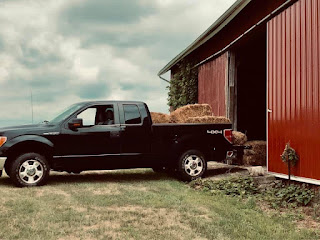
Wednesday, I took my travel companion on its last trip, from which it didn't come home with me. I took it for a drive the day before, to...
-
I've written about John Lloyd Wright, the son of the other famous Lloyd Wright, Frank, on this blog before. JLW was a skilled architect...
-
A way out in the country, down a secluded gravel road lies a small cemetery perched on a knoll, around which the road makes four severe turn...