21 April 2016

Kayaking Wythougan


Here's a photo-log of my kayaking/photography trip down the Yellow River (Wythougan in Native American) last Fall with a buddy, who is a far better photographer than I am.  We're fortunate here in River City to have such a great river that features some really wonderful historic bridges.  It was a great float, until we realized we needed about an extra hour of daylight to make it back to my truck.


19 April 2016

Garrett Post Office


I'm starting to be able to spot these things a mile away, post offices built during the Depression that feature Public Works of Art Project murals.  I was in Garrett late last summer to look at a theater project and their post office caught my eye.  Sure enough, it had one of Indiana's 36 extant post office murals.  This one recalls the city's great railroad past.  The following is from a piece I wrote about Rensselaer's mural:

The Public Works of Art Project was formed on December 8, 1933, as part of President Franklin Roosevelt’s New Deal program to pull the country out of the dire economic conditions brought on by the stock market crash in 1929.  On the December 8th date, a meeting was held by the Treasury Department’s Advisory Committee on Fine Arts which also included First Lady, Eleanor Roosevelt and the directors of eight major museums of art in the United States.  The goal was to employ artists in the decoration of public buildings and parks. To participate, artists had to prove that they were unemployed and qualified to produce works of art that would benefit public property.  Following the success of other New Deal programs, the Works Progress Administration was formed in 1935 and included under its auspices the Division of Professional and Service Projects with four programs: art, music, literature, and drama. The Federal Art Project was designed for the production of art among other related functions.

The Secretary of the Treasury, Henry Morgenthau, Jr., established a Section of Painting and Sculpture to employ artists for producing work for public buildings in 1935 after funding for the Public Works of Art Project was withdrawn.  The founder of the Public Works of Art Project, Edward Bruce, was chosen to direct the program. To achieve the goal of exposing the public to good art, post offices were selected because of high volume of use.  Bruce commented in a letter to President Roosevelt that placing art in post offices would carry out his “dream of letting simple people all over the country see at least one thing of beauty.”

Thirty-seven murals were commissioned for Indiana post offices.  Thirty-six are extant.  The first mural was installed in the Lafayette post office in 1936 and the last was installed in Monticello in 1942, one year before the Treasury Department program would end.


Garrett is located in west central DeKalb County. The town was platted by Beverly Randolph, the son of James Randolph, the chief engineer of the Baltimore and Ohio Railroad.  The town was platted in 1875, shortly after the railroad was constructed through DeKalb County, and was named for John Garrett, the president of the railroad.  Lots were sold immediately and a rush to create a new commercial and shipping center with access to the railroad occurred in the town genuinely developed by and for the railroad.  By 1913 Garrett’s population was nearly 5,000.  The town was incorporated as a city in 1893.

Some of the more significant public works developed in Garrett  at the turn of the century were the city’s water and light company plant that was established in 1896.  There were nine miles of water lines included in the city’s water system.  By 1912, the city had developed a boulevard lighting system.  The city had three miles of paved streets and five miles of sewerage under the streets by 1913.  The city constructed a new city hall in 1913 and a Carnegie library by 1914.  One of the largest public buildings in the city is the Sacred Heart Hospital which was constructed in 1902.

14 April 2016

Winter of Owl Discontent

My picture of a snowy owl
I have a confession.  I "bird".  And it is no recent hobby, in fact, I have lists of birds that I saw growing up through elementary school including species we saw on vacations out west and down south.  When we bought our first home and I put up a bird feeder, I began to keep track of what we saw right in our neighborhood.  And then when we moved to the country, the species changed and the list grew.

"Birding" for short-eared owls
As an Evangelical Republican, I have an unlikely friendship with a Catholic Democrat and together we have had great times "birding" in a few far reaches of the Hoosier state.  He follows sightings of unusual species more than I do, and he has far better eyesight which typically leaves me asking "where?" a fair amount.  Despite that, he alerted me to a couple of unusual sightings of owls over the winter and asked if I wanted to travel, in one case, well more than an hour to see them.  Sure, especially since I had never seen the species before.

Not my picture of a snowy owl
First was our trip to the Kankakee Sands Prairie Restoration project on the west side of the state.  Folks had been seeing Short-Eared Owls flying low hunting on the prairie.  At first, we saw nothing and it was cold.  Once we gave up and started to drive out of the area we saw one, then two, then several more.
Not my picture of a short-eared owl
Second was our trip to see a Great Snowy Owl north of Peru.  The owl, which seemed to be way out of its range, had been spotted in a field by several people over several weeks.  We managed to find it just fine, and I got slightly better photos this time.  Owls are some of my favorite birds, probably because you see them so rarely so they have a mysterious quality that surrounds them.

My picture of a short-eared owl

12 April 2016

The Tamarack Experiment

My tamarack starts
A few years ago I got my first look at the original c. 1834 survey maps of our county prior to the establishment of local government.  The maps are really amazing and carry a great deal of detail you wouldn't expect.  Sure, there was the Michigan Road and a few other blazed trails, mostly Indian trails, through the wilderness.  Native American encampments were noted, one less than a mile northwest of our house, as well as a handful of pioneer trading posts and taverns.

Natural features are also noted on the map and make up the majority of items the surveyors recorded for history.  Streams and wetlands, noteworthy trees and large stands of certain species were carefully placed on the large maps created in the nearly untouched wilderness.

Tamaracks in the fall
It was one natural feature that caught my attention and made me question if it were accurate.  Less than a quarter mile down my road, near its intersection with the Michigan Road was noted a "tamarack swamp".  There were several of these pockets here and there across the map.  I knew the area fairly well and it is still wet but now filled with silver maple and scrub elm.  I hadn't realized until I did a little research that indeed tamarack trees, which resemble pines but lose their needles in the fall, were native to this part of the state and were survivors of the glacial age found in bogs.


The trees had medicinal and other consumable uses by Native Americans.  The Chippewa word for the tree is "muckigwatig" which means "swamp tree".  Now I wonder if "muck" have Native American roots.  The tree would not have been plentiful in the county, so its qualities rendering it nearly indestructible to rot for fence posts and framing, probably sealed its fate.

Original range of the tamarack
I had mentioned this "find" on the map to a client who has a great interest in forestry and he mentioned that he was in the process of growing tamarack from seed.  He asked if I wanted to try an experiment if we could find suitable soils on my own property to grow them.  Well sure, they could grow to be beautiful trees and could possibly start to repopulate the species now vanished from our county borders.  So, I have three starts ready to be planted (and protected from deer) in a lowland area near our creek.  I'll have to live a long time to see these reach significant maturity, but I'd like to think I'm helping to put things back into a natural order, and who knows, maybe there will be tamarack swamps again in our future.


07 April 2016

St. Mary of the Assumption Catholic Church of Decatur


 I'm staying with the church theme here.

I have a project in Decatur that drew me into town about a year ago.  It wasn't the first time I had been in Decatur, but certainly the first time in a very long time.  I remembered seeing a giant unusual spire off of the main route that caught my attention, but not enough to draw me over a few blocks.  At the end of last year I went birding, yeah, that's what we call it, with a buddy over that way.  I mentioned my project and then mentioned seeing the church spire.


So, on our way back from the Limberlost restoration project, we swung through Decatur to drive past my depot project, and then over to see what was at the bottom of the spire.  Fortunately, my friend recognized that he had been to the church and since it was a Catholic church, St. Mary of the Assumption, he offered to go in with me.  I don't know if that's because he was afraid I might do some sort of Evangelical voodoo in it, or if he was concerned I might drop dead.  Regardless, we walked up to the doors and they were open.  And in I went.


The cavernous church was an impressive example of what was becoming a sort of "atomic age" architecture built in 1951 with some exceptional details.  The bell tower looks more like a spaceship landing than a housing for a bell that tolls for mass.  I think about how cool it would be to sit through a service or two in that building, though I noticed the feeling was more intimidating with this church compared to Tyson.  Maybe because it was darker, and larger-it felt as though the ceiling towered above me.


I appreciate good architecture, regardless of when it was built.  Good architecture can tell a story, not only in its form and composition, but it also tells a story about the people who inhabit it.  What they care about.  What they aspire to.  I had an exchange with a colleague who asked if the county intended to build a pole building, suggesting that we should aspire to build something that reflects who we are.  I responded that I feared that pole buildings did reflect our aspirations.

05 April 2016

Tyson Methodist Church of Versailles


While I don't know that I could ever live in an Art Deco-styled house, it is one of my favorite styles and I have been known to go out of my way, possibly breaking some rules, to experience buildings in that style.  I have passed by the Tyson Methodist Church in Versailles several times on my way to Madison and never worked up the courage to knock on the door of the pastor's office next to the church.


A few weeks ago I found myself in the area again and this time worked through a Versailles native to get me in the door.  I wasn't disappointed.  I soaked up the atmosphere of the church that was built in 1937 in honor of James Tyson's mother.  Tyson was a valued partner in the Walgreen Drug Company which has realized some major dividends for the town.


But what I couldn't have expected was a pleasant visit with our "tour guide", a 90+ year old member of the congregation, since she was a girl.  She relayed her knowledge of Mr. Tyson, she fondly referred to as Uncle Jim, as we sat together in the front pew of the church that gleamed inside and out.  She was nearly silhouetted by the massive leaded glass windows as we sat and talked.  She also didn't have kind words for politicians.  But then, neither did I.

I've been scolded before about my thoughts on the declining role architecture plays in our churches, but I will relay that there was something about being in the building that lifted my spirit and sent my thoughts to something of higher value, much above my sorry ability to understand the greatness of our God.

31 March 2016

Indiana Byways Passport Program


So, here is a great thing that we at the seven Indiana scenic byways have been working on since the beginning of 2015.  This is a great way to celebrate Indiana's bicentennial and really experience the Hoosier state.  We hope to see you on the road!

Indiana Bicentennial Byways Passport to Launch March 31st

The Indiana Bicentennial Byways Passport Booklet, containing routes for each of Indiana’s seven Scenic Byways, will be available on March 31st. The project is an officially sanctioned Indiana Bicentennial Legacy project and it will commemorate Indiana’s historic transportation corridors. A press conference and official kickoff event will be held at 2:00 PM at the Indiana Historical Society on March 31st to see the program off! The participating byways are: the Indiana National Road, the Wabash River Scenic Byway, the Whitewater Canal Scenic Byway, the Historic Michigan Road, the Indiana Lincoln Highway Byway, the Ohio River Scenic Byway and Indiana’s Historic Pathways. Scenic Byways pass through nearly fifty Indiana counties and account for over 1,000 miles of Hoosier Highways. The 32 page passport booklet contains a variety of stops from each byway and participants will be able to receive a stamp for checking into these stops. 

The Passport Booklet is a tool to explore scenic and historic resources in Indiana. All seven Scenic Byways display beautiful paths and historic transportation routes that tell the story of how Indiana was built. It is a road trip 200 years in the making!

Passports will be available on March 31st for a $2 suggested donation at each designated passport stop. More information on the participating Scenic Byways and passport stop locations can be found by visiting http://www.in.gov/indot/2827.htm. Please visit Indiana Byways on Facebook at https://www.facebook.com/IndianaByways/ for additional information and updates on the program. You can also share your photos and experiences traveling Indiana’s Scenic Byways.

29 March 2016

Back to Court-3 more of Indiana's greats


My summer travels during 2015 caused me to pass by several more of Indiana's courthouses and true architectural gems.  From Fulton County's courthouse in Rochester (above), to Jasper's Dubois County Courthouse (below), again, this is one thing that Indiana's early county officials did right!  Fulton County's courthouse was built in 1895-1896 and designed by Edwin Rush.  The Romanesque building prominently features lions that guard its entrances.


The Dubois County Courthouse features massive porticos on each side in the Classical style.  Its position in the center of Jasper on a slight rise emphasizes its height.  We stopped in Jasper to eat at one of their famous German restaurants on the way to Holiday World.  It was the only time it wasn't raining.  The building was built in 1909-1911 and designed by a Washington D.C. firm.


No, that's not the famous golden dome, it's the Vigo County Courthouse in downtown Terre Haute.  The building has strong French leanings and was built in 1884-1885 and designed by Samuel Hannaford of Cincinnati.  The building features prominently in downtown Terre Haute because of so much change in the historic context surrounding the building.  I snapped this shot at a stoplight while working at nearby St. Mary-of-the-Woods.

24 March 2016

The one, and for a long time only county memorial forest in Indiana

This unassuming pile of rocks is likely the base to the monument planned in the forest.
Back in 1943, the State of Indiana passed a new law permitting counties to hold wooded tracts of land under the concept that the land would address both conservation efforts and be used for recreational and "memorial" purposes.  The first such county to do so, as an example for others, was Marshall County in the northern part of the state.  It had an unlikely start, and for more than 50 years, remained the only county in Indiana to have a "Memorial Forest".  It was joined by Starke County in the last decade.

Here's an article about the forest that appeared in the Culver newspaper as written by Robert Kyle, a prominent Indiana journalist:

"A traveling troupe of beavers was responsible for the Marshall County Memorial Forest - the first established under the 1943 law permitting Indiana counties to acquire and maintain wooded tracts. First Sam Jones, an observant farmer living north of Burr Oak on Yellow River, reported he had seen signs of quaking aspen cut down in a small swamp across his line fence. Then Luke Duddleson, the county highway maintenance man, related in casual conversation around a tavern stove that "somethin'" was plugging up a culvert that led to the river "faster than I can clean it out." Russ Fisher, local authority on wildlife in general, and this writer out of curiosity visited the area several weeks later. We found a worthless 8O-acre tract, mostly blow-sand, and a sprinkling of long-neglected apple trees to one side of a swail surrounded by second-growth black oaks, through which a small stream trickled from a spring at the back of the property. Sure enough, there were evidences of beaver workings, and a small dam just back of the culvert was a second line of defense against Luke's determination to keep the culvert open.

During the hunting season Russ and I cruised the surrounding territory, flushed a number of wood ducks that had nested in small dead trees in the pond, and came to the conclusion that to preserve the beaver workings as an educational project we would have to acquire the area and reforest it. We talked the situation over with Harry Medbourn, county commissioner from our district, who came forth with the idea that the county buy it, taking advantage of the 1943 law, and make it into a recreational area. Meanwhile, Harry carried the idea to the other commissioners, Justin Myers and Ben Smith, who looked favorably upon using county funds to buy the acreage. By that time, public opinion was sounded out and sentiment, both favorable and otherwise, was fomented, and finally the opposition ran out of arguments, and funds of $1,600 were set aside, with the blessing of the Indiana Board of Tax Commissioners, and the property was acquired. Next Ted Shaw, Purdue extension forester and at that time acting state forester while Ralph Wilcox was in service, was contacted. He brought expert technical knowledge along with remarkable vision to the undertaking. His plan was for a model or "pilot" county forest from which other communities could get encouragement to reforest their waste land.


Russ enlisted the services of 18 active county conservation clubs and was appointed chairman of a planning committee consisting of Harry Lower of Plymouth, present conservation officer; Herb Sloan of Bremen, former conservation officer; Otto H. Grossman of Argos, ardent Waltonian; Mrs. F.W. Bates of Culver, president of the Marshall County Federation of Women's Clubs, and Orner Bixel of Plymouth, president of the County Council of Conservation Clubs. This committee, by donations, accumulated the $250 necessary to order the trees from the Division of Forestry and supplied the volunteer labor to clean the land and assist in planting. Boy Scouts, 4-H Clubs, neighboring farmers, conservationists and other interested groups planted 22,000 trees.  Nearly one-fifth of the area was hand planted due to the roughness of the terrain. Fire lanes, which surround and transect the area, were plowed and will be kept cultivated throughout the summer as protective measures. "The work resembled an old-fashioned barn-raising job," Ted added. "Everybody pitched in and got the job done. The old and the young were there, the women and the men. And they did a good planting job. Survival is very high to date." Future plans call for the planting of low-growing game food species such as the dwarf chinquapin oak, which had recently been found growing wild nearby. The development of the memorial shrine and natural amphitheater is the next step on the program. Plans are now being drawn. This memorial, possibly to be undertaken by county veteran organizations, will consist of planting hardwoods, with suitable markers as memorials to the 90-odd service men from the county who gave their lives in World War II. What Marshall County has done can be duplicated in every county in the state with a moderate expenditure of money and organized effort. It is admitted that the county forest is not the solution to our reforestation problems, but it is the initial step in that direction."

22 March 2016

big Nashville


The wife & kids in downtown Nashville
Big Nashville...as opposed to lil' Nashville, has had an allure to my wife ever since she devoted her heart to country music many years ago.  Think of her great joy when our nephew announced he was getting married in the heart of the city, which prompted a road trip last May.  I mean, I get it, I like country music as well, though that's been declining in the last year, but here was my wife giddy with the prospect of seeing  someone of fame in the land of country music.

Lunch on the back alley patio at Jack's BBQ
The famous Ryman Auditorium with stage backdrop from Prairie Home Companion
But it was to my surprise that we happened upon the stage crew of Prairie Home Companion setting up for a performance in Ryman Auditorium in downtown Nashville.  Might as well had been Rascal Flatts setting up to me.  And the BBQ was excellent, of course.

My nephew-the bearded & suspendered groom
The wedding, which seemed appropriately Nashville-themed, was great.  And I'm feeding my wife's county music addiction with tickets to the Band Perry next month in Wabash.

17 March 2016

From Dublin......Indiana


Last week found me traversing the southeast corner of our state from Osgood to Lawrenceburg, Richmond to Fountain City, and Cambridge City to Dublin.  And since it is St. Patty's day, I thought I'd share my experience from Dublin, or what there is of it.  I was asked to take a look at a Quaker church in the tiny National Road community.  And while there is a well-spring of Quaker blood in my veins, I had never been in a church of the Society of Friends.  What a smart-looking one to make my first.  It was built c. 1878 by the Dublin congregation.


A day before, I had just mentioned to a couple of congregants from the Westfield Friends Church that I'm proud of my Quaker ancestors who came from North Carolina and settled in Wayne and Henry counties to ensure that Indiana would not become a slave state.  And it was a close vote.


Quakers were very strict about marriage outside the church, and their "monthly meeting" records not only demonstrate that, but also are a wealth of information for genealogists.  My ancestors were members in nearby Spiceland.  I have a feeling that I may need to extend a family discount to the Friends in Dublin.  But what I and a friend who traveled with me wanted most out of our visit to Dublin was directions to a good pub.  Dublin, however, is a dry town, even on St. Patrick's Day.


I have for a long time operated under the false conclusion that I have Irish blood....though family records would still indicate some truth in that, my DNA tests show otherwise.  Still, I have a love for all things Irish.  My wife was thrilled to point out that her dad, adopted at birth, came back with results showing 53% Irish, which would just about have to indicate one of his parents were born to Irish immigrants.  No wonder I was drawn to her.

15 March 2016

Winter Hikes

Tippy River State Park

Sunday afternoons and evenings often find me chillin' on the recliner, watching the Simpsons and the news.  It's quiet around our house on Sunday nights since both kids are in youth group now, and my wife teaches the 5th-6th grade program.  And then one day about two years ago, a buddy asked me if I wanted to start hiking with him on Sunday nights.

Hmm....give up my warm comfy chair to hike in, sometimes, the teens, drudging through knee-deep snow trying to keep up with a guy who is a half-foot taller than me (or close).  Sure, I love being outdoors just that much to endure such craziness.  While those trips have become less frequent in the past year, we do still manage to hit the trails occasionally.  And we talk-a fair amount-which is hard to do when you're winded and trying to keep up.

Stretching far (ok, an hour or so) and near (local greenways trail), we have successfully hiked every state and county park, forest, and preserve-or so it would seem and would follow it up with a hot supper complete with coffee.  No offense to my high school friends out there, this was not your thing-I get that, but man would I have been all over it.

There is something about the woods, even in winter, that direct our thoughts to our Creator, of course it helps that the hikes come on the heels of a Sunday sermon.  Regardless, I'm reminded that we are but just a small part of this bigger thing around us, separate because He created us in His image, yet entrusted with the ability to destroy or nurture what cannot protect itself from us.  In that sense, it is as though God gave us a parallel between Himself and man.  What we choose to do with His creation is a reflection of how we view the Creator Himself.  So far, we've not done that great of a job.

10 March 2016

Hoosier bastions of pride

Warm

Now with kids in junior high and high school, our lives seem to become filled with activities that I wouldn't typically have found myself at a few years ago.  Our daughter, a cheerleader, had us going to junior high football and basketball games this year, while our son, in high school pep band, had us visiting the hardwoods at the local gym.

Cold
There are few places that celebrate community more than sitting in the stands off the grid-iron, or in the bleachers overlooking those bastions of Hoosier pride.  I will confess, I'm more of a basketball fan than football-likely because I have never caught on to all the rules of the latter.  And the fact that I'm never cold at a basketball game.  It's a joy, though, to see kids that I taught in Sunday school on the field or court, giving it their all.

08 March 2016

Channeling my inner Amish


Over the course of about the last two years, our preservation organization has been working on telling the "untold" stories of certain cultural groups and enclaves that settled in our county.  The Amish, who first settled in 1850, have become a large part of our population and continue to expand.  My great x3 grandfather, Samuel Hochstetler, was the first Amish to settle with his family in our county in that year, followed by four other families in the course of the next five years.

While on the path to discovery, our chief genealogist organized a meeting with the historian of the local Amish church and asked if I wanted to participate in the meeting.  He just happened to live at my great x3 grandfather's farm.  So, certainly.  He took us to the grave of my ancestor at the community's cemetery next to their first school.  And his grandson gave me a tour of the farmhouse and barn.

Last year, several cemeteries in that township were featured in a tour and my genealogist friend asked if I would be willing to play Sam Hochstetler and discuss the migration of Amish from Ohio to the area. I've done these cemetery tours before, but this one really caught my interest.  But, I needed to dress the part and our family gave up those simple clothes a long time ago.  A mutual contractor-friend of mine, an Amish fellow who was almost exactly my size, loaned his Sunday best so that I could look the part.  The clothes fit like they were customized for me.

And so, with many of the Amish gazing on that cold May day, I did my best to tell them about their history, which most seemed to know quite well.  Talk about a tough crowd.  The first thing I asked was how they used the bathroom with all of the hooks and flaps and straps.....evidently, that was taboo.  And then several poked at me with questions in Pennsylvania Deitsch.  It was both awkward and communal, if that's possible.

05 March 2016

Writer's Apprehension


Except for a few posts, 2015 was a bit of a dud year when it came to writing on Hoosier Happenings.  I had high hopes for 2016, being the bicentennial year of our collective Indiana home, but alas, we are well into March and nothing beyond my best wishes for Christmas and the New Year landed on HH.  Last month, someone from my elementary school found a post I had written about it a few years back and put it on our local "if you grew up in....you'll remember" FB page.  I looked at the stats today and it pushed February, 2016 into the top ranking of the most hits since I started HH in 2007.

Life is busy.  I'll blame it on that first.  By the middle of 2014, a full calendar of work began to create a backlog that continued to swell until the early part of 2015.  And even the brief time of "normal" was upended by an even greater backlog that I've only just now cleared the river for an even flow.  In 2014, I looked back and realized over a month of 8 hour work days went to non-profit efforts.  Since I needed to ratchet that back in 2016, I got by with just over two months of 8 hour days.  And 2016 saw the start of my new elected responsibilities, which was the only predictable allotment of time on my calendar.  By the middle of 2016, I realized I hadn't taken a single day off and thought to myself that I didn't leave my job with 4 weeks of vacation only to have a few days.  I think I managed to work in a week of vacation days last year.

I need to figure out a balance here.  I enjoy my work and responsibilities, and recognize God's blessed me, but I doubt that He intended me to work like a dog.  Quite sure of it actually.

Writer's block.  That's the other thing I'll blame it on.  Only I know that's not exactly true.  In fact, quite the opposite is true.  Instead, I would call it writer's apprehension.  The last year has provided enough fodder for a plethora of posts, but frankly I'm a bit apprehensive about sharing my thoughts on faith and politics.  Case in point-we Republicans created and deserve Donald Trump, and what's more disturbing is that more than half of evangelicals support him.  There's a dozen posts wrapped up in that statement alone....but I'd like see more civil discourse in 2016, so I find myself passing on a number of thoughts best kept to myself.  Just as a student of politics, I am fascinated with what is happening with our Grand Old Party.....if it truly even exists anymore.  I am more concerned about the future of the church.

So, I will attempt to get back on a blogging schedule for the few of you who land on this site.  I have always enjoyed delving into our history and culture as Hoosiers, and into our politics and issues of faith as an exploration of who we are and maybe who we should ascribe to be.


23 December 2015

Merry Christmas from our family to yours......hoping to get my blog on in the New Year!

30 October 2015

The Big Old Pumpkin


My folks are in the process of house-clearing with the end goal of selling and downsizing.  A few things have migrated to our house, including a box of school items from my childhood.  I had always recalled a poem I wrote in 6th grade, and a trophy I received for it, but never knew what happened to it.  Well, there it was in the box.  I won a statewide competition for this piece of literary
work, and in honor of Halloween, here you go....

The Big Old Pumpkin

Hello, you big old pumpkin,
I've got to cut you up.
First I'll take your brain out,
And put it in a cup.
Now to cut your mouth out,
In a scary sort of way.
I'll cut your eyes and nose out
And set you in the hay.
Now to make you swallow
A big candle that's bright,
And get you all ready
For Halloween Night.


Even at 6th grade, a literary genius.  Happy Halloween.
And yes, there are more.

22 September 2015

See you at the Pole: maybe it's time to grow up


It's been more than four months since I've sat down to pen a post.  Life has taken on a number of busy twists and turns that's left me with little time to think, much less reflect on happenings around me.  Recent tragedies in our community prompts one to reflect on what truly matters though, so I thought I would share some things that came to mind as I sat and waited for my son outside of the high school last night.

We expect an awful lot out of kids today, packing them down with schedules and responsibilities that few adults would want, let alone could bear the burden of.  Tomorrow is national "see you at the pole" day, during which time a remnant of kids will join hand in hand around their school's flagpole and pray for their school, their classmates, and try to be the light of love and peace.  This unifying, harmonious moment that we in the church, again, expect our kids to be at to "take a stand".  Because of the loss of one of their classmates this week, the day will be especially poignant here in River City.

I think about everything going on in our country, in our state, and our community....all the rage, defiance, arrogance, and the rush to Facebook to spout-off that appeals to elements of our darkest nature.  I think about the example we are setting for our kids.  I think about the divided, hostile world we are nurturing to leave them in our wake.

I think about the fact that we expect them to be adults, when in reality we're the ones acting like children.

Rather unceremoniously, but maybe providentially given tomorrow's event, a flagpole was raised today in a very prominent position north of our community where a few thousand people will pass by several times a day.  And that got me thinking about what I would say to, and pray for our next generation as they join hands tomorrow.

First, I'd say forgive me for being part of the problem and not working harder to bring peace to our community, for not representing the image of Christ that I've been called to be.  And I'd pray that we would all, parents or otherwise, be better examples for them.

Then I'd pray that they would be the generation to bring healing, not only to our community, but to our world from the strife and upheaval our generation has created.  I'd pray that they could embrace and reflect the Gospel in a way the Church in America has seemingly forgotten.

I think it's time we grow up and be the examples these kids need.  Otherwise, we will continue to perpetuate the problems of this world when we choose violent rhetoric over civility, and our rights over what is right.

So I'm asking, how will you pray for our kids as they gather tomorrow?

13 May 2015

Hobart's more than just a sign on U.S. 30


Ever travel that stretch of U.S. 30 toward Chicago and think, hmm....Hobart, it has a little sign out here on the highway and a mile or so of strip mall shops-but where's the rest of Hobart?  There really is more to Hobart-but you've got to get off the highway to see it.  Now, you may think that you've wandered into a land of medieval knights due to the false half-timbering here and there.  Evidently this was all the rage when their redevelopment commission began the stucco and board crusade in the early 1970s.  Personally, I like the kitchy feel.  The downtown was placed on the National Register in 2014.  Here's a little history on Hobart:

In 1846, George Earle, who had a mill and was postmaster of a nearby village named Liverpool, purchased land and constructed a new mill by damming Deep River a few blocks north of downtown Hobart.  Earle relocated the post office to his new mill site and within a few years platted a new village he named for his brother, Hobart.  The first schoolhouse in the region was constructed in 1845, near the future mill site, at the current Hobart Masonic Temple location.  In 1849, Lake County organized Hobart Township, in which the newly established village of Hobart would become the center for community life in the township.  Earle built the first cabin in the village; his son, John, constructed the first residence a few years later.  The new village was located on the Chicago-New York coach route, which allowed the community to reap the benefits of frequent travelers and trade.


Hobart became the second railroad center in Lake County when the Pittsburg-Ft. Wayne-Chicago Railroad was established through the town in 1858.  The railroad was the only line located in the county until after the Civil War; therefore farms and industry in the region brought their goods to Hobart for shipment to outside markets.  By the 1870s, the population reached 500; there were 95 families recorded in 1871.  Hobart was incorporated as a town in 1889.  In 1895, the Hobart and Western Electric Railway was constructed down 3rd and Washington Streets; it connected Hobart to the booming city of Hammond in northwest Lake County.  The railway remained active until after World War II.


James Guyer established a brickyard in the town in 1872.  Brick making became the largest industry in the community; there were four brickyards employing over 100 people by the early 1900s.  W. B. Owens Hollow Porous Clay Tile Works and Kulage Brick & Tile were the largest companies in the early 1900s.  The National Fire Proofing Company operated from Guyer’s former brickyard until 1966.  The company produced fire-proof brick and tiles.  The town also had four lumberyards.


The railroads and subsequent industry accelerated the community’s growth during the first decades of the 20th century.  In 1900 the population was 1,200.  It grew to over 6,500 by 1935.  The town responded by incorporating as a city in 1921 at which time the population had already nearly tripled to 3,500.  S. H. Henderson was the city’s first mayor.  Hobart’s population continued to climb dramatically through the middle part of the 20th century.  In 1950 the population had reached over 10,000 and by 1960 had grown to more than 18,000.  Hobart’s population currently is just over 29,000.

06 May 2015

The Erwin mark on Tippecanoe Township's Architecture

The 1879 Gaskill-Erwin House
Newly listed to the National Register of Historic Places is the Gaskill-Erwin House in Tippecanoe Township, Marshall County.  The house was built in 1879 by the Gaskill family but has had a much longer history with the Erwin family after they purchased it in the early part of the 20th century.

Joseph Gaskill and his family arrived in Marshall County from Stark County, Ohio in 1860.  Gaskill was the proprietor of a sawmill and also farmed his eighty acre tract.  They had eleven children between 1855 and 1876.  Lewis Erwin purchased the farm in about 1925.  The Erwin family had arrived in Marshall County from Stark County, Ohio during the mid-1850s.  Members of the Gaskill and Erwin families knew each other and jointly had sold property in Stark County, Ohio.  The Erwin family had accumulated considerable landholdings in the northern part of Tippecanoe Township and southern Bourbon Township.  Lewis, a grandson of the original Erwin to settle in the county, and Eleanor were the parents of two children, Emily and William.   The house remains in the Erwin family today.


The Gaskill-Erwin House is an excellent example of the Italianate style used on the construction of a large frame farmhouse.  The Italianate style was popular between 1850 and 1880, particularly in Midwestern towns where the expansion of railroads brought wealth to communities and created a building boom during the period.  Cupolas, towers, and bracketed cornices became the style’s hallmarks. The style was popularized by house pattern books by Andrew Jackson Downing during the middle part of the 1800s, but its popularity began to wane as it began to be replaced by the Queen Anne Style in the last decades of the 19th century.  While the Gaskill-Erwin House type is more typical of a late Georgian double-pile, its architectural style is in keeping with the popularity of the Italianate style during its construction date of 1879.

The 1855 Erwin House
An earlier house constructed by the Erwin family in about 1855 is just across the road from the Gaskill-Erwin House.  The earlier house was recently restored and is in the process of also
being listed on the National Register of Historic Places.  The house is an example of Greek Revival architecture applied to an "upright-and-wing" house type, which simply means a dominant front gable, usually two-stories tall, with a one or one-and-a-half story wing on its side.  The Greek Revival style became popular in American building trends as the nation sought to emulate its democratic identity rooted in Greek civilization.  The style typically has some appearance of pilasters and an entablature, even in its most simple rural form, as a nod to ancient Greek temples.

Ode to a Truck

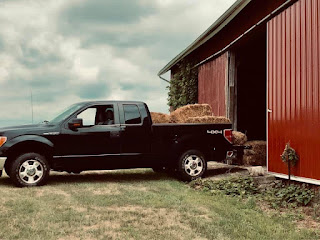
Wednesday, I took my travel companion on its last trip, from which it didn't come home with me. I took it for a drive the day before, to...