Showing posts with label preservation. Show all posts

09 June 2016

Help stop building abuse


 We've all seen it.  We know the signs.  Yet we choose to remain silent and let building abuse happen all around us.  We pass it every day and do nothing to stop it.  In Marion, Indiana, a group of people have decided to put an end to building abuse with the rescue of their old depot.  The depot served a railroad that ran from Anderson through Marion during the early 1890s.  The folks at Marion got the shaft though, when the railroad company built the foundation of their depot in 1893, then loaded the rest of the building materials on cars and shipped them down to Anderson who received a depot exactly like the one promised in Marion.  Ultimately, Marionites got their depot when it was opened for passenger service in 1895.  Restoration will be slow, but the abuse is over.  What abused buildings are you aware of River City?


07 June 2016

Photo journal of a Quaker church


One of the things I love about the work I do is the opportunities I'm given to visit places I've never been, nor likely would ever go.  I meet great people all across our state that are proud of their history and the buildings and places that embody it.  Such was the case at this little Friends Meeting House in Dublin, Indiana built c. 1874.  A great photogenic building with a wonderful history and steadfast folks who care for both.


26 May 2016

Vincennes: our first territorial capital


One of the most spectacular memorials in Indiana is the George Rogers Clark Memorial in Vincennes.  Its location along the Wabash River in Indiana first territorial capital is a fitting site given the importance of the river to the expansion of the country in the old west, now our Midwest.


Just across the lawn north of the memorial is this great bridge crossing the Wabash into Illinois.  Its grand flanking gateway carved with Native Americans is probably my favorite bridge in the state-well, second to the one I proposed to my wife on....I suppose that's my favorite.  While my reason for visiting the city this spring was because of it being the location of Indiana's Historic Preservation Conference, I'm losing a good friend to Vincennes-his hometown, so I'm thinking more visits are in my future.


17 May 2016

Holding Court in Porter & Sullivan Counties


The Porter County Courthouse (above/below) provides the tale of a phoenix, as it were, rising from the ashes.  The courthouse was built in 1883-1885 and designed by John Cochrane of Chicago, responsible for the Illinois State Capitol.  It typified many courthouses of that period with a mansard roof and clock tower.  However, just after Christmas in 1934 the courthouse suffered a major fire bringing the roof and tower down.  The building was substantially rebuilt and a fourth floor added giving the impression of more classically-designed courthouses of that period.


The Sullivan County Courthouse (above and below) with its great rotunda and stained glass dome was built in the Classical style and designed by Vincennes architect John B. Bayard in 1926.  The courthouse is the center of the small southwestern Indiana town taking its name from the county, Sullivan.  This courthouse, along with five others built during the same period, ended the time of classically-inspired design for Indiana's courthouses.


05 May 2016

Vacation 2015


You know you're getting behind on your blog when vacation posts are nearly a year old.

By the end of June last year I had realized that I had not taken off a single day yet that year.  The rest of the family had managed to spend time in Florida, twice for one, and they weren't nearly as interested in a family vacation that summer.  I was.  So we set aside three days of rest and relaxation in southwest Indiana.  Where it rained.  Nearly non-stop.  Still, it was a great time at Spring Mill State Park, German food in Jasper, Holiday World and the Lincoln Boyhood National Monument.  A photo-log of our trip:

They recreated a photo from 2004

Rain created a swollen mill race at Spring Mill

Doorway at Spring Mill


Recreated Abraham Lincoln Cabin

Lincoln Boyhood Home National Monument

Gettin' their German on in Jasper

Gloomy skies over the inn at Spring Mill State Park

03 May 2016

Hiram Lyon Cabin, c. 1846


I get pretty regular calls from concerned individuals asking "what are you going to do about ____" fill in about any historic building.  That occurred early in 2016 concerning a log cabin that I have had my eye on ever since it was partially uncovered by the owner in the late 1990s.  I went with another preservation professional to take a look at the cabin that the owner now wants to remove.

From some preliminary research, it looks like the cabin dates to 1846, and was built by Hiram Lyon, who with two other gentlemen petitioned to have West Township cut off from Center Township.  Lyon, himself, became the first trustee.  A saw mill was operating in the area beginning in 1840, which could have provided the floors, doors, and the framing for the gables/roof as was noted in a brief characterization of the mill that it provided such mill work used in "crude cabins of the pioneers".  The cabin is one-and-a-half stories with two rooms over two rooms, though this division may have been made during c. 1880, as trim work and doors in the cabin would suggest.


We found one organization that was interested in taking it, but alas, it wasn't meant to be.  I've always felt that with the extensive amount of state wetlands in our area, we should have a nature center of sorts for wildlife viewing and interpretation.  This cabin would be perfect.  Better yet, the bulk of the acreage of the Lyon property is now owned by the DNR.  But alas, again, IDNR would not permit a structure to be moved onto its property due to origin of funding.

There are other locations that this cabin could be relocated and used to tell the pioneer story of West Township, in the home of its first trustee, for future generations.  Does anyone have $30k for its relocation and restoration?

28 April 2016

Gene Stratton Porter's Limberlosts

Limberlost Cabin, Geneva
Hoosier-born Gene Stratton Porter was an author and early naturalist who shined a bright light on the loss of natural places in late 19th and early 20th century Indiana.  It was at that time that massive acres of wetlands were being drained in favor of farming, and was a few decades before the movement to preserve natural areas in the state with the founding of the state park system in 1916.  Porter lived in Geneva at a rustic home she designed and called "Limberlost Cabin", taking its name from the Limberlost Swamp nearby.  Later in life she built a similar home in Rome City on Sylvan Lake on property she called Wildflower Woods and dubbed the home Limberlost North.

Limberlost North, Rome City

On a birding expedition to the growing re-establishment of the Limberlost wetlands area near Geneva, we stopped by her home in December.  Work took me to Rome City early this year and I stopped by her later home on a snowy day to capture additional photos.  Here's a photo log of Porter's two homes.

21 April 2016

Kayaking Wythougan


Here's a photo-log of my kayaking/photography trip down the Yellow River (Wythougan in Native American) last Fall with a buddy, who is a far better photographer than I am.  We're fortunate here in River City to have such a great river that features some really wonderful historic bridges.  It was a great float, until we realized we needed about an extra hour of daylight to make it back to my truck.


19 April 2016

Garrett Post Office


I'm starting to be able to spot these things a mile away, post offices built during the Depression that feature Public Works of Art Project murals.  I was in Garrett late last summer to look at a theater project and their post office caught my eye.  Sure enough, it had one of Indiana's 36 extant post office murals.  This one recalls the city's great railroad past.  The following is from a piece I wrote about Rensselaer's mural:

The Public Works of Art Project was formed on December 8, 1933, as part of President Franklin Roosevelt’s New Deal program to pull the country out of the dire economic conditions brought on by the stock market crash in 1929.  On the December 8th date, a meeting was held by the Treasury Department’s Advisory Committee on Fine Arts which also included First Lady, Eleanor Roosevelt and the directors of eight major museums of art in the United States.  The goal was to employ artists in the decoration of public buildings and parks. To participate, artists had to prove that they were unemployed and qualified to produce works of art that would benefit public property.  Following the success of other New Deal programs, the Works Progress Administration was formed in 1935 and included under its auspices the Division of Professional and Service Projects with four programs: art, music, literature, and drama. The Federal Art Project was designed for the production of art among other related functions.

The Secretary of the Treasury, Henry Morgenthau, Jr., established a Section of Painting and Sculpture to employ artists for producing work for public buildings in 1935 after funding for the Public Works of Art Project was withdrawn.  The founder of the Public Works of Art Project, Edward Bruce, was chosen to direct the program. To achieve the goal of exposing the public to good art, post offices were selected because of high volume of use.  Bruce commented in a letter to President Roosevelt that placing art in post offices would carry out his “dream of letting simple people all over the country see at least one thing of beauty.”

Thirty-seven murals were commissioned for Indiana post offices.  Thirty-six are extant.  The first mural was installed in the Lafayette post office in 1936 and the last was installed in Monticello in 1942, one year before the Treasury Department program would end.


Garrett is located in west central DeKalb County. The town was platted by Beverly Randolph, the son of James Randolph, the chief engineer of the Baltimore and Ohio Railroad.  The town was platted in 1875, shortly after the railroad was constructed through DeKalb County, and was named for John Garrett, the president of the railroad.  Lots were sold immediately and a rush to create a new commercial and shipping center with access to the railroad occurred in the town genuinely developed by and for the railroad.  By 1913 Garrett’s population was nearly 5,000.  The town was incorporated as a city in 1893.

Some of the more significant public works developed in Garrett  at the turn of the century were the city’s water and light company plant that was established in 1896.  There were nine miles of water lines included in the city’s water system.  By 1912, the city had developed a boulevard lighting system.  The city had three miles of paved streets and five miles of sewerage under the streets by 1913.  The city constructed a new city hall in 1913 and a Carnegie library by 1914.  One of the largest public buildings in the city is the Sacred Heart Hospital which was constructed in 1902.

07 April 2016

St. Mary of the Assumption Catholic Church of Decatur


 I'm staying with the church theme here.

I have a project in Decatur that drew me into town about a year ago.  It wasn't the first time I had been in Decatur, but certainly the first time in a very long time.  I remembered seeing a giant unusual spire off of the main route that caught my attention, but not enough to draw me over a few blocks.  At the end of last year I went birding, yeah, that's what we call it, with a buddy over that way.  I mentioned my project and then mentioned seeing the church spire.


So, on our way back from the Limberlost restoration project, we swung through Decatur to drive past my depot project, and then over to see what was at the bottom of the spire.  Fortunately, my friend recognized that he had been to the church and since it was a Catholic church, St. Mary of the Assumption, he offered to go in with me.  I don't know if that's because he was afraid I might do some sort of Evangelical voodoo in it, or if he was concerned I might drop dead.  Regardless, we walked up to the doors and they were open.  And in I went.


The cavernous church was an impressive example of what was becoming a sort of "atomic age" architecture built in 1951 with some exceptional details.  The bell tower looks more like a spaceship landing than a housing for a bell that tolls for mass.  I think about how cool it would be to sit through a service or two in that building, though I noticed the feeling was more intimidating with this church compared to Tyson.  Maybe because it was darker, and larger-it felt as though the ceiling towered above me.


I appreciate good architecture, regardless of when it was built.  Good architecture can tell a story, not only in its form and composition, but it also tells a story about the people who inhabit it.  What they care about.  What they aspire to.  I had an exchange with a colleague who asked if the county intended to build a pole building, suggesting that we should aspire to build something that reflects who we are.  I responded that I feared that pole buildings did reflect our aspirations.

05 April 2016

Tyson Methodist Church of Versailles


While I don't know that I could ever live in an Art Deco-styled house, it is one of my favorite styles and I have been known to go out of my way, possibly breaking some rules, to experience buildings in that style.  I have passed by the Tyson Methodist Church in Versailles several times on my way to Madison and never worked up the courage to knock on the door of the pastor's office next to the church.


A few weeks ago I found myself in the area again and this time worked through a Versailles native to get me in the door.  I wasn't disappointed.  I soaked up the atmosphere of the church that was built in 1937 in honor of James Tyson's mother.  Tyson was a valued partner in the Walgreen Drug Company which has realized some major dividends for the town.


But what I couldn't have expected was a pleasant visit with our "tour guide", a 90+ year old member of the congregation, since she was a girl.  She relayed her knowledge of Mr. Tyson, she fondly referred to as Uncle Jim, as we sat together in the front pew of the church that gleamed inside and out.  She was nearly silhouetted by the massive leaded glass windows as we sat and talked.  She also didn't have kind words for politicians.  But then, neither did I.

I've been scolded before about my thoughts on the declining role architecture plays in our churches, but I will relay that there was something about being in the building that lifted my spirit and sent my thoughts to something of higher value, much above my sorry ability to understand the greatness of our God.

29 March 2016

Back to Court-3 more of Indiana's greats


My summer travels during 2015 caused me to pass by several more of Indiana's courthouses and true architectural gems.  From Fulton County's courthouse in Rochester (above), to Jasper's Dubois County Courthouse (below), again, this is one thing that Indiana's early county officials did right!  Fulton County's courthouse was built in 1895-1896 and designed by Edwin Rush.  The Romanesque building prominently features lions that guard its entrances.


The Dubois County Courthouse features massive porticos on each side in the Classical style.  Its position in the center of Jasper on a slight rise emphasizes its height.  We stopped in Jasper to eat at one of their famous German restaurants on the way to Holiday World.  It was the only time it wasn't raining.  The building was built in 1909-1911 and designed by a Washington D.C. firm.


No, that's not the famous golden dome, it's the Vigo County Courthouse in downtown Terre Haute.  The building has strong French leanings and was built in 1884-1885 and designed by Samuel Hannaford of Cincinnati.  The building features prominently in downtown Terre Haute because of so much change in the historic context surrounding the building.  I snapped this shot at a stoplight while working at nearby St. Mary-of-the-Woods.

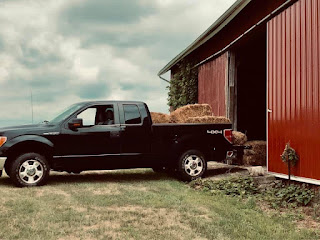
Ode to a Truck

Wednesday, I took my travel companion on its last trip, from which it didn't come home with me. I took it for a drive the day before, to...