Showing posts with label sycamore hill. Show all posts

24 May 2016

Where the Wild Things Are


This is Bandit.  Every night I have to go out and get to the bird feeder and suet before he does.
This little fella swam right past me while I was sitting down by the creek.
I've been roaming our little 8 1/2 acre piece of paradise as the weather warms and the sun has been making its appearance.  I remember the first time we visited Sycamore Hill and being a wildlife lover, I realized pretty quickly that I found "home".  Late spring seems to bring out the very best on the Hill, at least in terms of wildlife.  And with the advantage of phone cameras, I'm usually quick to send my latest sightings off to family and friends.  Now, none of these shots are spectacular, and some you'll just have to take my word for it, but here's a little photo-documentary of where the wild things are....on Sycamore Hill.

The bright red spot is a Scarlet Tanager.  I believe this is what the fortune cookie foretold. 

This is a Mockingbird that's been hanging around the farm.

Thankfully we found enough to make one mess of these tasty morsels.


12 April 2016

The Tamarack Experiment

My tamarack starts
A few years ago I got my first look at the original c. 1834 survey maps of our county prior to the establishment of local government.  The maps are really amazing and carry a great deal of detail you wouldn't expect.  Sure, there was the Michigan Road and a few other blazed trails, mostly Indian trails, through the wilderness.  Native American encampments were noted, one less than a mile northwest of our house, as well as a handful of pioneer trading posts and taverns.

Natural features are also noted on the map and make up the majority of items the surveyors recorded for history.  Streams and wetlands, noteworthy trees and large stands of certain species were carefully placed on the large maps created in the nearly untouched wilderness.

Tamaracks in the fall
It was one natural feature that caught my attention and made me question if it were accurate.  Less than a quarter mile down my road, near its intersection with the Michigan Road was noted a "tamarack swamp".  There were several of these pockets here and there across the map.  I knew the area fairly well and it is still wet but now filled with silver maple and scrub elm.  I hadn't realized until I did a little research that indeed tamarack trees, which resemble pines but lose their needles in the fall, were native to this part of the state and were survivors of the glacial age found in bogs.


The trees had medicinal and other consumable uses by Native Americans.  The Chippewa word for the tree is "muckigwatig" which means "swamp tree".  Now I wonder if "muck" have Native American roots.  The tree would not have been plentiful in the county, so its qualities rendering it nearly indestructible to rot for fence posts and framing, probably sealed its fate.

Original range of the tamarack
I had mentioned this "find" on the map to a client who has a great interest in forestry and he mentioned that he was in the process of growing tamarack from seed.  He asked if I wanted to try an experiment if we could find suitable soils on my own property to grow them.  Well sure, they could grow to be beautiful trees and could possibly start to repopulate the species now vanished from our county borders.  So, I have three starts ready to be planted (and protected from deer) in a lowland area near our creek.  I'll have to live a long time to see these reach significant maturity, but I'd like to think I'm helping to put things back into a natural order, and who knows, maybe there will be tamarack swamps again in our future.


04 March 2015

Schroeder Barn: the four seasons

Spring
OK-I give.  I think I'm ready for spring.  In the hope of a quick return to warmer weather, I offer up this collage of the four seasons at Sycamore Hill, featuring the Schroeder Barn, built in 1865.  Many thanks to my good friend over at Troy Sherk Photography for supplying the spring (top) and winter (bottom) photos.

Summer
Fall
Winter

15 October 2014

the Orchard

The first two (and only two) apples produced from Sycamore Hill Orchard this year-they tasted better than they looked
When I was a kid, the months of September and October came with the expectation that not less than a few days would be spent at Lemert's Orchard, just south of Teegarden, Indiana, picking apples with my grandfather.  Gramps set up a crate-making assembly line in the garage at the truckstop and often traded the crates he built for apples at Lemerts.  I recall riding in the back of his pick-up to the orchard and back, some 15 miles round-trip....something you can't do today.  And I recall stopping briefly at the cider press at the orchard farmstead and drinking amber goodliness out of an old tin cup they had strung to the press.  Recently I came across one of the crates gramps made, that my dad had placed on the brush pile, its in my garage now.

A few of last year's peach crop-none this year
When we moved to Sycamore Hill I determined to set out a small orchard for ourselves.  A year later we placed a dozen trees in the ground....and, with fierce competition from the deer, most survived.  Last year we picked a full bushel basket off the peach tree, and this year-which was pitiful for fruit crops-we pulled the first apples from a tree (2 apples to be exact).  The grape vines I set out are doing exceptionally well-our second season of canning juice completed last month.

2013 vintage grape juice
Last week I visited a friend in Culver and our conversation turned to the orchard industry that was thriving on the east shore of Lake Maxinkuckee during most of the 20th century, right up until the last decade.  One remnant orchard remains along 18th Road, the trees unpruned and now competing for room against an onslaught of brush filling the once neatly mowed paths of the orchard.  Since I have a project in that area that revolves around the old Lake Maxinkuckee Orchard, my curiosity was piqued when he started asking questions about an old foundation on what was once the Vonnegut Orchard.  So we took a long hike and found what appears to be the foundation of a caretakers cottage built about 100 years ago.  The cottage would have looked out over the vast orchard once managed by the Vonnegut (yes, Kurt Vonnegut) family who summered at the lake.

Believed to be the caretaker's cottage steps on the former Vonnegut Orchard
Standing there, imagining what it must have looked like, smelled like, hearkened back for me days standing in the midst of Lemerts Orchard, taking a big bite out of a Yellow Delicious and letting the juice run down my arm.  Years later, something in me still wanted that experience so I would stop and pick up a bag of apples in the fall at our local farm market, and eat not less than one on my trip back to college in Michigan.  A few years ago my daughter wanted that apple-picking experience and we were hard-pressed to find an orchard, let along one that would let you pick from their trees.
Our 2009 trip to the orchard
I don't think it's a matter of waxing nostalgic when I say I wish for yesterday, at least as far as this matter is concerned.  I think it's a basic instinct to want a stronger connection to the land, to understand the seed, the tree, the food of which you partake.  I think it's something our Creator put in us.  Maybe that's why fall harvest time has us longing for something we seek out in pumpkin patches, corn mazes, and the like.  Enjoy this time of the year.  I know I do.

10 April 2014

The Schroeder Family of North Township


The Robert Schroeder Family
Here's a little history (ok, a lot of history) on the family who developed our farm:

Robert Schroeder, Sr. was born in Dearborn County, Indiana on October 27, 1815 to Peter and Nancy Lyons Schroeder.  This was one year prior to Indiana being granted statehood.  Peter was born in Schuylkill County, Pennsylvania on November 11, 1786 to Nicholas and ____ Schroeder.  Peter’s parents had emigrated from Prussia in 1785 and settled in Schuylkill County, PA.  Nicholas was born in Prussia in 1745 and died in 1819 in Virginia.  He was a Lutheran minister who moved briefly to Dearborn County, Indiana before returning to Virginia.  They had two children:  Peter and John.

Peter Schroeder married Nancy Lyons in Dearborn County, Indiana in 1812.  Nancy’s parents emigrated from England, first settling in Virginia then moving to Indiana.  Peter and Nancy Schroeder had seven children:  Susanna, Robert, Eliza (Cummins), Peter, Jessee, John, and Joel.  They moved to Rush county in 1820, then to Clinton County in 1831.  Eliza (1817-1884) married David Cummins in Clinton County; they moved to Marshall County in October, 1834.  David Cummins was described as one of the oldest citizens of North Township, having always lived in sight of where he first located (McDonald, 1881).  The Cummins lived just northeast of the Schroeders, on the first road north of the Schroeder Farmstead.  Jessee Schroeder moved to Iowa during the early 1830s, but relocated to Marshall County with his wife, Emily, in 1833, settling along the Michigan Road, but then after 1860 moved to a farm in Polk Township.

Peter Schroeder and Robert Schroeder came to the area that would become Marshall County first in 1832 for exploration purposes.  The two dug ginseng and gathered cranberries to sell to markets in Logansport and Lafayette (History of Indiana, Marshall County Edition, Vol. 2, 1890).  The two spent a few months in the area then returned to Clinton County.  Robert was so pleased with the area that he returned in September, 1833, and settled near the location of the farmstead; he resided in the county for the remainder of his life.  When Robert settled in the county there were only two white families living in the county:  Samuel Taber (his son, Cyrus, was the first white child born in the county on June, 26, 1833), and Charles Ousterhaut.  Both families settled in the spring of 1832 and lived south of Plymouth.  Upon arriving in the county Robert was employed as a superintendent of construction by contractors opening the Michigan Road through Plymouth and some distance north and south of the town; he also assisted in constructing the first bridge across the Yellow River in Plymouth (McDonald, 1881 & 1908). The 1876 Illustrated Atlas states that Robert and Jesse Schroeder (brothers) settled along the line of the Michigan Road in 1832 and were the only white inhabitants in the area until 1835 when the remainder of the lands was open for settlement.

Siblings, c. 1910, prior to dredging Brush Creek
In 1834 Robert was joined by the remainder of his father’s family.  Peter located on Michigan Road lands a three miles north of Plymouth.  This appears to be on Section 9 of Michigan Road lands in North Township, in the vicinity or partly located on the original Robert Schroeder Farmstead.  The Hoosier Homestead awarded to the Schroeder Farmstead in 1977 stated that the farm had been in the family since 1833, indicating a portion of it had been the land on which Robert Sr. settled when he first came to the county (Farmers Exchange, June 17, 1977).  A quit claim suit in 1935 names Peter Schroeder (first, January 17, 1837) and successive owners of the “south part of the north half of the northwest fractional quarter of Section 9 of Michigan Road Lands by Galeman Dexter.  This would appear to be on the east side of Michigan Road, and the south side of 5B Road, an area where it is reported that Peter and Robert operated a cooper shop in the mid 1830s (Marshall County Genealogical Society Library Links, Summer 2011).  Peter Schroeder (Sr.) was present at the organization of the county in 1836, being appointed one of two first associate judges when the first term of court was organized in October, 1836 (1876 Illustrated Atlas); he continued in that role until 1843.  Peter was also listed in estry papers in 1838, having found a cow on his property.  Nancy Lyons Schroeder died in 1846 and was buried at Fairmount Cemetery, just north of the farmstead along the Michigan Road.  Peter (Sr.) died on November 15, 1868 and was also buried at Fairmount Cemetery (Marshall County Republican, Vol. 13, November 26, 1868).  Their son Joel, aged 15 years, 8 months, and 26 days, died on November 20, 1840 and was also buried at the Fairmount Cemetery.  This would have been one of the earliest interments at the cemetery.

Robert, in conjunction with Mr. Packard, erected the first sawmill in the county on Pine Creek in what would become Polk Township in 1835, as well as a log hut in which he resided during that time.  Robert Schroeder’s first home was described as a log cabin that had been built on what was the Frank Martin farm in the 1920s; this is located in the northwest corner of the intersection at Black Bridges (LaPaz: First 100 years).  The saw mill was abandoned.  Robert returned to central Indiana to marry Catherine Driskill on February 1, 1836 in Tippecanoe County.  Catherine was born on January 28, 1817 to William and Elizabeth Driskill in Clinton County, Ohio.  Robert became the North Township Constable in 1837 and held the office of County Commissioner from 1849-1851.  In 1840 both Robert and Peter Schroeder are listed as heads of households in Marshall County.  And in 1843 both are listed under a tax duplicates list for North Township.

Robert and Catherine were the parents of nine children, three of whom died in infancy.  The children who grew to maturity are John (b. 1838), Caroline (Thompson) (b. 1841), Mary (b. 1844), Susanna (Byers), Catherine (Trowbridge) (b. 1852), and Robert Jr. (b. 1860).  Two children who bore their father’s parents’ names, Peter and Nancy, died December 26, 1857 (age 1 year, 7 months, and 11 days) and November 16, 1850 (age 1 year, 8 months, and 8 days) respectively.  They are buried next to each other at the Fairmount Cemetery.  The name of the third child, its’ death and burial location is unknown, but likely it occurred prior to 1850, and likely it was buried at Fairmount.

In the 1850 census Robert is listed as a farmer and head of household in North Township.  His wife, Catherine, and children John (12), Caroline (9), Mary, Susana, and Nancy are also listed.  John was called the second white child born in the county in a news article reporting his death in 1925 (Plymouth Pilot, November 3, 1925); his birth would have been in 1838 and the article stated that his family had settled near Burns Bridge.  Robert, along with his brother John and Mr. Woodward (also from the area) left for California to mine for gold in 1852; they returned in 1855.  The same year the Marshall County Agricultural Society was formed “chiefly through the efforts of Robert Schroeder” and two other men (1876 Illustrated Atlas).  In 1857 Robert became a Wesleyan Methodist minister and in 1858 he was admitted to the Marshall County Bar.  He made a lucrative business of drafting legal documents.

The house, as it pretty much looks today too
The 1860 census lists Robert Schroeder Sr. as the head of household in North Township.  Catherine, his wife, and children Caroline, Mary, Catherine, Susan, and Robert, Jr. are also listed.  From 1860 to 1868 Robert Sr. engaged again in the mill and lumber business.  The family moved into their new homestead in 1867; it was located on a parcel containing just over 150 acres.  In 1870 the family is listed in the North Township census with children Mary, Catherine, Robert, and grandson Edward who was Mary’s son (born in 1862) and retained the Schroeder name.  Farmhands and maid William Wilkinson, Joshua Bryan, and Margaret Middleton, also resided with the family.  Robert Sr. was elected Justice of the Peace for North Township in 1874 and held the office for four years.  When the Old Settlers’ Society of Marshall County formed in 1878 he was unanimously elected President, since he was the oldest resident in the county at that time.  He was also a Notary Public from 1858 into the 1880s.

The 1880 census lists the family with children Mary and Robert Jr. still residing at home, along with grandson Edward.  Jane Wade, a maid, was also living with the family.  In 1880 Robert Sr. ran for the office of State Representative; he lost by only 331 votes.  Robert Sr. was a staunch Republican, having originally aligned himself with the Whig party then gravitating to the Republican Party when the Whig party dissolved.  He was also a firm promoter of the Temperance Movement.  Robert Sr. drew up a will on November 26, 1886, naming Robert Jr., and Edward, his grandson, at co-executors.  The will provided that the entire estate be left to his wife Catherine in the event of his death, with a stipend of $50 annually to Mary as long as she remained unmarried.  In the event that Catherine would die first, the entire estate was to be divided equally between Robert Jr. and Edward, and again, provide for the annual stipend to Mary.  Robert Sr. indicated that his other children were remembered by advancements he had made.

Their daughter Susanna, who had married Jacob Byers and moved to Iowa, made yearly trips back to the farmstead to visit the family.  She struggled with an illness in 1887 and thought a trip to the comforts of her native home would improve her health.  She instead died at the Schroeder Homestead on September 12 of that year, with her parents by her bedside.  She was buried at Fairmount Cemetery.

The mother, Catherine, died on March 14, 1890.  The location of her death was not mentioned in the obituary, but it is assumed she was at the homestead.  The obituary complimented Catherine by stating that the “hospitality of the Schroeder Household is known to almost every person in the county”.  She left behind her husband, three daughters, two sons, 26 grandchildren, and eight great grandchildren.  Services were held at the Fairmount United Brethren Church and she was buried at Fairmount Cemetery.  Robert Sr. died at his home on Tuesday afternoon of August 7, 1894 after being ill for several weeks, only able to sit in a chair “day and night”.  His funeral service was also held at the Fairmount United Brethren Church, and he was buried next to his wife.  At the time of his death he was called the oldest settler of Marshall County.  Their tombstone is inscribed with “first white settler of Marshall County.”

John Schroeder, the eldest son of Robert Sr., married Mary Abshire (b. 1843) in 1861.  They are listed in the 1870 census for North Township with the following children:  Milroy (possibly also known as James) (b. 1862), Mary (b. 1865), Sarah (b. 1867), and William (b. 1869).  William was a private with company M, 157th, IVI, in the Spanish American War; he died in the war.  There are two J. Schroeder residences listed on the 1880 North Township plat map.  One contains 80 acres and is immediately south of the Robert Schroeder Sr. farmstead.  The other contains 82 acres and is located just west of the Michigan Road, west of the Schroeder farmstead; the latter was owned by Carrie Schroeder in 1908.  These could be John, the son, or John the brother to Robert.  Both John (presumably the son) and Robert Sr. created a mortgage for the property south of the farmstead in 1876; likely the son built the homestead on that property that appears in the 1880 plat.  John, the son, was estranged for his wife for several years prior to his death in 1925.  He died at the county home at which he had been a resident since 1919; he was buried at Oakhill Cemetery in Plymouth.  Mary died in 1933 and was also buried at Oakhill.

Robert Sr.’s daughter, Catherine Trowbridge, died in 1928 and was also buried at Oakhill Cemetery.  Edward, the grandson who inherited an equal half of the estate, constructed a home further east of the homestead in about 1900, on the same side of the road.  Edward died in 1919 and was buried at Oakhill; his wife, also named Carrie, died in 1964.  Edward and Carrie’s children were E. Naomi (Stoneburner) (b. 1901), Olive R. (Dodson) (b. 1904), and Clarice E. (b. 1906).

After Edward’s death the jointly owned property, owned by his heirs and Robert Jr.’s heirs, was divided.  Edward’s heirs received the easternmost 40 acres of the farmstead and the south half of the acreage owned west of the railroad.  The remainder went to Robert’s heirs.  The division of land, included in the abstract, stated that Robert Jr. and Edward had jointly erected two dwellings and one barn on the farmstead.  A verbal agreement between the two men resulted in a general division of the land for farming and a general division of the barn for each to use half.  The house occupied by Edward Schroeder was to be removed from the lands that would be divided to Robert Schroeder Jr.’s heirs, and to vacate his half of the barn without doing damage to the barn.  If the men jointly erected the existing barn on the property, it likely was constructed during the 1880s.  The second dwelling constructed by the men mentioned in the abstract may have been a small farmhand quarters on the property, possibly used by Robert Jr. until his father’s passing when he moved his family into the homestead.

Robert Schroeder Jr. married Carrie Kleckner (b. 1871) on February 2, 1888.  They took up residence in the homestead, possibly prior to his parents’ death.  They were listed in the 1900 North Township census with their children:  Agnes (b. 1891), Veva (Basset), and Lynda (Thomas).  By 1910 two other children were listed with them:  Mildred (Boggs) and Kenneth (b. 1906).  Carrie’s brother, Harry and his wife, Maude Kleckner, and Carrie’s mother, Malinda, were also living with them.  They had a number of boarders:  Samuel Zile, Otto Dock, Ben Farel, John Anderson, Herbert Espach, Cliff Sanseman, Frank Whitner, John Williamson, George Barber, and George Moslander.  A speculative interurban line was being constructed through the Schroeder farmstead during this time and the census states that at least two of these men were working on the “electric road”.  The others were denoted with “odd jobs”, possibly farmhands.

Robert Schroeder Jr. died in 1917 and was buried at Oakhill Cemetery.  The same year two of his daughters, Lynda and Agnes, moved to South Dakota to teach.  Lynda met William Thomas in South Dakota and was married there in 1918.  Their only child, Robert, was born there on July 31, 1920.  The mother, Carrie, died in 1933 and was buried next to her husband.  Their son Kenneth, who remained a bachelor, became the sole resident of the homestead.  Kenneth made improvements to the barn in 1926; his initials “KWS” and “1926” are inscribed in the concrete on the west wall of the basement.  Agnes, who also remained unmarried, received the homestead from Kenneth in 1938.  Kenneth died in 1944 and Agnes died in 1947.  Both are buried at Oakhill.

Lynda Thomas’s family moved back to Marshall County on March 20, 1940 and took up residence in the homestead.  William and Lynda Thomas began raising beef cattle on the farmstead, which they increased to over 200 acres.  Their son, Robert “Bob” married Dorothy Carothers on June 7, 1944, who grew up on the farmstead immediately south of the Schroeder farmstead (the home fronts the Michigan Road).  

27 January 2014

An appetite for summer....

Grape juice.....from "The Vineyard at Sycamore Hill"
Even a guy who loves winter as much as I do has a limit.  That limit would be 15 degrees below zero.  So, to maybe bask in the summer that was, I'm going to offer a post or two reflecting on warmer days.

When we lived in town we had a little postage-stamp-sized garden.  It was about 8' deep by maybe 20' long.  Some of you are already thinking "postage-stamp size??"  You have to understand, my family had a gi-normous garden outdone only by my grandfather's "truck-patch" which easily exceeded 80' x 150'.  When we moved to the country four years ago, before there was even a hint of spring, I took great care in laying out what I thought would be a "sufficient" garden at merely 60' x 40'.  Added to that garden was an orchard and several grape vines that were planted in 2011.

Early in the life of the first garden planted at the Hill
The garden's first year produced a bumper-crop...particularly of cucumbers.  I adjusted the planting accordingly and the following years seemed fine.  This year my wife informed me that she would be too busy to can this past year's harvest, so instead of more tomatoes and beans, I planted extra rows of pumpkins just to fill the void.

Harvesting the 2010 bumper crop
In 2013, we were treated to our first harvest from the orchard and "vineyard" as I call it.  Of the peach, cherry, and apple trees, the lone peach tree blossomed and produced some of the finest peaches I've ever had.  My wife combined the peaches with raspberries that grow next to the garage for an amazing pie.  By the end of the summer I realized that we were going to have a bumper crop of grapes too....for the few vines we have, and for them only being two years old, I can consider two bushel baskets a bumper crop.  I gave one basket away and we took the other and made our own canned grape juice.  Since the grapes did so well, it got me thinking about branding and maybe making a go of wine making...."from the vineyards at Sycamore Hill".

Death of a cucumber, from the bumper crop of 2010
The Gurneys and Starke Brothers catalogs came last week.  It got me thinking of spring and summer all over again, and what the good earth, now slumbering beneath a deep cold blanket of snow, will bring forth again.

25 November 2013

Sycamore Hill, In His Service


We've hit the 4th anniversary from when Sycamore Hill "found us" so to speak.  Coffee-clutching at Starbucks with some buddies in 2009 led to a visit just to see the barn and the rest is history.  November has traditionally held some shake-ups in our lives, and always for the better.

I remember a conversation with my sister-in-law around the time we were buying the property.  I remember her asking if we planned to honor God with it.  Hmmm.....well, I had thought about establishing a nudist colony, but didn't figure the plan commission would go for that....so, sure, the alternative seemed fine.

Well of course we would.  We've been blessed to host family and school reunions, our pastor's birthday party (and if a 70s-themed party doesn't honor God, I'm not sure what would!), and I've had my 3rd and 4th grade boys' Sunday School class out to the farm for campouts.  While doing the 20s ministry we held campfires and get-togethers out here.  I've sat in the barn with buddies and recounted the blessings God's granted here on the hill, and that included hosting a wedding for friends of ours.  But it doesn't end there....because of the picturesque quality of the farm it's become a popular backdrop for photographers' family shoots.  In fact we were double-booked a few Saturdays ago.

But if there was one culminating moment where it dawned on me, yep, truly Sycamore Hill has been used in God's service it had to be while watching the video at the top of this post that was filmed in our barn for our church's celebration service.  Enjoy.

31 October 2013

The Haunting of Brush Creek Bridge

Brush Creek Bridge
One of the more interesting features of our farm we call Sycamore Hill is the creek that runs through a woods on the west side of our property.  Early settlers first named the creek Brush Creek, likely due to its primary path through wetlands now long since drained.  Just west of the creek is an abandoned rail bed that never saw even its first interurban car pass over it due to the company's collapse.  And just to the west of that is the abandoned Vandalia Railroad bed; the last train passed over it many decades ago.

At the back corner of our property Brush Creek takes a very sharp turn to the west before making another sharp turn north.  Over this short section of creek between its curves, the railroad constructed a steel bridge in the late 1800s.  Abandoned now, it serves as a picturesque reminder of our property's connection to the railroad....something I first noted in the photo at the top of this post when we visited the farm after a heavy snow, but before we moved in.

But it was what we didn't know about the Brush Creek Bridge that moves our conscious thought from picturesque to tragic.  The area near the bridge has an absolute silence, tucked down into the deep banks of the creek with lowlands on each side of the flowing water.  A few large trees send their branches out over the creek and a path worn by deer skirts the edge of the bank.  The rusted steel of the bridge creates a midnight-black form at night, removing all light and reflection from moonlight on the creek below.  Shortly after we moved to Sycamore Hill a friend forwarded a newspaper story from 1910 about a tragedy that occurred on the Brush Creek Bridge.

James Heminger, a veteran of the Civil War, was instantly killed on the bridge on December 13, 1910.  The older man joined another man by the name of Eli Silvius to hunt rabbits in the early morning hours of the 13th.  After some time Heminger handed his bag of game to his hunting companion and for some unknown reason headed to the bridge.  Speculation on Heminger's death indicated that he must have been standing on the ties of the bridge when an engine with the Lake Erie and Western passenger train struck him.  Heminger was deaf, which was the immediate cause reasoned for his not hearing the train as it approached.

The newspaper article stated that the body was badly mutilated.  The back of the head was crushed in, the left shoulder torn, the neck and left side of his face were cut open.  The lower part of his body was also crushed and the bones broken.  Heminger was described only as "an old soldier".

I've often wondered how one couldn't sense the approaching engine.  As anyone who has been even near a railroad knows, the vibrations in the ground-let alone a raised rail bed-would surely make up for other loss of senses.  Was this truly an accident?  And does the ghost of Private Heminger linger on Brush Creek Bridge?  While I leave out the more gruesome details of his death, I suggest to family and friends that the old soldier wanders the old railroad bed in search of his severed toe.

Great Halloween Story eh?  You can read the newspaper article here:  Killed by Train

06 October 2012

A perfect place, a great couple, and one amazing wedding


I remember shortly after we purchased the farm, my sister-in-law asked a question along the lines of "how can you guys bless others with this place?"

Regardless of what you have, but I think particularly so of land, I believe God has placed us as His stewards over it.  We simply are the caretakers of what shall one day slip through our fingers.  The question is what do you do with what God has given you?  Abuse?  Neglect? Make it better or worse than when you received it?  I guess that's a question with differing interpretations of "better".  I know that we feel blessed by what He has given us here on the Hill so we are always looking for ways to, in turn, use it to bless others.

So when my wife caught on that a young friend of hers from our church was looking for the perfect, yet unorthodox, place for a wedding, my wife volunteered our barn.  With a little bit of preparation, and a lot of hay removal, the couple which we had come to know well in the 20s ministry we led were united.

In a barn.
On a perfect September day.


And as I sat there, on a bale of hay, taking in the surreal nature of it all I couldn't help but find a great deal of satisfaction in just having the opportunity to be a small part of their day....by sharing what God has given us to enjoy.  And in turn, I got to hear a strings trio echo in the old hand-hewn rafters.

And as I was tallying the numbers in each barn bay, it was a relief to know the structural capacity of the barn floor withstood 140 people.  Whew.  Congratulations Lizzey & Troy!

01 September 2012

Confessions of Owl Obsession

I've heard that there is a fine line between interest in something and outright obsession.  I think my friends and family believe I crossed that line some time ago when attempts to identify and confirm our mystery owls on the hill took a rather interesting turn.

Wing Man-my fellow birding buddy-had contact with a fellow from Pulaski County who had great interest, and frankly skill, in being able to identify a wide range of birds regardless of good visuals.  Sounded like the man for the job since we never have gotten a good solid look at our owls with enough daylight.  So our expert came to Sycamore Hill one night and sure enough....our pair of owls were here.  But was he able to confirm their identity?

No.

So he suggested setting up a trail cam on a post near another fence post that the owls seemed to enjoy perching on and hunting from.  I figured why not at this point.  I had already crossed into the deep end.  So he and his son came back later that week to set up the camera....

Setting up the trailcam

 What we had hoped to see:

Barn Owl on post


And maybe this:

Bigfoot

What we actually saw:

Very inquisitive Bluebird


Red Tailed Hawk


One of about 100 pictures of Crows

Disgusted and taking down the trailcam


And today we are no closer to having a positive ID on our night hunters, though I have conceded the possibility that they are not Barn Owls, but may be Short-Eared Owls.  Which also are not supposed to be around here and don't match many of the characteristics that our owls do...that more closely follow those of Barn Owls.

About a month ago our owls fell silent for a few weeks' time.  Then within the last week or two we had noticed that one was back, but unfortunately not the other.  We're hoping that nothing happened to our other owl.  In a fit of obsession, after hearing the owl, I went out to the garage where I kept a monstrous spotlight my buddy gave me.  I took the spotlight to the woods by the creek and spooked it out from which it flew to the barn, then on to the field behind the hill.  I know what I saw.  And I'm no closer with an answer.  Other than...I think I'm obsessed.

18 June 2012

UFO - Unidentified Flying Owl

UFO on the ridge of our barn
I mentioned briefly a few posts ago about the return of the barn owls to Sycamore Hill.  Most people we tell either don't care or feign interest.  Some people think it is kinda cool.....but for the most part, aww...it's just another bird.

But barn owls are scarce in these parts......scarce in all of Indiana, but particularly up north.

Two years ago when the owls first made an appearance, we couldn't for the life of us figure out what they were.  Every night, like clockwork, the two birds would start sqauwking back and forth to each other....well, I say squawk...it really was like a screeching squawk if that's possible.  We were tormented by these two birds for the longest time because they called to each other about every 10 seconds for a few hours until about 2:00 a.m.  And then sometimes they would start again at 4ish.  When I did some on-line investigating, believing that they were owls or some form of nighthawk, I came across two sites that offered sound recordings of pairs of mating barn owls.  And when I played the recording my wife thought they were in my office.  Barn Owls.  They couldn't have been anything else.

So I mentioned it to a fellow birder and a friend who had a few vacant barns south of us.  We looked and never saw a nest, nor were they nesting in our barn.  We assumed a tree or a building further away.  We didn't hear the birds after about the end of July that year.  About that time I submitted a summer bird count to our regional Audubon group.  Which prompted a phone call from Mr. Audubon.  He seemed to think I wouldn't know the difference between birds, and certainly I didn't see one.  By the end of the conversation I thought he came around.  But when the state list was published........my barn owls weren't on it.  Well to heck with that.

What I came to realize is how extremely rare these birds are.  In fact they haven't been recorded in our county since the 1970s and only about a dozen pairs are reported in Indiana in any given year.  Well, they didn't return in 2011.  But about mid-May this year....they were back.  This time fellow birder and I staked out the hill one night and saw both.  Our wives thought we were nuts.

So, understanding the unique situation we have, I made contact again with Audubon and this time with a barn owl specialist with DNR.  DNR's response was "do they hoot or screech".  Well, that was an insult to my intelligence.  Audubon never responded.  And when they finally did.....asserted skepticism.  Short of shooting one and sending it to them, I wasn't sure what they wanted from me.

Well, they wanted owl pellets.  These are the regurgitated remains of vermin the owls can't digest.  So I collected the owl pellets.  DNR asked me to take pictures.  They didn't like the way they looked.  They wanted a photograph of the owl-so I sent one I took at 9:45 p.m. It reminds me of those flying saucer photos.  I offered to send the 30 second recording I made, which is proof-positive, but they declined.  I asked if they had ever heard a pair calling back and forth-at which point to get me to shut up they asked if I wanted a barn owl box in my barn.  Maybe.

We had a couple of local Audubon folks out to scope out the birds.  Since they don't appear until almost 10:00 p.m. you never get a good look.  I've seen the whites of their faces and undersides....but mostly just silhouettes.  My birder friend and I are considering camo by the barn to get a better look.  Audubon has started to warm up and now I've gotten several requests to come look at the birds, but I'm concerned they are going to get spooked and leave or not come back again.....so I am limiting night activities and the owl viewing area has been closed.  I'm probably being a bit over-protective, but since no one believed me to start with....well, their loss.  I'm also starting to think "so much for the experts"....no one I've talked to has heard a pair hunting together at night.  And it seems that very few have even seen them.  I've lived with them for two summers.


I think even if I had taken this photo and sent it, they still wouldn't believe me
The late night photo I took reminded me of something I've been telling folks now.  I think it would be easier to get Hoosiers to believe I saw a UFO than to get the people who should care to believe I saw a barn owl, let alone two.  So, we just sit back late at night with the windows open and enjoy listening to our alien visitors from another world.

21 May 2012

About the birds and the trees

Ash-lined drive at the Hill
Sycamore Hill is a regular bird-lover's paradise and for some reason this spring seems to be particularly busy for the little feathered folks.  In one week at the beginning of May we recorded 47 different species of birds up here on the hill.  A good showing by a wide variety of warblers and other spring migrating birds inflated that list.  These include the Yellow Warbler, Common Yellow throat, and the Cerulean Warbler.  A Scarlet Tanager also hung around for several days and at one time was within just 15 feet of the kitchen window.  Orioles abound too.  Almost without fail these smaller birds are working at a feverish pitch to glean bugs from the tips of our ash trees.

Yellow Warbler
I finally put 2 and 2 together with the number of warblers we have and the number of ash trees we have.  Probably not long after our house was built the farmer planted ash tree around the homestead.  There are 13 of these big trees now, several line our driveway.  I'm hoping the ash borer doesn't find them.


Cerulean Warbler

A warm spring evening brought the sound of a Whippoorwill....we've never had that here before.  A pair of Wood ducks have been camped out in the creek so my dad gave me a Wood duck box I've yet to hang up.  But one of the more interesting developments occurred just the other night.  It appears the squawking, mating pair of Barn Owls is back....though their call seems to be a little further off in the distance, which suits my wife just fine.  The pair was here our first summer, 2010, and we learned that they are pretty rare in Northern Indiana.
Barn Owl

30 November 2011

Out with the new, in with the Old

As soon as we closed on our new old place out in the country, we began a feverish attempt to renovate as much as possible and still move in within a 10 day period. One of the first things to go was the cheap 1960s era paneling that adorned the walls of the dining room. Under it we found....wallpaper......not less than four layers of wallpaper.


But that wasn't the problem. We assumed we would find layers of wallpaper attached to plaster walls....the condition of the plaster we assumed would be so-so. The problem is that there was no plaster. Instead it was plywood. Plywood? That made be re-think how old the walls were in the dining room. We knew that it had been the original summer kitchen with a porch off to its south side. We knew that another summer kitchen was added c. 1890 on the east end. We knew that when the bathroom was created in the old summer kitchen, they enclosed the porch. And these are the walls that had plywood....probably from the 1930s. The top and bottom pictures are the way we found the dining room.


So, we got an estimate to remove all the plywood, install drywall and finish it. And not that the cost was too high, but I stopped and thought.....gee, what I'd really like to do is cover the walls in wood planks.


The former owner, whose family had owned the farm since 1865, told us that there was wood stored in the barn from when the house was first built. She believed that since her great x3 grandfather operated a sawmill that it had come from the property. I climbed up into the rafters and found more than 50 oak planks, between 8-10' long, an inch thick, and anywhere from 12-18" wide. It was gorgeous old growth wood, probably not less than 100 years old when they were felled almost 150 years ago. The top picture is what we lived with for almost 2 years, the bottom picture is the oak in process.


So the new plan was to use the boards to cover the dining room walls....not only did I think it would look cool, but it also would keep the boards which had a history with the farm, with the farm. I pulled the boards down, picked out the very best, and off they went to an Amish mill to be planed and squared.


An then back they came. Our carpenter used all but about 6 of the 45 boards we sent to the mill. He created a plate shelf at the top of the boards, which reach to the tops of the doorways. We used the boards on the south entry hall wall as well. Then to give it a look like they've always been here, I applied a light base stain and did my best Karate Kid impression of furniture wax on, wax off. The result is fantastic....makes me feel like I'm in a lodge most of the day. We have the crown molding to install in the dining room, and some minor trim yet in the entry hall, but after almost 2 years of a whole lot of ugly.....my wife couldn't be happier. We plan to use the other boards for a new top for the dining room table, and we're having an "innaugural dinner" tonight with the carpenter's family. The bottom and top pics are prior to stain and wax.


04 November 2011

le' coupe re doux


By the end of this post you should be able to identify an extreme preservationist.


When we were closing on the purchase of Sycamore Hill the former owner asked what we planned to do with the chicken coop...but quickly followed that up with "oh you'll probably tear it down, it is in rough shape." My eyes opened wide and I said, heck no, that's part of the charm of the place. Last year we bit off interior renovations and restoring the WPA outhouse. This year we renovated the porch, put in landscaping, and are finishing interior renovations (coming soon!); but we (I?) also made a commitment to restore the coop this year.


The coop was built in about 1930 and based on the material that was used, it looks like most of the structural members came from a few walls that were removed inside the house. Since the coop sits between the house and the barn, at the base of the hill, the roof is a dominant feature of the 21' x 16' building....and I didn't want to lose the "look" of the rustic old corrugated metal roof....but it was leaking and had caused some structural problems. So I removed and catalogued the metal roof panels, fixed the wood roof and structural problems and replaced the fascia (that was a tough decision, but new won out), put down a drip edge, and covered the roof with ice and water shield-not a cheap product. In the end the roof looked........exactly like it did before I spent $500.


Then I had to patch in wood siding that had deteriorated or was missing. There was very little of that fortunately, and since the coop was constructed with scrap and leftovers, I had enough scrap and leftovers on the farm that matched the two types of siding that the repairs are virtually seamless. Then to give my dad something to do, he painted the entire building with a sprayer.


The coop has three windows (one on each side, except for the back) and one door. It looks like the windows and door came off another building on the farm. The south window and the door were fine. The west window (though covered with layers) was still there; the east window (also covered by layers and missing its mullions and bottom rail) was also "there". So I had the sashes restored and glass put in. We've wanted to paint our exterior doors on the house a feature color, which would be carried over to the coop. We decided on deep red, which ties in the red barn and the red trim inside the house. And it looks great on the little coop.


I kept a perfect record of the costs associated with this little project, as well as documenting it with photos just in case there is ever an insurance issue. From my office window I stare at the coop and outhouse all day long. I have to say I'm pretty pleased with the results. So the question is now, do we put chickens in it? I think that it's too nice for that....I may move my office into it. Next year we work on the '20s garage and start the big project...the barn.


Too often these little farm buildings disappear, until ultimately the barn is gone and the farmhouse sits there, looking like a fish out of water. I don't know how many structures have been removed here at Sycamore Hill. The corn crib foundation sits between the coop and the barn, but I don't see putting that back. The buildings work together to give this place the charm that I fell in love with almost exactly two years ago today. They represent a history that our generation is so far removed from, and I want to be able to have some vestige of that past that my grandparents and those before them knew, saved for future generations.

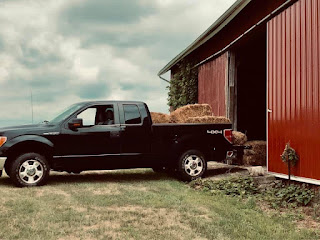
Ode to a Truck

Wednesday, I took my travel companion on its last trip, from which it didn't come home with me. I took it for a drive the day before, to...