Showing posts with label genealogy. Show all posts

17 March 2016

From Dublin......Indiana


Last week found me traversing the southeast corner of our state from Osgood to Lawrenceburg, Richmond to Fountain City, and Cambridge City to Dublin.  And since it is St. Patty's day, I thought I'd share my experience from Dublin, or what there is of it.  I was asked to take a look at a Quaker church in the tiny National Road community.  And while there is a well-spring of Quaker blood in my veins, I had never been in a church of the Society of Friends.  What a smart-looking one to make my first.  It was built c. 1878 by the Dublin congregation.


A day before, I had just mentioned to a couple of congregants from the Westfield Friends Church that I'm proud of my Quaker ancestors who came from North Carolina and settled in Wayne and Henry counties to ensure that Indiana would not become a slave state.  And it was a close vote.


Quakers were very strict about marriage outside the church, and their "monthly meeting" records not only demonstrate that, but also are a wealth of information for genealogists.  My ancestors were members in nearby Spiceland.  I have a feeling that I may need to extend a family discount to the Friends in Dublin.  But what I and a friend who traveled with me wanted most out of our visit to Dublin was directions to a good pub.  Dublin, however, is a dry town, even on St. Patrick's Day.


I have for a long time operated under the false conclusion that I have Irish blood....though family records would still indicate some truth in that, my DNA tests show otherwise.  Still, I have a love for all things Irish.  My wife was thrilled to point out that her dad, adopted at birth, came back with results showing 53% Irish, which would just about have to indicate one of his parents were born to Irish immigrants.  No wonder I was drawn to her.

08 March 2016

Channeling my inner Amish


Over the course of about the last two years, our preservation organization has been working on telling the "untold" stories of certain cultural groups and enclaves that settled in our county.  The Amish, who first settled in 1850, have become a large part of our population and continue to expand.  My great x3 grandfather, Samuel Hochstetler, was the first Amish to settle with his family in our county in that year, followed by four other families in the course of the next five years.

While on the path to discovery, our chief genealogist organized a meeting with the historian of the local Amish church and asked if I wanted to participate in the meeting.  He just happened to live at my great x3 grandfather's farm.  So, certainly.  He took us to the grave of my ancestor at the community's cemetery next to their first school.  And his grandson gave me a tour of the farmhouse and barn.

Last year, several cemeteries in that township were featured in a tour and my genealogist friend asked if I would be willing to play Sam Hochstetler and discuss the migration of Amish from Ohio to the area. I've done these cemetery tours before, but this one really caught my interest.  But, I needed to dress the part and our family gave up those simple clothes a long time ago.  A mutual contractor-friend of mine, an Amish fellow who was almost exactly my size, loaned his Sunday best so that I could look the part.  The clothes fit like they were customized for me.

And so, with many of the Amish gazing on that cold May day, I did my best to tell them about their history, which most seemed to know quite well.  Talk about a tough crowd.  The first thing I asked was how they used the bathroom with all of the hooks and flaps and straps.....evidently, that was taboo.  And then several poked at me with questions in Pennsylvania Deitsch.  It was both awkward and communal, if that's possible.

25 March 2015

Christopher Whitteberry: Patriot & Pioneer

Famous painting of the Battle of Brandywine Creek
I don't know that I can claim any larger number of Revolutionary War ancestors than the next guy, I just happen to be interested in family history and it seems that the stories bubble-up when I least suspect them.  Such was the case when I was trying to make some connection for a branch of the family little is known about.  My ancestor, George Laramore, whom I've written about before, was the only child born to Thomas and Mary Laramore after their marriage in Muskingum County, Ohio.  The history we had on Mary indicated her name was Whittlebury and her husband died before George had turned a year old.  But it wasn't Whittlebury, as I learned from spending probably too much time searching, it was Whitteberry.  And after Thomas' death, Mary brought her infant son to Indiana.

By the time Indiana was being settled in large numbers, the age of Revolutionaries was approaching eighty years old which is why the Hoosier state became home, and the final resting place, to very few Patriots engaged in fighting the British.  But in following Mary and her son, George, I found that she moved on to Indiana to live with her aging parents who came in about 1829 to Tippecanoe County.  Her father, Christopher, and mother, Elizabeth Packer Whitteberry had made a homestead in their 70s.  Recently I found their humble grave sites in rural southeastern Tippecanoe County.  And I learned that Christopher Whitteberry, at the age of 17, fought in the Revolution.

Patriot Christopher Whitteberry's gravestone in Tippecanoe County, IN
Christopher was born October 11, 1760, in either Pennsylvania or Virginia, and in his youth made shoes for the Colonial Army.  In 1777, Christopher participated in the Battle of Brandywine Creek which was one of the culminating battles of the Revolution in which both sides suffered tremendous losses and the Colonial Army, under George Washington, was held at bay away from the fledgling nation's capital at Philadelphia.  After the war, Christopher Whitteberry married Elizabeth Packer and moved to Muskingum County, Ohio.  The parents, with their younger children, continued westward to Indiana on horseback and purchased 80 acres.  Mary was born in 1803, according to an entry in a family Bible.  Elizabeth died in 1835 and Christopher, in 1843.  They were buried on a corner of their farmstead in what later became known as the McDole Cemetery, named for the family that included a granddaughter of Christopher which later farmed the land.  Christopher Whittebury, as far as I know, is my only Revolutionary War ancestor buried in Hoosier soil.

26 November 2014

Saybrooke or Starbucks?


So I'm trying to embrace by English roots now that I've learned my DNA results and I'm a great deal more English than German, and even less so-Irish.  I've been running down several branches of my family tree and one that has eluded me is that of the Chapman family who moved into Marshall County during the 1840s.  We've heard stories of Dr. Clarke Chapman, who graduated from LaPorte Medical School and rode horseback from his farm north of Argos to make house calls.  And through research we found that his father, Ezekiel, lived in Argos as well.  And the most fabled of family lore, was that Johnny "Appleseed" Chapman was a cousin who visited their farm.  That never quite added up, but I had always hit a brick wall with any information earlier than Ezekiel, who lived in New York state.

But in my recent research I was able to connect a more senior Ezekiel to my Indiana pioneer, which led to a third Ezekiel in Connecticut, which led to the Chapmans of Saybrooke, Connecticut, who founded the town in 1635.  Robert I came to America in 1635 from England and founded the town, his son, Robert II, and grandson, Robert III, lived and died in the New England town.  The founder's grave is now unmarked, but his son's grave, my great x9 grandfather, is still marked with a stone that has one of the region's famously carved designs-a stylized primitive angel.  I shared the photo with a friend and he immediately responded that it looked like the Starbuck's logo.  Huh...kinda.  I found   that most Chapmans trace their roots to Robert I, likely Johnny Appleseed does too....but I haven't found that yet.  Several more interesting stories have surfaced as well, but yet a few ancestors continue to elude me.


On this Thanksgiving eve, as I delved into the richness of our country's history reaching back to its foundations, I wonder what we are leaving in our wake.  What will those who come after us say of our generation?  For nearly 400 years we built, cleared, prospered and can be truly thankful for much.  But for what will the generations that follow be thankful to our generation?  I hope it's more than limitless Starbucks.

19 November 2014

Hagel des Vaterlandes

St. Stephens Cemetery, Dearborn County, IN
 And this is why I was surprised by my less-than-overwhelming German DNA results.

I took my mom and her sister on a whirlwind genealogical tour across the U.S. 6 corridor in three northern Indiana counties a few weeks ago.  In preparation for the trip, I plugged a few names of ancestors into findagrave.com.  Yes, it is for-real.  I knew that my great x3 grandfather had been born in Bavaria and came with his parents to the United States in the 1830s, first settling in Dearborn County, Indiana.  Jacob Ewald followed the love of his life to northern Indiana, while his parents and several siblings remained in Dearborn County.  I did not know where his parents were buried, so I plugged in their names and found that the cemetery was just off the beaten path to Madison, which is where my wife and I were planning to spend our anniversary.

My wife capturing a moment of me paying respect to distant family
Knowing my wife now expects to visit cemeteries on all of our family trips, I of course didn't want to disappoint her.  On our way back from Madison, we crossed county lines and went to St. Stephen's Old Church Cemetery.  Although we couldn't find Jacob's parents' stones, we did find two siblings that had died as children in the 1850s.  The stones were inscribed in German.

All of the stones in this little cemetery were inscribed in German.

All of them.


In my travels and historical research, this was a first for me.  I've been in burial grounds where a few stones were in Yiddish, German, and Greek.  One cemetery near Chesterton has several stones with inscriptions in Swedish.  But I had yet to come across a truly German enclave, like this St. Stephens community must have been for my ancestors.  I did a brief investigation of the history of the church and cemetery and could only find that the church began in about 1842 and that this township in Dearborn County had begun to be settled by "industrious" German immigrants during the middle 1800s.  My Ewald ancestors being among them.
Believed to be a tintype picture of Phillip Ewald, my great x4 grandfather, immigrant from Bavaria
In driving the winding, hilly roads to their resting place, and as I peered out across the broad green valley, I wondered if this felt like home to them.  I wondered how Phillip, the patriarch, felt leaving the rest of his family behind.  No wonder the small group of German Lutherans clung together upon reaching the new land.  The Ewald line represents my family's most recent arrivals to this country.  These Germans continued to carry their language with them, first to St. Joseph County and then to Bremen in Marshall County, where a large German population also settled.  They continued the use of their language into the 1900s with sermons preached in the language of their Vaterland.

12 November 2014

The Results are IN!


Inspired by the PBS program "Finding Your Roots", and trying to resolve an internal debate about some family lore, I simply asked for a DNA kit from Ancestry.com for my birthday this year.  A vile full of spit and a few weeks later, my ancestral-origin profile arrived.


My grandfather, sometimes with seriousness, and other times in jest, claimed that we had Native American blood.  In my genealogical research, I haven't found that native link-but some lines got blurred in Virginia, so I thought it was possible.  When grandpa had us grandkids "on the hook" he'd tell us we were part Blackfoot, to which he'd take off his sock and show us the bottom of his dirty foot.  That should have clued me in.  More believable was his story that he knew that the first to carry our name in the New World arrived with his brothers from Ireland way back.  This didn't add up to what became pretty overwhelming probability that the first of my namesake came from Germany during the Revolution, and dropped the "t" from his name so that it sounded more Anglicized.

Plight of the Spanish Armada
Then there was this little matter of my paternal grandmother, who was a Bryant, and her lineage came up through Kentucky in the 1830s.  Family tradition is that we were "Black Irish".  Never heard that term?  Black Irish is a term used for people with darker complexions and hair from the Emerald Isle, and at least one theory suggests they were descended from survivors of the Spanish Armada that wrecked off the coast of Ireland.  BUT at the first inaugural family reunion in 2012, my aunt, the eldest member of that family unit, brought a photo album of the Bryants and some family members appeared so dark-skinned, that we wondered if the black in Black Irish, might have actually been, well,  Black and Irish.  My aunt quickly closed the photo album.

Destruction of the Armada
So there was a part of me that thought my regions of origin could have looked like a smorgasbord of ethnic groups.  Based on my research though, I thought it would be more likely that about 50% or more would be German, and the remaining but likely minority amount would be English-Irish.  Have I built up the suspense enough?

Yup, about as Anglo as they come.
How about 49% English-Scottish and 34% German-Alsace region.  The remaining amount included only 2% Irish (say what?) which was as much as the percentage of Eastern European Jew.  I don't know that the last surprised me.  I did get a full 6% of Iberian peninsula, which could relate back to the whole Black Irish-minus the Irish evidently.  Well, I'm about as white as they come...a friend said I'd get lost in a snowstorm.  How boring.  I have to rethink the concept that the first of my namesake dropped the "t" and that maybe some aspect of Gramp's story was true-just not Ireland, more like England.  Geesh, England's never really even held any fascination for me.  S'pose I'll have to follow the Royals now.

10 September 2014

Getting in touch with my "Plain" roots

Hochstetler Reunion at Old Samuel Hochstetler's Farm c. 1850, in 1913
 Earlier this year our preservation organization began discussing what we might do to participate in the state's upcoming bicentennial.  We landed on a concept that would include highlighting the history of one group, and their architecture, that hadn't previously been recorded in the nearly 200 years of our county.  That group is the Amish, who first began to settle here in 1850.  So, someone from the genealogical society set up a meeting with this group's local historian and sent me a message with the place and time.
Samuel Hochstetler barn, 1850
And then I realized that it was the farm of my ancestor, Samuel Hochstetler, that we would be visiting.  This man's son now live in the house with his family.  During our visit the man unrolled a photo I hadn't seen before, of the farmstead and extended Hochstetler family, from 1913.  A grandson, who also had an appreciation for their history, gave me a tour of the house and barn.  What a surreal feeling stepping into the house and barn built by my great, great, great grandfather over 150 years ago.
Jonas Yoder barn detail, 1852
Jonas Yoder farmhouse, c. 1880
We made a return trip to visit with the Amish historian.  This time we wanted to stop and document what remains of the "first families" farms of the Amish community.  There were four farms of the first four Amish families to settle in our county northeast of Bremen.  These are the Samuel Hochstetler, Jonas Yoder, John Borkholder, and Valentine Yoder family farms, along with their Amish school and cemetery.  Samuel's family was the first to arrive in 1850, though a scouting party of the church had come to Indiana in 1841.

At the grave of my great, great, great grandfather-Samuel Hochstetler
The historian also pointed out Samuel's grave-which I had not previously been able to locate because the inscription is long gone.  Of the four original farms, three of the c. 1855 barns remain and two of the original homes; both Samuel's house and barn survive, but the house has been added to.  A third house was the second built by Jonas Yoder, after a fire in about 1880.  That's a pretty good testament to preservation by the Amish community.

20 March 2014

How much more German can it get?

Marriage certificate for my great, great grandparents-Carson & Clara Ewald, 1895.
If you haven't figured it out, I'm sticking with a family history theme this month.  My oldest roots in the county are deep in the soil of German Township.  During the early 1830s a few of my German-immigrant ancestors began to settle in the township that would ultimately bear their fatherland's name.  The following generations did what cultural anthropologists tell us runs counter-cultural to most immigrant groups.  They held on to their native traditions, and tongues.

Birth certificate for my great grandmother, Edna Ewald Hochstetler, 1896.
From my ancestors the Roths (later changed to Rhodes), Schwiesbergers, Walmers, Ewalds, Bargers (later changed to Bergers), and Geyers descended German traditions tied most tightly to the Lutheran and Methodist churches in Bremen.  St. Paul's Lutheran and Salem United Methodist both continued the tradition of preaching sermons in German well into the first decades of the 20th century.

Not long ago my great aunt gave my mother color copies of marriage and birth certificates belonging to the family.  These were printed in their native tongue.  Aside from the rich color graphics of two of the documents, and the gold-leafing of the other, it's the German lettering on the documents that make them great vestiges of family history.

Birth certificate from my great x3 grandparents, 1871.

The oldest document is a birth and baptismal certificate for George Roth and Catherine Schwiesberger (my 3x great grandparents), from 1871.  Their daughter, Clara, married Carson Ewald in Bremen in 1895, which is the certificate with the oval-shaped design.  Carson and Clara Ewald had my great grandmother, Edna, whose birth certificate is dated January 15, 1896 and has the image of a dove, rainbow, and Easter lilies.  I find it interesting that by the time Edna was born, the branches of families had been living in the United States for not less than three generations.

18 March 2014

A Culver Family's Sacrifice


The Howard & Coral Bryant, Norm & Louise Lamunion, and Wesley & Chloe Bryant families of Culver
One of my favorite old family photos, though it is in poor condition, is one that was taken when my grandparents and my grandmother's family lived in Culver during the 1930s-1940s.  My great grandfather, Wesley Bryant, lost their farm near Argos during the Great Depression.  They relocated to Culver and bought a small house in town.  They had four sons and one daughter, Alice-my grandmother.  The oldest son, Henry, and my grandmother were already married and out of the house.  My grandparents also chose to live in Culver where my grandfather worked for the state highway, and my grandmother was a regular guest singer at a Culver radio station.

Private First Class Harold Bryant's gravestone in Culver.
When World War II began, my grandmother's three brothers who still lived at home all enlisted.  Herberdean (Beanie), Hilton (Bugsy), and Harold (the youngest) were called away to serve their country abroad.  My grandmother and grandfather, who had a hearing impairment and could not enlist, went to work at the Kingsbury Ordnance Plant.  They had a ration of gasoline to get them, and a carpool of other workers, from Culver to the plant on a daily basis.  Henry established a factory in Kingsford Heights and made rubber boots and coats for soldiers.  Henry's daughter married a Kabelin in LaPorte and began the regionally-based hardware chain.

From left to right:  the Lamunions, Howard & Coral Bryant, Harold Bryant, and Wesley & Chloe Bryant at Culver Cemetery
The old photo-which looks to have been taken during the winter months-was the last snapshot of the family all-together on the front porch of their Culver home.  The last photo, because Harold never returned.  He was killed on Christmas Eve during the Battle of the Bulge.  He, and my great grandparents, were laid to rest in the cemetery on Culver's south side.  My great grandmother's sister, Coral, married my great grandfather's brother, Howard, and they had one child-Louise, who married Norm Lamunion-an old Culver family.  The Bryants and Lamunions all share a row in the cemetery's midsection.

15 March 2014

Three generations at LaPaz School

My grandmother's diploma from LaPaz High School, 1941.  It has a nice graphic of the school in the center of the diploma, unlike my grandfather's which came from Bremen High School.

I first wrote about going to LaPaz Elementary School on this blog a few years ago.  Since that time, I've written a few posts, but I don't know if I shared that I was the third generation in my family to attend the school.  Recently, while going through a few boxes of old photos, I came across class pictures of my dad's class and my grandmother's classes from their elementary years.  So I thought I would find one of mine from about the same grade and place them in a row.  My dad, Jack, and my grandmother-who evidently went by "Rosy"-had their class pictures taken outside of the building-it appears to be outside of the 1928 consolidated school (just outside the music room for those LaPazites).  By the time I was attending LaPaz, it was only an elementary school and it seems like we always had our class photos taken inside the building.  In my picture, we are standing in the gym in front of the stage.  I certainly miss this old school!

My grandmother's second grade class at LaPaz School, c. 1931.  My grandmother's on the top row, second kid from the right.  Check out the kid on the bottom row with his hands over his face!

My dad's third grade class at LaPaz School, c. 1955.  My dad's on the bottom row with his arms crossed.

My second grade class at LaPaz Elementary, 1977.  I'm on the bottom row, first kid on the right.  The kid on the opposite side from me, bottom row, and I became best friends and got together just last night-37 years later.  And I'm friends with several of these kids on Facebook!

08 January 2014

Will's Feed & Saddle Shop, Rochester

My great great grandpa's feed and saddle shop in Rochester (right).  The Mail Pouch sign and an earlier Henry George tabacco sign (just barely visible) would have been painted on the building while he owned it.
I seem to be on a family tree theme, if you'll indulge me a bit more.  A few weeks ago I was driving through Rochester and passed by a building that my grandfather told me once housed his grandfather's saddle and tack shop.  I had noticed the building next to it had been extensively renovated, covering up much of its original appearance, so I thought....shoot....I better take a picture of my great-great-granddad's store while it still looks like it did in the early 1900s.


Will and Adella Garner's home at 514 Fulton Street, Rochester
In the last years of his life I would drive my grandfather, whose real name was Charles, but he went by "Jack" to visit his sister, Hazel, who lived just outside of Rochester.  Gramps would point out various things he remembered in Rochester as a boy, though he grew up in Argos.  He told me once that his grandfather came with his brothers from Ireland.  I found that to be inaccurate.  He also told me that we were part Cherokee through that line.....another claim I've found no evidence of.  So, I do take hesitation on relaying the earlier part of this story-though his grandfather, William, was listed as owning a farm, and being a merchant in the censuses.


The William and Adella (Prill) Garner family, c. 1902.
"Will" Jacob Garner was born in Cass County, Michigan in 1861 to Henry, who, according to my grandfather's aunt, only stuck around long enough to make babies.  She was 95 when she told me this.....and I cleaned it up!  In Henry's defense, he was enlisted in the Union Army.  The family had lived in Wabash County for nearly 20 years before moving to Michigan, and then returning to Fulton County, Indiana after the war.  Will married Adella Prill, who was supposedly Cherokee, and they had a large family of nine children.  I've seen a photo of the farm they lived on near Leiter's Ford in the late 1800s.  But by 1900, Will had moved his family into Rochester to 514 Fulton Street, where Will and Adella continued to live until his death in 1942.  A brother named John, who they called "Jack" lived with Will's family in the early 1900s.  This was the first of four generations of Jacks in our family.

My great grandfather, Harley, and his father, Will, at Will's house on Fulton Street, c. 1939.
Will opened a feed, saddle and tack shop on the north end of Rochester's downtown, on the Michigan Road, in about 1900 just a few blocks from his house.  While in town I swung by to see if I could locate 514 Fulton Street.  It was still there and it matches the house I have a photo of from about 1940.  Every generation of my family since Will have also been entrepreneurs.  While that may seem like I'm bragging, my wife pointed out once that it's likely because we can't work for anyone else.  That seems highly accurate.


06 January 2014

A simple life: the Hilliards of North Township

The unusual double headstone for the Hilliard family is located near the center gate of Fairmount Cemetery, just a few rows in from the Michigan Road in North Township, Marshall County.

Taking pointers from the sermon series our pastor preached during December, I thought I would write about an ancestor that typically would be left out of the "who's who" in my family tree.  A few individuals in the genealogy of Christ presented at the beginning of Matthew were unlikely candidates to be included by Matthew to present Christ's "Jewishness".  Individuals that most would have skipped over, like Rahab, present a picture of Christ as the Son of God of second chances, of the not-so-famous or desirable.

Several weeks ago I wrote about the oldest cemetery in Marshall County and one of its residents, Silas Higbee, a notable person in North Township.  But also buried there are a few of my ancestors that are part of a line that produced 10 generations who have lived in this area.  But they're anything but famous, and they certainly knew hard times.

John Hilliard and his wife, Maria, were born in Ohio.  John was born in about 1800, probably in Miami County, Ohio where an exceptionally large and early Hilliard family was present.  An older John Hilliard and his wife Elizabeth were one of the first families in the county during the 1780s.  By 1850 the younger John was married and lived in Centre Township, LaPorte County, Indiana were he had a small farm and two sons, Bronell and Fielding, and a daughter, Elizabeth.  The family had purchased land and were residing in North Township, Marshall County by 1853, the same year Bronell married Lavina Fites in nearby St. Joseph County.  Lavina was born near Bremen in 1834.  John's land holdings grew fairly substantially, but he suffered two losses during the 1860s.  First his daughter, Elizabeth, died in 1867, then his wife died in 1869.  Both are buried at Fairmount Cemetery.  Financially he must have suffered as well.  He was living with his son, Bronell, in 1870, and his land was gone.

The township trustees were charged with care for the indigent.  I came across a North Township trustee's ledger from the 1870s and in it found that John Hilliard was judged a pauper and was ordered to be detained at the county asylum (poor farm) which would have been located near Tyner at this time.  His stay must not have been long because he was living with his son again by 1880.  The census records indicate John was an invalid.  John died in about 1885 and is thought to be buried next to his wife and daughter in Fairmount Cemetery in an unmarked grave.  A rather inglorious life likely shaped by toil and hardship.

Several years ago my great aunt, who was township trustee at the time, gave me a few items from this side of my family.  One item is an exceptionally old rocking chair that had belonged to John Hilliard and dates to c. 1850.  I think about its story from time to time, how it likely made the journey from Ohio to LaPorte County, and then on to North Township in Marshall County where the family has since resided for 160 years.  I think about the hope that they must have had in purchasing their farm, and the sadness in losing his daughter, wife, and farm in a short period of just a few years.  Something about that loss makes the rocking chair that much more important to me.  It isn't priceless jewelry, rare glassware, or highly-refined furniture.  It's just a simple chair from a simple life laid to rest in an unmarked grave.

11 September 2013

Calling all descendants of Patriot Nathaniel Cole

My wife capturing the moment with me and my kids
This will be a first.  I don't think I've ever used this blog as a call to action, but here we go.  I have noticed on many occassions that the blog post about my ancester Patriot Nathaniel Cole often gets a number of hits.  I assume it's not folks looking for "patriot" or "tea party" in the title, because occassionally I am contacted by fellow descendants.

This past summer we took a slight detour on our way back home from vacationing on the East Coast.  As if all the cemeteries we visited weren't enough, I had to visit my ancestor's gravesite near Binghamton, New York.  The Colesville Cemetery to be more specific, near the Nathaniel Cole County Park, both named for my ancestor.....a Revolutionary War patriot known for his courage and tenacity under fire.  Cole was born in Connecticut and after the Revolution, moved with his family and a small band of neighbors to Broome County, New York and established Cole's Hill, later Colesville, along with a tavern and inn on the market road.

I wasn't sure what to expect at the cemetery, but it wasn't that the namesake of the park and village buried there, in the middle of it all, would have a broken and nearly illegible gravestone.  Fortunately there was some contact information on a brochure at the cemetery-which was well-kept-no complaints there.  When I returned home I sent an email asking about how I could participate in repairing his stone.  I never heard anything until about a week ago when I was contacted by a headstone preservation specialist.  I didn't know such a thing existed.  I asked "can you make a living at it?"  He assured me he could, and does.....a young fellow with a passion for preservation.  Reminded me of me, and not just because we shared the same uncommon first name.

This might have been my wife making fun of me
So, he shot me a price.  And I understood then how he could make a living at this.  It was $200.  Not a steep amount, but I'm going to offer YOU, oh distant cousins of mine, a chance to participate in this worthy effort and return a little respect to the gravesite of our patriot-ancestor.  If you contact me with an email address I will let you know how you can participate.  I am working through a local preservation group for the tax benefit and some accountability for the contractor.

30 May 2013

The Bundys of New Castle

Henry County Courthouse & Soldiers' Memorial
The Indiana High School Basketball Hall of Fame isn't the only thing in New Castle.  Spying the Henry County Courthouse from Highway 3, after we left the Hall, I asked my son if he wanted to drive up the hill to the downtown.  He said "sure".  As if he hasn't figured out that's an invitation for architecture viewing by his dad.

What a fantastic downtown New Castle has, and the courthouse is amazing too.  Unfortunately, being Good Friday, it appeared closed the day we visited.

My great x5 grandfather, Christopher Bundy, moved from North Carolina to Wayne County, Indiana in 1819.  In 1821 he purchased a tract of land next to the original plat of New Castle.  Bundy served in the American Revolution at the age of 19.  He was part of the large Quaker migration from the South to Indiana, ensuring the state's "free" status to the slavery question.

The Bundy name became inseparable from the town's history when one descendant, General Omar Bundy, had this read about him in the Congressional Record in 1940:

'Mr. Speaker,' said Mr. Springer, Congressman from the 10th Indiana District, 'I rise to report the death of one of our outstanding military geniuses, Major General Omar Bundy...A graduate of West Point in 1883, he afterward participated in many military expeditions of this country. In his early life he took part in the engagement with the Sioux Indians. In the first World War he commanded the 2nd Division and later the 6th and 7th Army Corps...'".

General Bundy became immortalized during World War 1 when he refused to obey the retreat orders given by his French superiors.  This is his now famous response:

'We regret being unable on this occasion to follow the counsel of our masters, the French. The American flag has been forced to retire; this is unendurable and none of our soldiers would understand their not being able to do whatever is necessary to re-establish a situation which is humiliating to us and unacceptable to our country's honor. We are going to attack...'"

Bundy was credited as the hero of the battle of Belleau Woods and thereby liberated Paris.  Two poems were written to commemorate this event:  Bundy's Men and Where Bundy Held the Paris Road.  The Major General Omar Bundy Auditorium in New Castle is named for him.  And for the record, I'm NOT related to Al Bundy, and hopefully not Ted Bundy either.

16 April 2013

Family roots in the Old (Indiana) Northwest

Andrew Moore, pioneer of Lake County
Several weeks ago I wrote about a project that took me over the state line to Beecher, Illinois.  Since the outing was largely charitable in nature, I combined it with a little genealogical research that I had wanted to do in the area so that the sting of giving away services wasn't felt too deeply.

During the 1820s through 1830s two branches of my family traveled through northwest Indiana to settlements on the border of Lake County, Indiana and Kankakee County, Illinois, probably down the Sauk Trail.  The trail was an ancient Native American game route, also confirmed as a mastodon trailway around the south edge of Lake Michigan.  The Sauk Trail was incorporated into a supply route to Fort Dearborn from Detroit by the federal government in 1825.  The road became known in Indiana as the Chicago Road.


Adam Hamilton, pioneer of Kankakee County, IL
Adam Hamilton was born in 1793 to English immigrant Thomas Hamilton.  Thomas, though born under the Union Jack, was part of the First Virginia Regiment during the American Revolution and was camped with General Washington at Valley Forge.  Adam married Margaret Howard in Ohio in 1819 and then moved to Jackson County, Indiana.  Adam purchased property in Kankakee, Illinois in 1835 and 1836.  In 1841 he bought property on the west side of the Illinois/Indiana border, east of Sherburnville.  This became his permanent home.  The farmhouse is still there on the south side of Route 2, immediately across our state line.  After his death his farm was sold to Washington Allen.  Adam's son, Jacob, continued to live in the area and became the first supervisor of the township.  While no gravemarkers remain, it is believed Adam and Margaret are buried in West Creek Cemetery, a stone's throw from their farmstead, in West Creek Township, Lake County.  Jacob and several other Hamilton's are buried here, along with Washington Allen.


Village hall and church in Sherburnville, Illinois
Jacob Hamilton's wife's grave in West Creek Cemetery
Adam and Margaret's daughter, Rebecca Hamilton, met William Moore and were married in 1858 near Momence, Illinois.  William was called away to duty for the Union army, enlisting in Company H of the Illinois 100th regiment.  William was wounded in the Battle of Stone River, TN, captured, and imprisoned during which time he carved a ring from "a generals horse's bone which had been shot out from under him".  I've never been able to confirm that story.  We do know it was carved while he was held, and I wore it in my wedding thanks to the generous folks at the Marshall County Historical Society.

William Moore, Col. Company H, 100th Illinois Infantry
William Moore was the son of Andrew and Hannah Cole Moore, and one of a long line of William and Andrew Moores that stretch back to the 1600s in Connecticut.  Andrew was born in 1806 in New York and married Aurena Hine in 1825.  They moved from New York through Adrian, Michigan, where William was born in 1836.  They purchased 160 acres in West Creek Township, Lake County, Indiana the following year.  He was the first justice of the peace in the township and helped organize the first Methodist church in the area in 1838.  They lived several years in the Sherburnville area before permanently settling in Indiana.  All seven of Andrew's sons volunteered for service during the Civil War; three died and the other four suffered from life-long disabilities.  William and a brother, Frank, began a sawmill operation in Argos, Indiana.  The work proved too much for the wounded vets and William began a drugstore in the community.  Andrew sold his land holdings in 1865 and moved to Lowell where he opened a mercantile until his retirement in 1872.  He and Aurena are also buried in West Creek Cemetery.
A sales receipt for merchandise at William Moore's Argos mercantile.  These were made out to his daughter Lucy Chapman (my great x2 grandmother) and his son, Charles.  Based on the date, it appears that the merchandise was part of their inheritance from their father who had died a few weeks prior in 1893.  Check out the prices!

An interesting story about another of William's brothers, James, relates to his occupation.  He had a contract to build railroad depots along the Union Pacific Railroad, which included depots for the new transcontinental line between Omaha and Promontory Point, Utah.  He was witness to the driving of the golden spike that joined the railroads in 1869.

28 March 2013

On a mission in Tefft: 46380

Hettie and Uncle Alonzo Hilliard, Postmaster at Tefft
As I mentioned before, I have collected more information on my family tree over the last few months which has led to a great cache' of pictures that I have found on-line.  This picture of my great x3 uncle, Orphus Alonzo Hilliard, and his wife, Hettie, was a great find.  Evidently Uncle Alonzo moved westward from LaPaz, Indiana to an even smaller town in the midst of the freshly drained Grand Kankakee Marsh in northern Jasper County, Indiana.  Now-whether he moved to Dunnville or Tefft in the late 1800s is unclear-but we know it was one and the same.

What?

Isaac Dunn, a pioneer settler of the Kankakee Marsh, laid out Dunnville in 1883 just south of his log cabin which was located between Dunnville and the Kankakee River.  Dunn built a bridge across the Kankakee, according to oral tradition, from a Ferris wheel he scrapped from the Chicago Exhibition in 1893.  I've heard this refuted, but it does make for a great story....and the restored bridge would make for a great picture on a sunnier day.


Dunn's Bridge
Soon the folks in Dunnville began getting their fellow Hoosier's mail intended to go to Danville, and Danvillites began to get Dunnvillites mail, which made the postmasters go, well, postal I suppose.  Because of the confusion Dunnville was changed to Tefft, named for Dunn's brother-in-law.  When this occurred, I'm not sure.  But I do know that at least while Uncle Alonzo was postmaster in the community, it was receiving mail sent to Tefft.  Alonzo was postmaster from 1909-1937.  If you look closely at the photo at the top, a board with POST OFFICE and TEFFT painted on it is nailed to the corner of the building in the background between the couple.  My guess is that the photo is from the 1930s.

Welcome to Tefft!
So, being the inquisitive fool that I am, and since a trip to Tefft would only be minutes out of my way from my latest excursion to Monon, with this picture in hand I went looking for Uncle Alonzo's house and former post office.  Amid the unusually late lake-effect flurries of our post-spring equinox, I rode into town on a mission.

The Alonzo Hilliard family and home, c. 1900, Tefft or Dunnville?

Unfortunately, I think I was looking for the wrong house!  Because when I went back on-line to dig up a little more information on Alonzo, I found this earlier picture of my ancestor-which I believe is the same house some 30+ years prior to the shot of the house-post office.  Alonzo was also a carpenter, and since the house looks new in this earlier photo-I imagine he built it himself.


What I assumed took the place of the Tefft Post Office
I also wanted to see Tefft's current post office, which was even less evident than a scrap piece of wood nailed to the corner of a house.  It is now housed in their former schoolhouse which was constructed in 1916.  I saw the school.  I didn't see the post office.  Surprisingly enough, Tefft has its very own zip code:  46380.  Why do I get the sense that this little town's post office may be on the chopping block? 

Another trip to Tefft awaits.


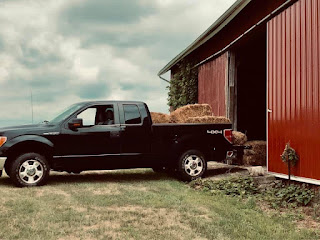
Ode to a Truck

Wednesday, I took my travel companion on its last trip, from which it didn't come home with me. I took it for a drive the day before, to...