28 April 2012

Springtime around the Farm


I just thought I would share a few pictures from when we were experiencing a slightly warmer spring a few weeks ago.  Enjoy!


Welcome to the Farm

The old lilac hedge

The kids crossing our creek

Could this look any more Hoosier?


21 April 2012

Monuments Jensen left behind


Ostermann Monument, Dyer, IN (rear) by Jens Jensen

I've written here before about famous landscape architect Jens Jensen who created a movement at the beginning of the 20th century that was, well, a century ahead of its time.  Jensen promoted a form of natural landscape design intent on using native plantings and stonework that reflected a regional, and specific eco-system, in which the design was created.

This, to me, was a greater triumph than his colleague on the architecture side of design, Frank Lloyd Wright, realized.  While Wright was a leading force, and a master, for new architecture-he also rode the wave of a society that was desperate for a break from tradition.  Jensen, on the other hand, was positioned at the pinnacle of time during which a classical "city beautiful" movement had crept into nearly every community-large and small.  Jensen rebuffed the classical arrangement of the landscape, certainly, but his larger message was running counter-culture to American ideas about the use, or abuse, of land.

Jensen sought the preservation of the landscape and the reestablishment of natural areas.  Remarkably, this became a key feature of the Lincoln Highway Association's 1921 "Ideal Section" of road near Dyer, Indiana.  They turned to Jensen to design the Ideal Section-which would be touted across the country as an example of the most appropriate and modern way to design highways.  Jensen designed footpaths removed from the concrete road, stone bridges, and even concrete light poles that blended with their surroundings.  Does this not sound like common themes of our Transportation Enhancement projects today?

When Henry Ostermann, a native Hoosier and major promoter of the Lincoln Highway, was tragically killed in Iowa, the Lincoln Highway Association turned to Jensen again to design a fitting tribute to Ostermann-and it would be located in the Ideal Section.  The monument, and a monument created during the 1960s by the Daughters of the American Revolution for the Ideal Section, stand together on the south side of U.S. 30 (Lincoln Highway) and are all that remain of this tribute to road-building innovation.

Jensen designed the monument in his tell-tale method of natural limestone laid to appear like stratified layers of bedrock, which form a bench-not unlike his trademark "council rings" only linear versus circular.  Jensen also incorporated an arch made of stones in which a plaque honoring Ostermann was placed.  It is currently awaiting restoration.

So my question in researching this site was "how prolific was Jensen in monument design?"  This is hard to know.  Jensen did a significant amount of work in Illinois, Wisconsin, Michigan, and Indiana.  Most of this work was residential and civic building landscape design in nature or city parks.  In a book published on Jensen an exhaustive list of his work was included and it lists only two projects that were purely monumental or commemorative in nature.  And both are in Indiana.  One is the Ostermann monument.  The other is a monument to his beloved Prairie Club, the organization that led early 20th century efforts to save the Indiana dunes at Lake Michigan.

Prairie Club Founation-Indiana Dunes State Park
The Prairie Club monument is located at Indiana Dunes State Park.  It was located nearer the historic gate house, but was relocated to the front lawn of the nature center.  I was curious about this other Jensen monument, so when making a trip for work, I swung by the Dunes for a look-and a hike.  The Prairie Club monument is also quintessential Jensen.  It has a more natural form, and a linear bench as well.  A unique feature is the brass snake fountain in one corner of it.

While the monuments certainly serve as tributes, as their creator intended, they also serve as monuments to one of the most important environmental leaders Indiana has ever had.  Thank God Indiana, and the Dunes, had Jens Jensen.

04 April 2012

Indiana's Carnegie Libraries: "Temples of Knowledge"


Recently I have been doing some research on Indiana's Carnegie libraries, specifically for Monticello's Carnegie Library. I had heard once or twice before that Indiana has more Carnegie libraries than any other state.....oddly enough, it was mentioned as a sort of justification to tear down River City's own Carnegie "in the middle of the night" as some recall.

Andrew Carnegie amassed a fortune in the steel business in Pittsburgh during the latter part of the 19th century. When he sold his company to U. S. Steel and J. P. Morgan in 1901 he increased his philanthropic giving, particularly to support the broad national movement of establishing public libraries. Carnegie funded the construction of 2,509 libraries throughout the English-speaking world. This amounted to $55 million in donations to cities and towns. A total of 1,679 libraries were funded by Carnegie in the United States. More Carnegie libraries were funded in Indiana than in any other state: 164 libraries were funded in 155 Indiana communities at a cost of $2,614,000. Of the 164 library buildings funded by Carnegie in Indiana, only 18 have been razed (according to Alan McPherson in Temples of Knowledge).

Carnegie believed that the public library was “the people’s university” and that it generally supported the betterment of a democratic society. He also believed that libraries enabled immigrants to have a better cultural understanding of America. At the time of his death Carnegie had distributed 90% of his wealth for the betterment of mankind.

Publicly funded county and township libraries in 19th century Indiana were typically poorly housed and had a limited selection of reading materials. An early Indiana philanthropist, William Maclure of New Harmony, had assisted in establishing Mechanics and Workingmen’s Libraries in most of Indiana’s counties. By the end of the 19th century the state seemed culturally ready for the establishment of libraries. Legislation at the state level in 1899 permitted the levy of a local tax for the support of public libraries, supported by business leaders and the power elite. Literary and women’s clubs at the end of the 19th century promoted the idea of better public libraries as well.

A national consciousness of social responsibility to improve one’s community and home had become part of American life during the first decades of the 20th century (ah the good ol days). This further aided the establishment of what many considered a symbol of community pride and intellect: the public library. The decades during which Carnegie funded libraries in Indiana were considered the second half of Indiana’s golden age of literature. While it may seem hard to imagine, the literature produced by Hoosiers created a cultural shift in Indiana as a national demand for works by Indiana authors occurred. This helped to improve and increase the general public perception and receptiveness of literature and culture in Indiana.


Monticello's public library can trace its roots to 1903 when White County’s superintendent of public schools, J. W. Hamilton, began to urge officials to establish a library. A public library board was created on March 4, 1903. A tax was levied by Monticello on property owners for the operation of the library. Over 800 books were received from a book drive that was held in town to build the library’s inventory. Additional books were purchased to bring the total to 1,025 and on the afternoon of September 1, 1903, the Monticello Public Library was opened to the public.

The library had been housed in two rooms of the courthouse until demand for a permanent home for the library resulted in a letter to Andrew Carnegie in 1905. The letter requested information on what steps would need to be taken to request funds for the construction of a library building. Carnegie responded with a commitment of $10,000 for a building in Monticello.

Some interesting tidbits from the Monticello library during the World Wars: in 1918 the library received a letter from the Public Library Commissioner that requested all libraries remove books on explosives. During World War II a “memorial shelf” was created in the library to feature local men who were enlisted in the military. Nora Gardner, the librarian who served from 1903-1947, organized a Victory Book Drive in 1942 to provide reading material for the military. Local Boy Scouts assisted with the effort by placing large containers in locations for people to drop off books. 1,150 books were collected by the Monticello library and sent to Chanute Field in Rantoul, Illinois.

The Monticello Carnegie was designed by Indiana architect Charles E. Kendrick of Ft. Wayne and Rochester. Kendrick also designed Carnegie libraries in Kewanna, Crown Point, Delphi, and Ligonier. A unique feature of Monticello's Carnegie is its corner entrance. Only one other Indiana Carnegie had a corner entry; it was located in Columbus but was demolished in 1970. The library also has a window bay that overlooks the Tippecanoe River, another feature not often found on Carnegies. The building now houses the White County Historical Society Museum. If you're wondering what that tower-looking thing on the ground next to the building is, it came off the Monticello City Hall in 1974, the year a tornado devastated the downtown and destroyed their historic courthouse.

23 March 2012

Beysbohl from Left Field


Chances are if you’ve taken in a South Bend Silverhawks’ game, or have seen any of the news revolving around the stadium’s overhaul under its new owner, you probably can’t help but wonder what that old brick building is doing sticking up above the left field fence. It looks like a church, but yet, sorta not.

The building is a synagogue and it is the former home of the Sons of Israel congregation. It represents in built form the rich Jewish history of its neighborhood and the City of South Bend. The synagogue was the first house of worship constructed by members of the Jewish community in South Bend and was at the heart of a once thriving Jewish neighborhood south of the downtown.

During the late 1840s and the 1850s the first Jewish people settled in South Bend. These settlers were largely of German origin. They first peddled goods and merchandise prior to the establishment of many successful business houses, financial institutions, and real estate developments. By 1878 South Bend’s Jewish population had reached 125 persons. The number of Jewish people in South Bend grew to 1,200 by 1912 after a large immigration of Jews from Russia and Poland during the late 1890s through the early 1900s. They were part of a large wave of migration by Jews escaping persecution in Europe between about 1880 and 1920.

While Jewish immigrants to the United States enjoyed acculturation in many aspects of social interactions and enterprise, the Hebrew practice of religion is what set the people apart from their largely Christian neighbors. The first Jewish congregation formed in South Bend in 1887; it was known as the Hebrew Orthodox Congregation and over time met in several locations in the city. In April of 1900 twenty-two Russian and Polish members of that congregation withdrew and formed a separate congregation called the Sons of Israel. The congregation purchased a lot on South William Street in the same year by raising $1800. The lot was in the heart of the Jewish neighborhood and was surrounded with residences. Construction on the Sons of Israel Synagogue began in October, 1901; some of the members assisted by digging the basement. It was dedicated on June 8, 1902.

The Sons of Israel Synagogue represents a more orthodox approach to religious practice by the Jewish community, most notably in its separation of men and women during assemblies by use of a balcony. The Orthodox congregation also incorporated a mikveh in the basement of the building. The orthodox plan is likely due to its founders’ Russian and Polish traditions. The building also maintains the practice of its eastern wall being the front wall of the assembly hall in which the ark is centered, facing the land of Israel.

The Sons of Israel Synagogue is important architecturally on a number of levels. First, it is the oldest synagogue in the City of South Bend and it retains a significant amount of its character defining features. Second, its design is a unique blend of the Romanesque Revival style with a form of European brick gothic design, and according to Chicago architect Robert Nevel, it is thought to be the only synagogue of its kind in the United States that introduces the Chicago school influence of architectural design. It also is believed to be the sole surviving synagogue of its simple scale remaining without alteration in the Midwest.

The fate of the now vacant synagogue seems promising under the new ownership of the Silverhawks. Masonry restoration is underway and the building is heading for listing on the National Register of Historic Places. I just hope they don’t sell ballpark franks out of it…….but if they do, they should at least be kosher.

19 March 2012

Dierks Bentley - Home


Lately this song has been striking a chord with me.  While it celebrates who we are, it also doesn't gloss over the wrinkles in America's past.  And what I think I like the best about it is the hope for unity in moving ahead versus the absurb division being pushed at us from every direction.

11 March 2012

Indiana Novelty Manufacturing Company: the oldest link to Plymouth's industrial past is gone

Bird's eye view of the Indiana Novelty Manufacturing Company (c. 1898)


I was spending a quiet afternoon at the home of an accomplished architect in Beverly Shores Saturday when phone calls started streaming into our home regarding an enormous fire that was raging in one of Plymouth's largest landmarks. The smoke could be seen in neighboring towns. This morning the hulk of a building was still smoldering, but it was indeed gone.


A later photo (c. 1915) when the building was used by the Abrasive Manufacturing Co.


Plymouth's oldest link to our industrial past was quickly engulfed in flames Saturday afternoon. The building had been recently used for storage and to most Plymouthites is no doubt known by any number of names, however, as a memoriam, I'd like to reflect on its grand beginnings.


The Indiana Novelty Manufacturing Company was organized in 1891 by several leading Plymouth businessmen. Among them were H. G. Thayer (owner of the Thayer mansion), James Gilmore, George Marble, and C. L. Morris (who owned the Morris house kitty-corner from the factory). The company manufactured wooden novelties and was particularly known for wooden bicycle rims and mud and chain guards for bicycles. The company was also the first to invent and market "the famous one-piece interlocking joint, which is excelled by none and which has made the Plymouth rim famous throughout the world." In 1898 the plant was the largest of its kind in the world and at full capacity was producing 10,000 rims PER DAY (in the 1890s!).


The company had sales houses in "every principle city" of the United States and marketed the rims to foreign countries as well. It was estimated that Indiana Novelty was producing more than half of the rims used by cycle makers in the 1890s. The firm employed over 300 hands (whether that means 150 men at 2 hands each, I don't know!) and had a company payroll of $8,000 per month. The company was unrivaled in Marshall County and much of this part of rural Indiana for its size.


The company's own dedicated fire department building
At a bicycle exhibition in about 1895 this was said of the company "the exhibit of the Indiana Novelty Manufacturing Company consisted of a full line of the well known Plymouth wood rims for American or English makes of tires as well as a complete line of handle bars and guards" (from Sporting Life magazine, Jan. 30). The firm was likely at its financial height when the owners sold the company to American Bicycle Company Inc., which was better known as the Bicycle Trust. The Trust was incorporated in June, 1899, and had $40 million in capital. It secured control of 44 plants nation-wide, including two others in Indianapolis (New York Times, Sept. 1, 1899).


The original two story portion of the plant (right side above) housed the company offices. The board room/manager's office had the most remarkable wood coffered ceilings I think I have ever seen. The plant was outfitted with its own fire department building in the southeast corner of the plant. As subsequent owners and manufacturers used the facility, additions were made to the north of the original building and to the south of the original manufacturing line, connecting the once stand-alone fire department building to the rest of the facility. Had the small brick fire department building still been isolated, it may have survived.

Thayer Mansion, Plymouth

The building, which at one time had put Plymouth on the world map, has now moved into our past. Pictures of the fire are here: http://am1050.com/2012/fire-destroys-400-pennsylvania-avenue/

10 March 2012

Political Menagerie


How have you been weathering the political storm during the course of this primary season? I've thrown together this little menagerie, which seems to be the right term, of thoughts.

Gone are the days, I think, when we could rely on true statesmen to represent us in public office. I had always put Richard Lugar in that ultimate class of politician/public servant. I've been so disappointed with his campaign ads born out of desperation for political survival. Several weeks ago Senator Lugar started his attack on President Obama-proving to his constituents back in right of right Indiana that he's no moderate. Then he started his attack on Murdock, maybe justly so, showing his absentee record to be something we should be concerned about. I think if Murdock was elected, he would be certain to show up to push his agenda through. That's what we should be concerned about.

Driving down U.S. 31 and across Highway 24 it seems that Murdock has either a real groundswell of support, or a few lackies from some campus Republicans' club that are doing their best to convince travelers of Hoosier highways to vote for Murdock. I think it's the latter....don't ask me why, but something about the rather regular intervals of "Retire Lugar" signs with "Murdock" signs placed on state right of ways, makes me believe the support isn't local. And someone should probably tell those kids it's also against the law to put signs there. I guess breaking the law is less important than getting out the vote.....something we see far too often around here.

I think I would have rather seen Lugar lose the primary and leave with his dignity intact than to appear to pander to the lowest common denominator of the party. But if we do elect Murdock.....well......we get what we deserve.

I had hoped Santorum would have won Ohio. Not because I'm a Santorum fan, but I'd really like to see an open convention this summer.....and there may still be a chance. It is wholly possible that the GOP may end up with a far better candidate if that happens. If your household pays attention to the news like we do, maybe you've heard this comment "they all just kinda creep me out". They kinda do, don't they? Romney is like a pompous Frankenstein, Santorum is like Howard Dean (waiting for the whooaaa-eeee-yahhhh), Newt is like, well.....Newt. Which leaves Ron Paul as seemingly the most normal candidate-and probably the most honest. Which evidently only attracts 10-20% of our party. That's crazy......and maybe Paul too.

My prediction for the fall: Romney will likely end up the GOP nominee (but I've said that months ago). He will go on to beat President Obama (also said that months ago). The reality is that it will have nothing to do with anything other than the public's perception of the economy. This was true with Carter, Bush Sr. (the last quarter of 1992 was on the upswing), Bush Jr.'s legacy for McCain, and it will be true for Obama. The economy, or the perception of its health, really, is the only factor in presidential campaigns. My grandfather once said "people vote their wallet". That seems true-for us to go from one extreme in electing Barack Obama, to what will be certain to be the other extreme in electing Mitt Romney. Not that either one of these men's policies are extreme.....but seriously, people thought President Obama was/is the anti-christ, and black nonetheless, and Mitt is part of what most christian groups would consider a cult.

And what is up with Rush Limbaugh? True colors folks. The thing that was more disturbing to me wasn't necessarily the names he used (it's like I expect that out of him), but his comments two days later. He actually suggested having videos posted online of women engaged in certain activities if they desired to have birth control included in their health insurance......I'm sure he was trying to be funny, I hope, but that should have sent chills down the spines of all my good christian friends out there who listen to this guy....and quickly, and finally, turned his loud mouth off for good. I used to listen to Rush all through college. I've grown up since then.

And this may not be political, but it did make me roll my eyes. When Jim Irsay, owner of the Indianapolis Colts, offered $50k to the tornado victims in southern Indiana......did anyone else want to slap him around a bit? Add insult to injury a few days later when Peyton Manning was let go. C'mon Irsay-that would be like me dropping a nickel in the Salvation Army kettle over the sound of trumpets. If you're going to donate-great-keep your mouth shut with such a small amount......if you really wanted to use a donation as a way to spur others on to give, say you'd match up to $1 million. You saved over 20 of those by letting Manning go.....and Indianapolis will never be the same.

25 February 2012

Plymouth main street Part 8


The Corbin-Bechaka House was constructed in about 1865 and designed in the "cube" Italianate style. The home’s architecture developed with successive owners of the house. Horace Corbin had the home constructed in about 1865. At the time it was constructed Corbin owned the entire block on the west side of Michigan Street between Harrison and North Streets. An engraving of his estate is in the 1875 Atlas of Indiana. Corbin contracted with architect William S. Matthews to make renovations to his home in 1880. The original plan was called “execrably designed as to practically deprive its owner of at least one-third of the room which should have been at his disposal…the interior of the home was remodeled in its entirety”. The second owners, the Hesses, made additional changes to the home in about 1915. The Hesses contracted with William Foker, a local stone mason of some fame, to create a new front porch and a new porch on the south side of the home. It seems reasonable that the concrete terrace walls that form the south and east edge of the lawn was constructed at about this time. This would have also been about the time the estate was divided into building lots. The third owner, the Bechaka family, was the first to enclose the porch and added the decorative iron balcony railing during the early 1950s. The home had extensive restoration under the fourth owner, the Emmons family, in 2005.

Horace Corbin was born in 1827 in Troja County, New York. By the time he arrived in Plymouth, Corbin was already a practicing attorney. He was elected prosecuting attorney for Marshall County in 1852. In 1862 he was elected State Senator from the district represented by Marshall and St. Joseph Counties. In 1872 he was elected as the city of Plymouth’s first mayor. In 1875 Governor Hendricks appointed Corbin as the judge of the 41st Judicial District. Corbin was also heavily engaged in the real estate business and owned two large farms in the county. He was married to Catherine Houghton, the daughter of John Houghton, in 1853. They had three children: Manfred, William, Horace, Charles, and Cleon. The Corbins are recorded at this location in the 1870, 1880, and 1900 censuses. Horace Corbin died in 1897. Lewis Hess was the second owner of the house. Hess was the president of the Marshall County Savings and Trust Bank located in downtown Plymouth. Lewis and his wife, Ona, had four children: Pansie, Faye, Lelia, and Frederick. The Hesses lived at this location into the 1930s. Harry Bechaka immigrated to the United States from Greece during the 1930s. He and his wife purchased the home and it remained in the family until the 1990s. Bechaka operated a restaurant in downtown Plymouth.

The Prosper Ball house was constructed in the Dutch Colonial Revival style in about 1915. It is an exceptional example of the style. Prosper and Alice Ball were the parents of five children: Alexis, Mary, Marcellus, Clement, and Richard. In 1920 Prosper’s brother, Alpha, and his mother, Catherine, were also living with the family in this house. Prosper’s father, Phillip Jacob Ball, was a native of Germany who settled in Plymouth in 1872. Phillip founded the drygoods and clothing store in partnership with his brother-in-law, Mr. Carabin. That partnership was dissolved in 1890 after which time the firm became known as Ball & Company. Prosper and his two brothers, Alpha and Jerome, became sole owners of the business after their father’s death. In 1908 the business was the largest merchant shop in Plymouth and employed fifteen people. The home remained in the Ball family into the 1950s.


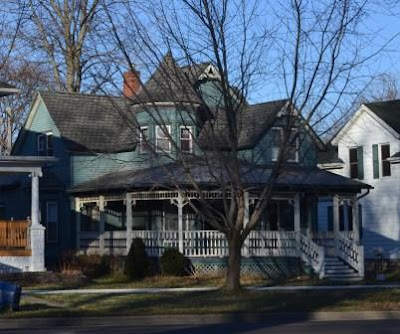
This home is considered a bungalow and was constructed in about 1925. It appears that Lyman and Eunice Butler were the first occupants of this house, though they had moved by the 1940s. The Butlers were married in 1924. The home was constructed soon after. Lyman Butler was the Marshall County Extension Agent for nearly twenty-five years until his death in 1947. The Butlers were living at this residence in the 1930 census but moved soon afterward to a home on Pearl Street in the south side of the city.

And that concludes our trip down North Michigan Street....but more to come from other parts of town including the south side.

Plymouth main street Part 7


The home on the left was constructed for Frederick and Lucinda Hill in about 1889 in the Queen Anne style. Hill was the proprietor of W. W. Hill & Son, Bakers and Confectioners. Frederick was the son of William W. Hill, who began the bakery in downtown Plymouth in 1855. Frederick was born in Plymouth in 1857. He was the manager of the Central Union Telephone Company in Danville, Illinois until his association with his father’s bakery. Frederick Hill constructed a downtown business block for the bakery; it has a second and third story meeting hall used by the Knights of Pythias, of which he was a member. The building currently houses the Historic Crossroads Center of the Marshall County Museum. The house was recorded in Wilbur Peat’s book Indiana Houses of the Nineteenth Century. Peat describes the house as Neo-Jacobean and states “so massive a roof on a story and a half house gives the impression the walls are struggling to support excessive weight.” At the time the book was written the house was owned by Harvey Phillips.

The Stevens Home was constructed in 1895 in a blend of the Queen Anne and Shingle styles (above-middle). Smith (S. N.) and Martha Martin Stevens and their children Katherine and George F. had this home constructed for them in 1895. Smith and Martha were married in 1893. Smith came to Plymouth from Argos, Indiana in 1884 after receiving an education from Valparaiso University. He was admitted to the bar and began to practice law that same year. He was the Marshall County prosecuting attorney from 1890-1894 and 1897-1904. He was a member of the Plymouth School Board from 1900-1906. He held the office of Democratic County Chairman, Chairman of the 13th Congressional District, and member of the Democratic State Central Committee. Smith Stevens was the attorney for the State Bank of Plymouth as well as the local representing attorney for three railroads in the city. In 1914 he was elected Judge of the Judicial Court Circuit; he held that office until 1920. He practiced law afterward until his death in 1930. His wife, Martha, continued to reside at the home into the 1950s.


Dr. Thomas and Gertrude Eley and their son Thomas Jr. had this home constructed for them in 1935 in the Colonial Revival style. It is one of the newest homes on Michigan Street. The Pilot News carried an article on the home when it was constructed. It was called a FHA Model Home in the article. Dr. Eley was a medical doctor and surgeon. They lived at 825 N. Michigan in 1930 prior to building this home. Dr. Eley was the secretary of the Plymouth Kiwanis Club when it formed in 1921. Mrs. Eley was a founding member of the Plymouth Tri Kappa in 1946. Mrs. Eley continued to live in the home after her husband’s death. She lived in the home she called the “Candlelight House” into the 1950s.


Who hasn't enjoyed this little cottage? It was constructed in about 1895 in the Queen Anne style. Joseph and Alice Anderson are listed at this address in the 1910 and 1920 censuses. Joseph’s occupation in 1910 was listed under commercial trade “brewery” and in 1920 as a manufacturer of cigars at home.

Plymouth main street Part 6


The Logan-Stanley House was constructed c. 1902 in the Classical Revival style. What is commonly referred to as the Stanley home locally, was probably constructed for Harley Logan, an attorney, who appeared to live at this location with his family in 1910. Harley Logan was born in Plymouth in 1864. He served as city attorney and in 1904, became mayor. He was elected to that office again in 1905 and served until 1910. He also was the county attorney during this time. The Stanleys lived at the home into the late part of the 20th century. Eugene Stanley operated the Memorial Album and Records Company from a building on the site. It is connected to the house by a tunnel. Stanley was a member of the Indiana House of Representatives and lost a close election to future Governor Bowen for the house seat in 1956. The Stanley Fountain, in the south side yard of the home, is a local landmark.


The Woodbury Home (on left above) was constructed in 1922. It is an American Four Square with Craftsman style influence. Oscar and Mamie (Beldon) Woodbury had two daughters, Lucille (VanGilder) and Mary (Thompson). The couple lived in their home into the 1950s. Oscar was listed in the 1930 census; his occupation was “odd jobs”. The house on the right was constructed for Francis Garn in about 1907 in the Free Classic style. He was a grain broker in the city. He and his wife, Mary, lived at the home with their son, Rulo, in 1910. The Garns were followed by Harry and Zorah Unger. Harry was an attorney with a large family who lived in the home in 1920. John and Dora Hildebrand lived in the home next. John was a contractor who installed sewers. By the 1950s the Sisters of the Holy Cross had purchased the home as a residence for their members. The home is a private residence again.


This home is a rare survivor from probably the first generation of homes constructed in the original town plat on about 1860. It is has the unusual distinction of being the only Michigan Street home that doesn't face Michigan. It may be classified as an I-cottage or single-pen. The home has some Greek Revival influence with regard to its regular window placement and formality and the broken cornice on its side gables. However, it has an Italianate styled full front porch. Though they were not the original owners of the house, the residents in 1910 were George and Susan Neff and their daughter, Hazel. In 1909 Hazel became a charter member of the Wythougan Chapter of the Daughters of the American Revolution. George was involved in the commercial trade selling cutlery. By 1920 George was widowed, but his daughter and her husband were living with him. His daughter was a music teacher and his son-in-law, Chase Smelser, was a civil engineer. In the 1940s the home was occupied by Ray Poetzel and Mary Coffy who operated Ramar Electronics from the location.

21 February 2012

Plymouth main street Part 5


The Cleveland House (on left above) was constructed in the Craftsman style applied to an American Four-Square plan in about 1915. Charles and Mary Lamson Cleveland came to Plymouth with their only child, Arnott, in 1891. They previously had lived at Edgerton, Ohio. Cleveland founded the Edgerton Manufacturing Company in Plymouth in 1891. The company became the largest producer of basket and fruit packaging products in the United States. Cleveland was elected mayor of Plymouth in 1910 at which time he turned over control of the company to his son. By 1920 Charles returned as an assistant manager of the factory. Mary continued to live at the residence after her husband’s death into the 1930s.

The Miller House (on right above) was constructed in 1911 in the Free Classic style. William Foker, renowned stone mason from Argos, was responsible for the porch and foundation. Welcome J. and Clara Heyde Miller had this home constructed for them in 1911. They lived here with their daughter, Virginia, who was born in 1909. Welcome was a piano tuner and salesman in the county. He was tragically killed at a railroad crossing in Plymouth in 1942. Clara continued to live at the home into the 1950s.


The Cullison House was designed in a unique Plymouth blend of the Free-Classic and Craftsman styles. The home was constructed for the Frank and Eveline Cullison family in about 1908. The Cullisons moved to Plymouth from a nearby farm in 1900 to begin a business in the manufacturing of wagon wheels. The business evolved to the manufacturing of buggies at which time it became known as the Plymouth Wagon Works, located on East LaPorte Street in the downtown. The business continued to grow and became known as the Plymouth Body Works which manufactured truck bodies used throughout the United States. The Cullisons raised three sons at the home: Darrel, Floyd, and Oscar. In 1930 they moved to a cottage at Pretty Lake and shortly after the business failed during the Great Depression.

Plymouth main street Part 4

The Metsker House was constructed in 1917 in a blend of Queen Anne and Shingle styles. Clay Metsker was a prominent newspaper owner and politician in Marshall County and Indiana. Metsker was born near Delphi, Indiana in 1869. He graduated from DePauw University in 1891 and moved to Beloit, Wisconsin. He managed the Beloit newspaper for four years during which time he also became the head of the county’s Democratic Central Committee. He relocated to Plymouth, Indiana in 1897 and purchased the Daily and Weekly Independent, a local newspaper. In 1902 he purchased the Plymouth Democrat, a newspaper begun by the McDonald family and then owned by Daniel McDonald. He merged the two newspapers into the Plymouth Democrat. Metsker was elected State Representative from Marshall County in 1900. In 1904 he gave the keynote address at the state Democratic convention. He toured the state of Indiana with presidential candidate William Jennings Bryan in 1908, and gave the introductory speech for presidential candidate James Cox to a crowd of 10,000 people in South Bend in 1920.

In 1930-31 Metsker self-published a book of his own poems entitled The Glow Book and a book he authored about prohibition entitled Booze On It’s Hunkers, Or A Nation’s Awakening. Metsker constructed a number of downtown business blocks including a building for Democratic headquarters and the Rialto Theater. In 1917 Clay Metsker purchased the home site and constructed this home for his wife, Nellie, who was ailing with tuberculosis. Nellie died in 1919, having lived in the house less than two years. The Metsker family owned the home into the 1950s. Clay died in 1949 but his second wife, Mabel, continued to reside at the home.


The Dr. Reynolds House was constructed in about 1905. It could be termed a stripped down version of the Colonial Revival style. The builder's choice of massive molded concrete block for the walls adds to the scale of the house. Dr. Carl Reynolds, a veterinarian, operated his practice from this location from about 1905 through the 1930s. Louis Overmyer, a shoe merchant, and his wife Estella, lived at the home in 1910; George Rafferty, a clothing salesman, and his wife Alma, lived at the home in 1920, and George Strohlein, a cashier for the railroad, and his wife Ruth, lived at the home in 1930. Carl Reynolds’ father, George, was a local physician and appears to have had his office and residence in this block earlier in the 19th century. Carl’s mother, Martha, lived with her son at this address in 1910. Martha is shown as the owner of the property in the 1908 plat of the city.

The Price-Murphy House was designed in the Queen Anne style. Jacob Price, a brick mason, constructed this home for himself in about 1905. He lived here with his wife, Jessie, and sons Carl and Clyde, and his daughter, Helen. They were still living here in 1920. Price is shown as the owner of this lot in the 1908 plat of the city. Gray and Edith Murphy purchased the home during the 1920s. Gray was a salesman at a grocery store. John Murphy, Gray’s son, lived here with his family into the 1950s.

15 February 2012

Plymouth: main street Part 3


The Oliver Soice House was constructed c. 1880 in the Carpenter Gothic style. Though the home has had its wood siding and decorative trim either removed or covered with vinyl siding, some aspects of the house are unusual. The house was constructed in a cruciform plan with each leg of equal length; a rarity in Marshall County. Local lore states that the home was situated in such a way (angled toward the intersection of Michigan and Monroe Streets) due to speculation that the railroad would pass east to west north of the courthouse and this house was a speculative depot. Nothing has been found to substantiate that. The original design of the home was in the Carpenter Gothic style with vergeboards, finials, and roof cresting. Originally there were no dormers located on the house and a porch wrapped around the southwest walls.

The Oliver Soice family lived in the home from at least the 1890s through the 1930s. Oliver Soice was born in Bremen, Indiana in 1855. He graduated from Hillsdale College in Michigan before moving to Plymouth. He held the office of deputy county treasurer for twelve years and was elected treasurer for one term. He was an original organizer of the State Bank in Plymouth and was its cashier. Olive, Oliver’s wife, continued to live at the home after her husband passed away.


Adelbert and Atha Clizbe constructed their home in about 1902 in the Free Classic style. The Clizbes were the owners of Clizbe Brothers Manufacturing Company. The firm, located in Plymouth, was incorporated in 1896. It manufactured grinding and polishing machinery and light counter shafts. It was in business into the 1940s. The Clizbes lived at this home until about 1940.

Plymouth: main street Part 2

The Schlosser House was constructed in 1910 in the Tudor Revival style. Samuel Schlosser was a partner in Schlosser Brothers Creamery, located in Plymouth and Bremen, Indiana. The creamery was founded in Bremen in 1884 and operated at several sites in north central Indiana. Samuel became president of the Plymouth branch in 1901 and of the corporation from 1927 until his death in 1938. Samuel married Ada Hodges in 1900; they had three children: Samuel, May, and William. They constructed the home in 1910-1911. Ada continued to live at the residence after her husband’s death and was still living at this address in 1953.
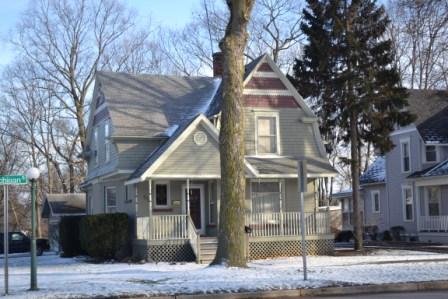


The Humrichouser House was constructed in 1878 in the Italianate style. Henry Humrichouser constructed this home on the site of his original home in 1878. Humrichouser was born in York County, Pennsylvania in 1829; he came to Plymouth in 1850. He was involved in the grain and stock business and had a large grocery and merchandise establishment in the city. After his retirement in 1877 he became a gentleman farmer with two large farms in Center Township. He also became a director at the State Bank. Henry married Rachel Hunter in 1858 in Ohio. They had two sons, William and Harry. William died at the age of 21. Harry was born in 1866 and became the sole inheritor of his father’s estate due to his mother’s death in 1903 before Henry. Harry lived at the home into the 1920s with his wife, Winnie, and three children. Harry became part owner of the local telephone company. In 1909 the Wythougan Chapter of the Daughters of the American Revolution was organized at the home; Winnie served as hostess. The Kain family purchased the home in the 1940s and it continues to be in their family today.

Plymouth: a main street like no other. Part 1

I assisted a group of architecture students and their professors in a design charrette in Plymouth. In their final report with the charrette they said that "Plymouth's main street was like no other, unparalleled in Northern Indiana." I think that they may have been correct. I intend to do a multi-part series on Plymouth's main street, which is named Michigan Street because it is the historic Michigan Road. I hope to highlight some of the best architecture of the street and give you the stories behind the elegant homes that line this graceful tree-lined Hoosier treasure.

The J. C. Capron House (above), constructed in 1900 in the Queen Anne style.
John C. Capron was born in Plymouth in 1871. He graduated from Stanford University in San Francisco in 1893 and started his law practice in 1895. J. C. Capron was captain of Company M, 157th Indiana Volunteers during the Spanish-American War. In 1894 he married Harriet Cullen of Plymouth. Capron was the Marshall County court stenographer for his father, Judge A. C. Capron, during the late 1890s. Capron lived in the home only a short time before it was sold to Clinton and Florence Bondurant. Clinton was born in German Twp., Marshall County, Indiana in 1870. He was engaged in the real estate and loan business and was county sheriff from 1900-1904. He married Florence Field in 1897. The Bondurants lived in the home with their daughters Helen and Dorotha in 1910 and 1920. The couple was still living at this address in 1930.


The former First United Methodist Church parsonage was constructed c. 1889 in a blend of Italianate and Gothic Revival styles. The original owner of the home is unknown but by 1910 it was being used as the parsonage for the United Methodist Church, which, at that time was located at the intersection of West LaPorte and South Center Streets. The congregation constructed a new building in 1914-1915 two blocks south of this home on the same side of Michigan Street. It was used as their parsonage until about 1951. The federal censuses and city directories reveal some of the ministers who had lived here; they include Ernest Wareing (1910), Otto Martin (1920), Robert Ross Shannon (1930), and Richard Blake (1949). Blake was living at the church’s next parsonage near the church in 1953.


In the days ahead we'll continue down the block-stay tuned!

17 January 2012

Intoxicating trip down memory lane


Getting settled into our home....finally.....has prompted me to go looking for a few pieces of artwork, photographs, and keepsakes that have been boxed up with the idea that some day they would adorn our walls. Most of these are kept in a long tote in the basement. I pulled it out the other day and then my trip down memory lane began.


When I finished the trim in my office I created a photo shelf off the top of the door across the wall. This allowed me to display a couple of pretty slick black and white photographs from college; each of which has special meaning to me. When I went to find them, I found a few other pieces of paintings from college-4 decent ones that I've kept all these years-and I took the best of the lot for my office and told the kids they each had to choose one for their rooms. No one wanted the alien-looking guy climbing toward infinity.


Then I came across "the ugly picture" as my wife refers to it. It is a chromolythic print that hung in my great x3 grandmother's kitchen, from the late 1800s. It was given to me maybe 20 years ago and has been in storage ever since. I've sized it up for a frame but my wife says no way will that hang in our kitchen. I don't see this as a closed case-stay tuned for more on the ugly picture.


But what I finally landed on, and spent a fair amount of time reminiscing over were the drawings from my thesis while in the school of architecture. Your thesis project is supposed to exemplify everything you've learned in school and culminate with a kick-butt project. Your class is given a redevelopment site and you select a building site and program within that context. The year before us went to California for their project; the year behind us went to Alaska. We, well, we went to Milwaukee.
But that's ok. Milwaukee is a unique, blue collar, down and dirty rugged sort of city.......and it led to the inspiration to design a building that both embraced the industrial nature of the city, but tried to capture the spirit of progress in its downtown. The building program I created for the building? A micro brewery with loft style apartments. How does that not scream Milwaukee? My project site was along the river and next to a massive old power plant, and in the shadow of several national brewers. I'm not a beer drinker, and my parents probably would have been mortified if I had told them what would represent 5 years of college education. Regardless, I began to study the brewing process, and the research became an integral part of the thesis project. And for precedent, at least with the building form, I went out and photographed every grain elevator I could find in a 50 mile radius. And while on a college trip in Oregon that year, we stopped at a micro brewery in Mt. Angel for additional "research".


Did you know that beer first arrived on America's shores with the European colonists? The Pilgrims landed at Plymouth Rock in December of 1620, because, in the words of one diarist aboard the Mayflower "we could not now take time for further search or consideration, our victuals being much spent, especially our beer." What did George Washington, William Penn, and Thomas Jefferson all have in common? They all brewed beer on their plantations.

By March of 1996, with graduation just a few months away, the program and general form of the building was set. I created a large "vault" between two massive brick end walls that contained the loft apartments. The vault was the brewery. A restaurant was dockside on the river and I created large dining rooms cladded in copper to give the effect of brewing vats. The plans and elevations were drawn with graphite and colored pencil. The model-I was always jealous of my buddies who did great models-explored materials as much as rusted steel to mimic cortin steel, copper, wood, and glass. And yes, the "vats" are tuna cans painted with copper paint. I even honored my two professors that year by depicting their faces on one drawing of two monks holding each side a a giant vat. Yes, my colleagues pointed it out to them.


The only thing I remember from my presentation.....which I cleaned up on......was that the jury thought the drawings were "intoxicating" and that it would have only been better had I served beer to the jurors. I made a mental note of that, but to this date have never served beer to my clients. Maybe one day, when I am a multi millionaire, I'll build it myself.


11 January 2012

Daniels: How high can he count?


In a bit of a celebratory, yet intrepid spirit I flipped the channel over to watch Governor Daniels' last state of the state address. And that lasted about 30 seconds before I felt nauseous and continued flipping through the channels. Ultimately I shut the tv off and started reading a new book called "Radical". Sounds about right.


The sole part of the address I caught was a comment that reveals his fixation that other states want to be Indiana. I don't find this to be true. It makes me think he has some form of inferiority complex-as though saying it enough may make it true. He relayed a story that a reporter asked him what kept him up at night, or maybe how he overcomes insomnia. His response was "I don't count sheep.....I count how many states I'm glad I'm not the governor of". And after he gave his smug little smile....I turned the channel.


But, that left me wondering, maybe concerned, exactly how high can Mitch count?

Because here are some stats that put Indiana pretty close to the bottom these days:

36th in unemployment

42nd in SAT scores

32nd in median income

41st in population growth

38th in personal health

40th in foreclosures

32nd in the poverty rate


This leads me to believe that Mitch gets pretty tired after counting to only about 12 or 15!


Where Indiana does shine is our 22nd place (just a little above the middle) for debt as a percentage of gross domestic product. I guess that's something to celebrate.


No, Mitch, I'm afraid that it's the governors of other states who are counting their lucky stars they don't have Indiana's problems. And this may be why people don't want to live here anymore. You and Mr. Bosma balanced the state budget all right-on the backs of everyone paying more in sales tax, our public schools, and our cities and towns. You're not a miracle worker, you're a charlatan that's gotten 6.5 million Hoosiers to drink from your punch bowl.

09 January 2012

a psalm for the new year


Time is Yours, oh God. The passing of each day, the movement of the heavens above, the surge of the sea and rolling of the land below, these were established from your throne.


We cannot still the waters nor hold the heavens in place. We cannot add a day to our lives, nor see what lies beyond our eyes. You know all things, and the days of man You have numbered.


But we rest in your mercy. Just as the morning frost clings to the earth on stem and branch, so You embrace us. Just as the sun warms the earth, You set your face upon us. Just as the rain breaks the thirst of dry ground, You give life to your children.


Strengthen us like You give power to the wing of the eagle and leg of the deer. Give life to my arm, that it not fail, and direct my thoughts that You may delight in the work of your servant. Let us not weary in establishing justice and acting from mercy.


We are but reeds in the field moved by the breeze, but You are the breeze. We are but the sound of waves on the shore, but You are the mighty sea. We are but hatchlings in the nest, but You are the eagle. You are awesome, oh God.

Ode to a Truck

Wednesday, I took my travel companion on its last trip, from which it didn't come home with me. I took it for a drive the day before, to...