13 June 2013

Chief Papakeecha and the village he left behind

Indian Village Cemetery, 1836, and Highway 5 on the left
If I am ever late to anything, you can assume one of two things have happened.  Either I am in a ditch, or my standard arrive 5-10 minutes ahead of schedule was over-compensated for and I arrived 20 minutes ahead of schedule......so I'm doing a little sight-seeing.

That's what happened when I arrived in Cromwell a full 25 minutes ahead of the meeting at which I was scheduled to speak.  So I kept driving south of out Cromwell-having never driven that stretch of Indiana Highway 5.  Not sure of where I would turn around, when I got about a mile and a half south of town my jaw dropped as I entered into a little hamlet that just bled history.

Original post office, c. 1855 (left) and church, c. 1880 (right)
The highway dropped and curved toward a small cemetery.  There was a short string of 1800s homes on the left side of the road, along with a picturesque chapel, and a small church on the right side of the road with the cemetery.  These were all situated on a small bluff.  I had entered "Indian Village" not to be confused with the incorporated town in St. Joe County.

Indian Village Brethren Church, 1879
The town, once called Alcinda, was the reservation home of the Miami Indian chief by the name of Papakeecha...which sounds more Italian to me.  The chief, whose name means "flat belly" (no doubt a product of 6 minute abs) lived in the village from 1827-1834.  He was chief from 1820-1837, at the time of his death and just before the removal.  An Indiana Historical Bureau sign marks the location of an Indian stove in the village where the Miamis prepared their last meal before being removed from their reservation lands.  The cemetery dates to the 1830s and a few nearby buildings, including the village's first post office, date to the early settlement period by European Americans.

Houses on the village's "main street" and bluff, all c. 1870
Yeah-it usually is pretty easy for me to get jazzed up about these things.  But I thought the setting was exceptional.  As I shot pictures in all directions from the cemetery entrance, I'm sure the mechanic across the street wondered....what the keecha anyway.

11 June 2013

What Ben Hur hath wrought

Study of General Lew Wallace
During the summer of 1996 I spent a long weekend with a college friend from Hoopston, Illinois, which is just over the state line west of Lafayette.  He introduced me to the west central region of Indiana with tours of Attica, Williamsport, and as far east as Crawfordsville.  There we visited a great little architectural gem, now open to the public, with a fantastic history linked to Indiana's golden age of authors and artists.

General Lew Wallace, a Civil War general and an author made famous by his book Ben Hur, was from Crawfordsville.  He married well, which allowed him to pursue his writing career.  His famous work, turned into movies in the 20th century, created more wealth for him than that of his wife's family.  Wallace, already owner of a stately home in Crawfordsville, decided that he needed a study (read:  man cave) on his wooded estate.  So in 1880 he designed a wonderful Romanesque building with a private terrace, moat stocked with fish, inglenook, and large room with a vaulted atrium.  Carved faces on each of the four walls of the building depict characters in Ben Hur and a second book he thought would surpass that book, but bombed.

Statue of Lew Wallace near the study
A few weeks ago a friend and I were attending an Indiana Landmarks meeting in Greencastle.  On our way back through Crawfordsville I suggested we stop at Lew Wallace's study for a short tour.  I'd say I need a man cave like this.....but I guess that's what the barn is for.

Both being familiar with local oral tradition that Wallace wrote a portion of Ben Hur while vacationing at Lake Maxinkuckee, we asked the tour guide if he knew if the story was true.  He said he had heard the story, and that Wallace did vacation on the lake, but given the timing of when the book was written, it was doubtful because Wallace was in Crawfordsville and the southwest during its writing.  Bummer.
Inglenook in the study-something every man cave needs
I've never read Ben Hur, and I don't think that I've ever seen the 1950s film version in its entirety.  But this did give me some incentive to do so.  Here is a link to the General Lew Wallace site:  http://www.ben-hur.com/_index.php.

06 June 2013

Receiving the mail in Hobart and Culver

I'm sticking with the New Deal post office theme for another post.


Hobart Post Office
I am working in Hobart, Indiana's downtown area.  Realizing they also have a New Deal-era post office, camera in-hand, I joined with the Hobarites in visiting the lobby of their post office to see if it was home to a public works supported mural.  Sure enough.  During the 1930s post office construction was prolific under the New Deal.  Post office design was all being handled from the post master general's office, which explains why so many look the same.  While the design style of Hobart's post office stayed true to the basic elements of the Colonial Revival style, which characterized nearly all post offices built during the 1930s, certainly elements of the then-popular Art Deco style were brought into play.  This is most obvious in the strong vertical window and entry bays and in the carvings of eagles above the windows.  The Hobart Post Office was constructed in 1937.

Culver Post Office
 Contrast that to the over-the-top Colonial Revival style application on the post office constructed in the tiny lakeside community of Culver.  It does make me wonder if there was a method in determining how designs were selected for each community.  Culver's post office is Colonial Revival in the truest sense of the term.  Right down to the Jeffersonian cupola on its roof.  The Culver Post Office was constructed in 1935.  Having known it was home to a public works mural, the last time I was in downtown Culver-camera in-hand again, I visited the lobby and shot a few pictures.

Receiving the mail in Hobart with town founder, George Earl's gristmill in the background
While generally all of the public works post office murals stuck with the theme of receiving mail in their communities, awarding commissions to complete the works to a wide variety of artists resulted in a broad interpretation of the theme.  Hobart's mural was painted by William Dolwick in 1938.  He depicted the early years of the community and included the founder's grist mill which would have lasted another 15 years before it burned in the 1950s.

Receiving the mail in Culver
Culver's mural was painted by Mrs. Henrick Mayer and was installed in 1938.  She selected the community's internationally known military academy as inspiration for her work.  In it she shows academy cadets alongside local residents and farmers receiving their mail.  At that time the academy was just over 40 years old, a scene certainly more modern at that time than Hobart's.  Another interesting feature of Culver's mural are the small vignettes the artist created on either side of the main picture.

04 June 2013

Main Street Ligonier

Ligonier's Carnegie Library
Traditionally a street dubbed "Main Street" is the commercial heart of a community.  It brought people in and out of town through the downtown retail area lined with tightly packed one to three story buildings....what we recognize as our historic downtowns today.

There are a few places where this is not the case though.  For example, in Plymouth the main commercial corridor is Michigan (Road) Street while Center Street, the founders' version of Main Street, lies a block to the west.  It functioned as a sort of civic corridor with the post office, town hall, courthouse, several churches, and later the Carnegie library all lining the tree-lined street.  A similar situation exists in Ligonier where Main Street lies a block west of the commercial corridor.  Here too are provisions for a public square, their Carnegie library, post office, police station, and at least one church-or should I say synagogue.

Ligonier Post Office

Post Office Interior
Ligonier's Main Street is very broad, as though the founders had intended it to be an avenue planted in the center with trees.  It has impressive homes beginning at its north end/intersection with the original Lincoln Highway, that continue south for nearly a dozen blocks.  Mixed among the impressive homes are a handful of architectural gems.

New Deal Mural
Their Carnegie library is situated in the public square that served the town as a park since its inception.  Across the street from the library is the town hall and police station.  A block to the north is Ligonier's Colonial-style post office created under the New Deal projects of the 1930s.  It also has a large interior mural created under the same program.  A fraternal lodge is located next to the post office.
Ahavas Sholom Synagogue
A few blocks to the north is the Ahavas Sholom Synagogue.  It was constructed during the 1880s and replaced the original wood-frame synagogue.  Ligonier had a large Jewish population until it dwindled in the latter half of the 20th century.  The synagogue is the second oldest in the State of Indiana.  Its stained glass windows reflect the religious heritage of those that built it.  The library owns the building and it is used by the Ligonier Historical Society for tours.

Interior of the synagogue.  The stained glass depict Biblical friends David & Jonathan.
Ligonier also has an impressive collection of large Queen-Anne and Classical Revival homes, many built by leading Jewish merchants and industrialists of the town.  A historic stone fountain and clock are located in a small triangular park on the south side of the entrance into the downtown.  Across from the park is an historic gas station that has been converted into a town museum.

30 May 2013

The Bundys of New Castle

Henry County Courthouse & Soldiers' Memorial
The Indiana High School Basketball Hall of Fame isn't the only thing in New Castle.  Spying the Henry County Courthouse from Highway 3, after we left the Hall, I asked my son if he wanted to drive up the hill to the downtown.  He said "sure".  As if he hasn't figured out that's an invitation for architecture viewing by his dad.

What a fantastic downtown New Castle has, and the courthouse is amazing too.  Unfortunately, being Good Friday, it appeared closed the day we visited.

My great x5 grandfather, Christopher Bundy, moved from North Carolina to Wayne County, Indiana in 1819.  In 1821 he purchased a tract of land next to the original plat of New Castle.  Bundy served in the American Revolution at the age of 19.  He was part of the large Quaker migration from the South to Indiana, ensuring the state's "free" status to the slavery question.

The Bundy name became inseparable from the town's history when one descendant, General Omar Bundy, had this read about him in the Congressional Record in 1940:

'Mr. Speaker,' said Mr. Springer, Congressman from the 10th Indiana District, 'I rise to report the death of one of our outstanding military geniuses, Major General Omar Bundy...A graduate of West Point in 1883, he afterward participated in many military expeditions of this country. In his early life he took part in the engagement with the Sioux Indians. In the first World War he commanded the 2nd Division and later the 6th and 7th Army Corps...'".

General Bundy became immortalized during World War 1 when he refused to obey the retreat orders given by his French superiors.  This is his now famous response:

'We regret being unable on this occasion to follow the counsel of our masters, the French. The American flag has been forced to retire; this is unendurable and none of our soldiers would understand their not being able to do whatever is necessary to re-establish a situation which is humiliating to us and unacceptable to our country's honor. We are going to attack...'"

Bundy was credited as the hero of the battle of Belleau Woods and thereby liberated Paris.  Two poems were written to commemorate this event:  Bundy's Men and Where Bundy Held the Paris Road.  The Major General Omar Bundy Auditorium in New Castle is named for him.  And for the record, I'm NOT related to Al Bundy, and hopefully not Ted Bundy either.

28 May 2013

Indiana's Basketball Hall of Fame


My son loves sports.  Any sport.  And he astonishes even the most savvy of sports fanatics with the stats and depth of information he has going back decades for most organized events.  One time while we were having dinner out (mom was gone) my daughter and I started quizzing him on who won what Superbowl in any random year, to which he would add the score and mvp to his response.

The table next to us got very quiet, then started to stare in wide-eyed wonder.  I'm thinking we may try to get him on Letterman.


At any rate, his Christmas gifts included a couple of tickets to the Indiana High School Basketball Hall of Fame.  Did you know that we're the only state with such a thing?  I know, hard to believe right?  As other states think "you have what?"

Honestly, I wasn't sure what we'd find when we visited over spring break.  I knew it was a new building so the idea of it being crammed into a less-than-functional or inappropriate facility didn't exist.  How I hoped it would have been in a historic gym!  Regardless, the facility-spectacular.  The displays-very well done.  I always set my expectations pretty low when it comes to these kinds of venues.  But let me be clear.....I was impressed and highly recommend it for anyone.

Walking the memorial terrace in front of the Hall
Basketball was introduced to Hoosiers by a minister from Massachusetts who was relocated to a congregation in Crawfordsville in the early 1900s.  Consequently, when the sport became popular and early state tournaments were held-that region seemed to excel in wins.  Pieces of the gymnasium where the game was first played are behind glass at the hall of fame.

Pieces of the building where the first game of basketball was played in Indiana
There were plenty of references to Milan and other David and Goliath stories from pre-class basketball Indiana, including River City's own state title.  I was amazed to see the ranking my dad's high school had during the late 1940s through the 1950s....including a large "best of county" trophy for the LaPaz Vikings, representing a town of a few hundred folks.


23 May 2013

"Early" warning system....from the 1950s


One day I was lamenting with a fellow progressive that I was tired of consistently hitting brick walls.  To which she said "let me tell you a story".   One day an old man died and went to heaven and God said "well done".  "Well done?!" the man asked emphatically.  The old tired soul said, "God you asked me to push on that big boulder, and I did my whole life, but it never moved an inch."  To which God said "I never told you to move the boulder, only to push on it".

And that maybe sums up a great deal of my life's efforts.  Particularly my time on city council.  While watching much of the effort from four years of devotion undone, there were a few things that couldn't be, thankfully, because the wheels had been set in motion.  Granted, the guys who came after me got the credit....but to heck with the credit.  The results are the reward.

I am reminded of one of those rewards every time I see another devastating tornado, like the one that occurred in Moore, Oklahoma this week.  After the Evansville tornado in 2005 which claimed 25 lives-many in a mobile home park, I began to investigate our own early warning system.  It was an outdated siren, a technological relic of the Cold War, which had served River City as a warning for fires, air raids, and a noon whistle (gotta love that) along with its use for tornado warnings.  The unfortunate situation was that the siren's audible reach was limited to a fairly small ring around the downtown-which may have been fine for 1950s municipal boundaries, but not for a city that had more than doubled its geographical boundaries, and was now ringed with subdivisions.  To make matters worse was the exceptionally high number of mobile home parks that were part of the city, most lying outside of the siren's reach.

So I presented an idea to the city council that an "Emergency Strategy for the Unprotected" or ESU be developed over the course of 2006.  The ESU addressed issues ranging from hazardous chemical spills either by rail or highway cargo, identification of homes prone to flooding (River City gets its name honestly), and most importantly-our ability to warn residents of dangerous weather.  I met with individuals responsible for city and county emergency response and formulated a basic game plan for addressing several areas where the city was lacking.  Interestingly enough, it seemed that training our own haz-mat team wasn't cost efficient based on our infrequent need; however, within a year after the report there had been two hazardous chemical spills in or near River City.  Regarding flooding, the recommendation was to complete the buyout of homes in flood-prone areas which had begun during the 1980s.  A master plan for a downtown park helped push post-ESU buyouts; however, there are still a handful of homes and even a small mobile home park that is likely off the city's radar.  Two or three of the homes have water inside the homes on a consistent basis with flooding.


Exhibit C-mobile home parks and high density apartment complexes in the city

But the crux of the report centered on our woefully inadequate tornado warning system.  Based on review of several available systems, and learning that most cities and towns within a 50 mile radius of River City had already updated their warning system, the recommendation for a system of new sirens posted around the city was logical.  Two maps were included in the report-one to show where our highest densities of unprotected residents were located, and one to show recommended placement of new sirens to achieve the most coverage with spill-over for our non-resident, non-taxpaying community members.  But the report didn't stop there-it also addressed the need to have some form of designated safe places for residents without adequate shelter.  The South Bend Tribune found the story of some interest and interviewed a resident of one of the city's largest mobile home parks that contains upward of 10% of the city's population.  Featured on the front page, she pointed toward a shallow swale along an old railroad bed that she would take cover with her family.  My intention was to begin a dialogue about where residents in harm's way might find shelter.......of course, mobile home park and apartment building owners believed the intention was to force them to build adequate shelters.  God forbid!  And being that they were politically connected, it didn't fare well for my re-election campaign in 2007.  Thankfully, what did occur out of this was the requirement for any new mobile home park to have an emergency shelter for its residents.


Exhibit D-recommended new siren coverage
The new early warning system was budgeted in 2007 for implementation in 2008.  After both my and the administration's ouster in the 2007 election I wasn't feeling so confident that the new administration was as committed to the new system.  As 2008 began to come to a close I mentioned to a good friend who sat on the Council that it really was important, politics aside, to get the new sirens in place for public safety especially since it had been budgeted for 2008 and wasn't budgeted for 2009-which would mean waiting until 2010 at the earliest before it could be implemented again.  Whether or not there was any thought that not doing the project could be politically challenging, I don't know, but thankfully and ultimately, the project was completed. 

I remember the first time I heard the sirens being tested.....it brought a smile to my face as if it were music to my ears.  While I hope that River City never experiences a tornado, there is a great deal of satisfaction in knowing that if it did, the new system may just save lives.  I'm not typically complimentary to the subsequent administration-but kudos on this one.

21 May 2013

Bowen: less politics, more service

One of my favorite pictures, though maybe a little politically-charged today, with my buddy Dan and Doc at FBI headquarters in 1986.
A few days before Doc Bowen's memorial service his confidential secretary during his time at Health and Human Services and I reconnected on Facebook.  I had met Kim when a buddy and I spent a week in DC with Doc and my grandmother.  I mentioned to Kim that I recalled her once commenting that she and other staff would be a little frustrated with Doc because he would slip out of his office and make his own copies.  Cabinet members just didn't do that kind of thing.

Other similar stories about Doc's servant-approach began to surface at his memorial service, but I don't know that any really surprised anyone.  The most telling of his character was during his time as governor when he personally shovelled out the driveway of a Meridian Street resident who had called and complained that a snow plow had closed off her drive.  This servant heart was always evident at our family functions when we found that he was always the first to step up to the kitchen sink and wash dishes.  Always.  And seemed a bit insulted if you suggested that he relax in the living room.

I also recall from my trip to DC the number of specially-organized tours he arranged for my buddy and me.  We got a tour of the FBI and FDA (you can imagine which we thought was more entertaining), as well as special tours of the Capitol building and the White House.  Doc personally escorted us on the White House tour, a behind the scenes look at the west wing.  After we were dropped off by the driver we were able to see the Oval Office and Cabinet Room, unfortunately President Reagan was gone at the time, but then while waiting to be picked up Doc shifted us into the standard public tour which I doubted many cabinet members would walk through with the masses.  But that was Doc, he thought nothing of it, nor did he see the need to have his security detail with him.

But maybe the memory that I recall had the most profound affect on me was from an IU game where I saw him interact with Ryan White.  I retold that story when I introduced him as the speaker at a prayer breakfast in River City a few years ago.  I shared this story before on this post.  There are many other stories, but they would all point to the qualities that stood out to the people he met:  humility and servant.  Doc was a reminder to all of the scripture "the first shall be last".  While we should hope that this is a common trait among our elected officials or "public servants", it seems deficient in mainstream politics today.  Doc may have been an exceptional example, but we should expect some level of humility and a life that reflects service to the public beyond the mere "representational" role.

As Doc's memorial service concluded and the procession to the cemetery began, my family stood among the many elected officials who had come to pay their last respects, including our current and several former governors and legislators.  As we stood there I questioned to myself, in this political age is it even possible to elect someone like Doc?  I'm tired of the self-absorbed, self-serving politicians who are more beholding to their parties than they are people.  It is a rare, and probably short-lived career, to see an elected official put people before politics.  But I think that's because so many people elected to office today never truly "served" by nature of their own character, not by job, position, or title.

Doc continued to truly serve despite his title.  This is probably what has left the most profound mark on me and may cause me to have unfair expectations of myself and others.  It is a high mark to reach for, but shouldn't we all strive for this more in our lives?  The country would be a much better place if we had a lot of Doc's running around.

13 May 2013

Doc's love for Indiana

Doc and Grandma Bowen sharing Bremen's Lehman mints with President George Bush.
My wife likes to tell people, when reflecting on how we met, that "he told me that he was never leaving Indiana".  'Tis true.  She was heading to Colorado and I had my heels dug deep into this Hoosier soil.  For some reason I love this boring, beautiful, backward, people-caring, mostly flat, piece of heaven on earth.  I don't know if the feeling is reciprocated-but that's ok, eventually she'll come around.  I love Indiana.  For my 13th birthday I asked my mom to make my cake in the shape of Indiana.  I fly her flag as much and as proudly as I do the stars and stripes.  And I write about her all the time here on HH.  I've been in all but four states in this country and wouldn't trade the motherland for any of them.  So what's wrong with me, right?

Too much Doc Bowen in my life I think.

As I sat through his memorial service last week and began to process through comments that he made to me over the 11 years I called him grandpa, it was stated over and over again how much he loved this state.  And that's when it clicked with me.....I think I got this crazy love for being a Hoosier from Doc's influence in my life.  There's no other explanation.

Doc spoke so proudly of the communities, the parks, the landscape, the people of this state that one couldn't help but feel a bit star-struck in being a Hoosier.  His love for the state was palpable.  He pointed us to an Indiana to be proud of, to care for, and to want to call home.  I think about how we churn out our youth and rather than talk-up the qualities of home, we keep their roots loose from the soil and encourage them to move on as if this place isn't good enough.  Maybe it's time to rethink what is good.

I remember he felt a special fondness for New Harmony.  I understood why the first time I visited, and now I've been back a half-dozen times.  But he loved the whole state, as is evident from the 92 trees he personally selected and planted to represent Indiana's 92 counties on his property in Bremen.  And when he went to Washington he took a piece of his hometown with him to offer visitors a taste of Indiana.  He always had Lehman mints on hand.  The home he constructed in Bremen while he was still governor was created from a salvaged timber frame barn and had a massive field stone fireplace.  They called it "the lodge".  It felt as if it grew from ground it sat on and when you entered it, you were surrounded by heritage home-grown in Indiana.

The Bowen "Lodge"
If you were to ask me what set Doc apart from today's generation of politicians, this would have to be one of two things:  he loved the place he served.  I've never understood candidates who jump boundaries, or are newcomers at serving the place they hope to represent.  Their intentions seem suspect.  I think to truly represent a place, a people, you have to love it.  It has to be deep in your craw.  It has to be something you can't shake, rooted so deeply in your soul that serving just spills out.

That was Doc Bowen.  He couldn't help himself.  He loved Indiana too much.....and she loved him.

I like to think that this aspect of Doc's life left an indelible mark on me.  I certainly followed his passion for planting trees and touring our state.  I've been fortunate to have worked in nearly a hundred communities throughout Indiana getting to know many on an intitmate level.  It has been a huge privilege to work with folks from Fort Wayne to Dyer along the Lincoln Highway Byway and from Madison to Michigan City along the Michigan Road Byway.  Through all this I have met some of the finest Hoosiers in our state......and I can't help but join with them in making Indiana the best she can be.  To celebrate who we are.  To leave something for the next generation to be proud of.  That's what Doc did.  It should be what we all strive to do.

11 May 2013

My "grandpa" Bowen


Two people equally rocked by grief found a great deal of companionship and comfort in each other in September of 1981.  Their spouses of many years had been taken away too suddenly; they knew each other from a few decades of living in the same small northern Indiana town of Bremen.

One was my grandmother Rose, a beautiful country woman who insisted on neatness and order.  The other, well, just happened to be the recent former governor of Indiana-"Doc" Bowen, our family doctor-turned legislator and governor.  Together they made each other whole again and the grief visible in my grandmother's face turned to a smile as a sense of humor I don't know that I had ever known before became a part of her demeanor.  And everything about her life changed quickly when she moved from the large ancestral farm house to a condo in Indianapolis, and then to Washington DC.  While we missed having her near us, we became forever grateful to Doc for treating her so well.

I remember when I told my 6th grade teacher that my grandmother was going to marry the former governor.  I already had an interest in politics before that time.....imagine how excited I was.  When I transferred to a private school the following year I knew a few friends who also transferred and so the story was already out, though it seems that as I grew older during high school I talked about it only with my closer friends.  And that was hard, given my growing interest in politics and Doc being thrown onto the national stage on Reagan's cabinet.  By the time I graduated I had spent time with "grandpa" and grandma Bowen in Indianapolis, at IU games, a week with a buddy in DC at their home, until grandpa was the commencement speaker at my high school graduation.

Just a year before I began classes at Bethel College their new Bowen Library had been dedicated, complete with a small museum, bust of Doc in the lobby, and even a few items from my grandmother.  This time, being a little wiser, I kept my connection to Doc to myself.....even as I would glance up at his name on the library while I passed it on the sidewalk talking with friends.  And so it remained until my Senior year at Bethel-during which time Doc spoke during a special session on leadership at the college......and I had lunch with him and my grandmother afterward.  And then people started to put 2 and 2 together.

I invited my grandparents to my college graduation in 1991.  After the ceremony I looked and looked for them but didn't see them.  The next day I learned that they had just discovered my grandmother had terminal cancer.  The best prospects gave her three years.  They had just relocated back to Bremen from DC several months before after Doc helped with the transition from the Reagan to Bush administration.  Grandmother's cancer treatments proved unsuccessful and wore heavily on her.  Feeling a strong desire to stay close to home, the application to Ball State's architecture program was pushed to the back in favor of Andrews'-only an hour from home.

During my first year at Andrews I followed the same closed-mouth policy concerning my "famous" grandfather.  Grandma's health deteriorated quickly by the end of 1991 until I was praying she would just make it through Christmas.  I came home every weekend and sometimes mid-week to visit with her if even just a short time to let Doc run errands into town.  She made it through Christmas and died January 21st-the same day her father died years before.  Grandpa Bowen was again rocked with grief, all too familiar with its sting from when his first wife passed away-also with cancer.

Doc found companionship again as our family's ties quickly faded.  At Andrews, I found it less important to conceal what had been a significant part of my life.  I think by my third year in the architecture program I was comfortable sharing this with friends.  Besides, I was out-of-state and the Bowen name didn't ring as loudly across the border.

After I graduated from Andrews and returned to the area where the Bowen name rang the loudest, I went back to my closed-mouth policy except when asked.  I continued to keep it to myself even as I began my own political career.  It wasn't until I introduced Doc as the speaker for the mayor's prayer breakfast in 2005, two years after I had been elected to city council, that the connection was really "out there".  After Andrews I reconnected with Doc on a few occasions, including breakfast with our family in March, 2011, just a month before he really began to struggle with his memory.

Yesterday I attended Doc's funeral.  I was remembering him as the grandpa I knew during those formative years through junior high, high school and college.  I remembered him like any other grandson would remember their grandfather, though it seemed like I had lost that part of my life more than 20 years ago.  As I sat processing so much of what I knew about the man, both highs and lows, it became pretty evident to me that he left a mark on my life I can't shake.  And so, if you will indulge me, I hope to unpack some of that in the coming posts.

I don't know that Indiana has ever had, nor will she have again, a public servant more dedicated to her people.  Enter into your rest, good and faithful servant.

09 May 2013

Historic Lakeview


Like so many other county poor farms, the White County Commissioners voted to discontinue service at their facility at the end of 2010.  And, like so many other county farms, the building and land were in jeopardy of being razed and redeveloped.

However, most county homes aren't lakefront properties like the Lakeview Home in Monticello.  It is situated on a bluff overlooking Indiana Beach on Lake Shaffer.  Concerned that "Lakeview" land offered "lake views" some concerned White County residents banded together to see what could be done to save the 100+ year old home.  The thought was to make the building eligible for tax credits by listing it on the National Register so when it went to auction it may entice the right buyer.

The building was designed by a noted local architect, but it should also be noted that by this time a booklet had been developed by the State of Indiana called "Public Charities in Indiana" which was essentially a guideline to design of state hospitals, prisons, orphanages, county jails and county homes.  With any familiarity at all of county homes after about 1890, one can identify the common design features and layout quickly:  middle part/administration and superintendents' quarters, left and right wings/resident dormitories, the rear wing/kitchen and dining, and typically a small addition on the back or a separate building that had actual jail cells with steel bars.  Only the exterior architectural design features and details varied from county to county.  Most county homes employed the Romanesque style, or variants of the Queen Anne or Classical styles.  Here is a link to the1904 book: The Development of Public Charities in Indiana

The "poor farms" were self-sufficient.  They had enough acreage to maintain livestock and grow food for the residents.  Able residents worked the fields and with livestock, if they were men, and worked in the garden or laundry and kitchen duties if they were women.  Barns (most of which have been the first to disappear from the county farm complex), orchards, and even cemeteries.  Frequently the county farms were far enough removed from town cemeteries that paupers' graves were dug in one corner of the poor farm.  Marshall County's poor farm cemetery was razed by over-zealous county commissioners and tenet farmers; the exact location has been lost.

White County's county home still has one barn and another shed remaining on the property-but the main house is intact with only minor remodeling.  It has the prescribed layout associated with Indiana's county home model including an attached jail wing on the back of the building.  It also has an impressive entryway down a long alee of trees.  The county separated the farmland and auctioned the house and its lakeview site.  The developer seems sensitive to the history of the home and can access tax credits since it was listed on the National Register in 2011.

07 May 2013

Louis Solomon on the Lakeshore

The Solomon Enclave-Beverly Shores
 The development of the lakeside resort community of Beverly Shores grew quickly in the post-war years.  Many of the seasonal residents were Chicagoans who brought their Windy City architects with them.  One of those architects found respite in the dunes himself and purchased a large lot in 1948 on which he constructed three side-by-side vacation homes for his family.

Louis Solomon was a prolific Chicago architect known primarily for designing large apartment buildings.  Solomon attended the University of Illinois during the 1930s and later established his firm with a brother-in-law who was a contractor.  The firm expanded and continues to this day.  Solomon practiced in the International Style.  The introduction of this style of house in Beverly Shores would have been unusual except for a prior introduction of the style that arrived....by barge!

Interior of one of the Solomon houses
The developer of Beverly Shores, which began in 1927, was a Chicago real estate developer by the name of Frederick Bartlett.  Bartlett's son, Robert, purchased six of the futuristic homes that were located at the 1933 Chicago World's Fair "Century of Progress" exhibition.  He dismantled two-those he could-and trucked them to Beverly Shores in 1934-1935.  The remaining four houses he placed on barges and floated to the new resort.  He hope the futuristic homes would bring attention to the development and attract more home building.  The Century of Progress houses are still located along the bluff overlooking the beach and have been restored through a cooperative agreement between Indiana Landmarks and the National Park Service.

The National Park Service purchased several properties throughout the lakeshore in order to create the Indiana Dunes National Lakeshore during the 1960s.  They reached an agreement with the Solomon family as well and currently own the three-home enclave.  The homes were listed on the National Register in 2011.

02 May 2013

From Falls of the Iroquois to Rensselaer

Downtown Rensselaer
Rensselaer.  I have to admit it took me several weeks typing that over and over again before I stopped mis-spelling it.  The little Hoosier city is the county seat of Jasper County.  Its founders decided to confuse future generations of outsiders by deviating the plat, established in 1839, at an angle from true north.  James Van Rensselaer and his son, John, purchased land surrounding a series of short falls and rapids along the Iroquois River in 1835.  Here they platted a town which the state recognized as the county seat of Newton County (prior to the separation of Jasper on the east).  The Van Rensselaers named the town the "Falls of the Iroquois" but the state chose "Newton".  In 1841 the state was petitioned to change the name to Rensselaer....for which it has remained named.

Jasper County Courthouse, 1896
While many of Rensselaer's downtown buildings date to the mid 1800s, the most notable development in the commercial hub of the county happened in 1896 when a new, quite magnificent courthouse was constructed on the public square.  It was designed by Grindle & Weatherhogg of Fort Wayne and was their only Indiana courthouse commission.

An unusual English cottage style diner, c. 1925.

As is often the case when new courthouses are established in a downtown area, the commercial buildings around the courthouse go through substantial renovations often to mirror the new architecture of the courthouse if not in style, certainly in impressive detail.  Such was the case opposite the courthouse in Rensselaer when three notable buildings sprung up.
A great moment in Jasper County history was when President Dwight D. Eisenhower spoke at the courthouse in 1962 to honor Rensselaer resident Charles Halleck.  Halleck was a member of the US House of Representatives from 1935-1969.  The downtown was placed on the National Register in 2011.

Buildings opposite the then-new courthouse include the bank (left) and the Odd Fellows' Lodge (right)

30 April 2013

Receiving the Mail on the Farm in Jasper County

Rensselaer Post Office with the Jasper County Courthouse in the background.
Until 2009 I had been to Rensselaer only twice in my life.  Once I had driven through it on the way to Remington; actually I was driving through Remington also.  This was back when I would just pick a route in my college days and then just drive.  The second time was on the job for a potential project associated with Drexel Hall (Indian Normal School), a part of St. Joseph College.  But in 2009 I was invited to take a look at the city's New Deal-era post office and its downtown for possible National Register nominations.

So I drove into the Jasper County seat of government, spied their amazing courthouse, and quickly noted that the street grid threw me off my Midwest-mindset that streets go north-south and east-west.  After multiple trips to Rensselaer, I still get confused which way I'm heading until I leave town and become re-acclimated with polar north.

The Rensselaer Post Office, built in 1937, is fairly non-descript and was designed in a style that became known as "starved classicism".  This was due to the fact that leading up to the Great Depression the United States Postal Office was building more and more elaborate buildings in high classical or colonial revival styles and that just wasn't going to fly under the stretched budget of Depression-era America, regardless of the USPS being a recipient of New Deal funding for construction.


So, the post office's chief architect during the 1930s stripped away all the frills of more exuberant times and primarily focused his attention on the entry areas in new construction.  This is why post office after post office constructed during the 1930s all look very much the same (they repeated the pattern almost to a T).  But the Rensselaer Post Office has one exciting thing that differentiates it from the scads of other post offices around the country and puts it in good company with only a handful of other Hoosier Depression-era post offices.  It was the recipient of a large mural in its lobby.

The mural was also created under an arts project of the New Deal.  The mural was painted by John Costigan, a well-known East Coast artist who had received a commission for two other post office murals outside of Indiana.  The Rensselaer mural is called Receiving the Mail on the Farm and it was completed in 1938.  Costigan's commission was $670.  Several other Indiana post offices have retained their historic murals painted under this program (more coming to this blog soon).  Only one has been lost.  A book by John Carlisle called A Simple and Vital Design explores all of Indiana's post office murals.  Occasionally I find myself in a community I recall from Carlisle's book and get the itch to pay a visit to the post office lobby.....one of America's last great meeting places.

"Receiving the Mail on the Farm"
The Rensselaer Post Office's National Register nomination is pending review by...well...the USPS, and it's been 4 years.  At one point the nomination had ironically been "lost in the mail."  No kidding.  The good folks in Rensselaer are anxious to have the mural cleaned and restored.  Godspeed.

25 April 2013

For 200 years...the best we can come up with?!

The new...and boring...Indiana license plate.
Not being aware of any major unveiling of our newest state license plate that will take us into our Bicentennial celebration in 2016, the forgettable plate made its first appearance to me while I was waiting in a drive-thru line at Starbucks.

And I thought-no way.....is this the best we can come up with for our 200th anniversary of statehood?  There probably is some symbolic message we are sending, not so much with the artwork, but by the lack of imagination on display for the rest of the country to see on our backsides.  Maybe it really does represent what we are?  Oh geesh.

Here are some words I think best describes our new plate design: bland, boring, drab, dull, humdrum, insipid, lifeless, mundane, prosiac, and vapid.  Yes-I googled synonyms for boring.  And I can't imagine having that plate on my car for the next 6+ years.  I found what must have been a specialty plate design for our 150th, along with what must have been standard issue.

1966 standard issue plate?
 
1966-150th-special issue plate?  I think this looks familiar.

I also found many of the new plate's predecessors so I felt like I should share them.  I remember many of them and wonder if you remember them too?  How about the state of Wander?  Or just the plate with stripes at the bottom during the 80s?  I guess the new plate could be worse.

1928-when a plate was nothing more than a plate!

1980-not a bad design, just hard to see.
1981-pretty boring

1984-outsiders thought we were the state of Wander.
 

23 April 2013

An Avenue through the Forest

This c. 1929 home has the appearance of a French manor house.
Hammond's wealth abounded and while much of the downtown may have lost its link to the city's vibrant past, one area of the city retains the atmosphere present during its glorious heyday.  There is a long strip of residential development that occurred between the Illinois state line and Hohman Avenue, south of the downtown.  These blocks straddled Forest Avenue, aptly named because of its development in untouched areas.  The development occurred during the late 1890s but blossomed during the 1910s and 1920s.

A simple Dutch Colonial Revival home, c. 1925.
As the city extended further south, the neighborhoods were serviced by electric car lines on Hohman.  The developments became known as Moraine, Southview, Roselawn, and Ivanhoe at the southernmost end of Forest Avenue.  Southview and Ivanhoe were some of the most desirable locations and carried the most prestigious addresses.

One of a multitude of bungalow style homes in the Moraine neighborhood.
The neighborhoods appear much as they did during the height of their development, save a few more garages and drives.  While construction fell off during the 1930s and early 1940s, it rebounded after the war and held strong into the 1950s.  Simple bungalow and Colonial Revival designs were popular in the Moraine area, while Southview and Ivanhoe displayed  robust wealth and finer tastes with massive examples of Tudor Revival and Colonial Revival homes.  Several of the homes have a storybook look as if they fell out of the pages of a childrens' fairy tale.  The string of neighborhoods were placed on the National Register in 2009-2010.

The shingled roof of this Tudor Revival home is supposed to mimic the thatched roofs of the English countryside.

18 April 2013

Hammond's downtown isles

Hohman Avenue, Hammond, looking south
I wouldn't have been able to tell you anything about downtown Hammond prior to 2009.  That area of northwest Indiana was simply a place to drive 70 mph through on the interstate toward western destinations.  Then at the end of 2008 I began to make trips off-interstate into what was once one of the wealthiest locations outside of Indianapolis in the Hoosier state.

Unfortunately the grandeur once associated with downtown Hammond has been largely scarred by tear-downs due to abandonment, urban "renewal", and major transportation corridor projects.  In fact the downtown hardly exists as a whole anymore, but is rather two enclaves as if a sea of asphalt flooded the downtown and only a few blocks on higher ground were saved.  One of those downtown enclaves is located along State Street, which was listed on the National Register several years ago.  The buildings that remain along State Street have largely become a part of the Hyles-Anderson First Baptist Church campus.  The fundamentalist mega-church and its college located in Crown Point have recently endured a great deal of less-than-fun-damning scandal that has left its own pall on Hammond's downtown.
Hohman Avenue, Hammond, looking north toward St. Joseph's Catholic Church
The other, certainly more marketable and vibrant downtown enclave is situated along a three block area of Hohman Avenue.  The buildings that remain demonstrate the city's impressive gilded past as a banking and insurance center in the Midwest.  The Great Depression spun the city around on its heels, though it managed to stage a comeback into the 1950s.  But urban renewal and transportation corridor development in many ways doomed the city's core to a deserted island with little coming and going....mostly going.
Hammond's Masonic Temple, demolished in 2009
I sense that the downtown is due for another comeback.  In order for that to happen the city has to capitalize on its financial foundations and easy access to Chicago.  In this on-line world, the large office buildings offer immense expandable space for new tech development companies as the recent Innovation Center on Hohman can attest.  Retailers follow white collars, as is evident from the metro-style cafe' that opened in 2009 across the street.  But the tear-downs have to stop....hopefully the Masonic Temple, one of the largest in Indiana, will be the last lost to the sea of asphalt.  It was demolished before the ink was dry on Hohman's National Register certificate.

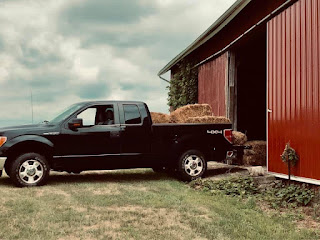
Ode to a Truck

Wednesday, I took my travel companion on its last trip, from which it didn't come home with me. I took it for a drive the day before, to...