02 June 2011

One Munster Shrine


Last Friday I had a dreary trip across Indiana beginning at the Illinois state line and finishing at the Ohio line, all on Route 6. The company was good, and for the most part, the scenery was interesting, but it was an awful gray overcast day for taking pictures.


We hadn't gotten too far into Indiana from Illinois when this happy steer put a smile on my face despite the gloomy skies above. A bit further down the road my observant driver spotted Calvary on the south side of the road in Munster. What's that doing up there I wondered. Knowing that we were on a tight time frame to make it across the state during daylight hours, of course, we stopped.

And it was the best stop of the day.


We gathered up a few photos, walked briskly through the stations of the cross (backwards I think, and we missed a few....that's the trouble with us Protestants), but we couldn't help but be drawn to the unique material the shrine was made from during the 1950s. Sponge rock from Arkansas. Never heard of it. But it was used in masterful precision. I was headed back to the car when my driver (sounds like I'm Amish) began talking to some older gentlemen who looked like they were heading off to do some important work. They planned to spend the day in the tomb switching light bulbs. What? So they invited us into the tomb below Calvary and it was one of the more impressive places I think I've been in here in ol' Indiana.


Now, my pictures (stupid camera) didn't do this place justice. It was really quite remarkable. I went online and found this link that has a little better photography than my orange blurs, and more history: http://www.roadsideamerica.com/story/11529 . I think what was so amazing was the use of light and stone together in the tomb. And just so that you don't think I wasn't reverent, I asked if it was ok to take pictures, and I did spend a little contemplative time before rolling the stone away and getting back on Route 6.


The one picture that turned out perfectly was the one of my hand. I was inspired with all kinds of thoughts and spiritual applications when I placed my hand on the stone, unfortunately they escape me now. I'll be sure to post more on my travels on Route 6 soon.

25 May 2011

Random things from the Hill

I feel like things are starting to become a blur. I've hardly caught my breath with how busy I have been and how much I'm trying to get done at Sycamore Hill. We have the garden in and much weeding is in our future. We landscaped the west and north sides of the house (when we moved in there was some overgrown prickly landscaping on the south side in about 12" of sparkly quartz stone and that was it).


We found scads of mushrooms here this year. 80 around one tree in our yard alone. We also found trespassers on our property while we were looking for the tasty little morsels. After three batches I had had my fill until next year.


This past weekend we acted on a rather good idea I had earlier in the week, if I do say so myself. We have a basketball rim that was intended to go up in the barn but the floor is too uneven so I planned to put it on the garage-but there is no concrete there....yet. So when I was mowing the path to the lower level of the barn it dawned on me that there was a heck of a lot of concrete out there. So with shovels and scrapers my son and I uncovered many more square feet of concrete that has become his basketball court and I put up the rim on the barn. Where else would you put a basketball hoop in Hoosierland?

18 May 2011

telling the Hoosier story


Indiana's Cultural Tourism Conference was held on Monday in Merrillville. Since it was a short jaunt down the road, and I thought it would be good exposure to thoughts and ideas about promoting the Michigan Road and other projects I am involved in, I took the day and spent it listening to heritage and cultural tourism cheerleaders.


There were a number of messages about how to promote and market yourself, but the over-riding theme was find what makes you unique and tell the story. My mind drifted into the stories to tell from my hometown and across the state. Some places do a great job with this. We just don't.


There is something to be said of a society that is wise enough to look inside itself and celebrate the cultural heritage that has been left to them. I think that there is something even bigger to be said of a society that is blinded to its past, its' lack of depth, and the rather vanilla appearance of its place. We are missing opportunities left and right to develop the quality of life that people want. It just takes forward thinkers and good leadership to deliver it-something we seem to run from. I coined the term "brain flush" several weeks ago to describe not the accidental loss of our brightest and best, but the deliberate disposal of quality people.


Certainly not to wallow in doom and gloom, I should point out that there are several refreshing locations across our state-maybe in the most unexpected places-that "get it". It's a joy and an honor to talk and work with Hoosiers of that caliber. And if I could give Hoosier Happenings a giant pat on the back, when this blog was started almost three years ago I wanted to celebrate our culture-to tell the story of what makes us unique as Hoosiers. With nearly 700 posts under our belt, I think we've been pretty successful in doing just that. And by reading all this dribble, you are as much a contributor to the discovery as I am.

09 May 2011

Another trip on Route 6


Maybe it's because I grew up on one of the greatest coast-to-coast highways in America, or maybe it's because our family's identity was so tied to the road, but I can't hardly get enough of driving the Grand Army of the Republic Highway....Highway 6. And my grandparents must have felt the same way when they shot this picture of my uncle Michael O'Leary back in the 50s when they traveled the road to the east coast.


Several weeks ago I was asked to meet on a project and I suggested this great diner I've always wanted to stop at but never had a reason to do so. The 20th Century restaurant located at 6 and 15 is a classic late-50s diner that doesn't look like its been touched since it was first opened, even as we've embarked on a new century. This fellow I met and I talked a long time about old 6 and the role it played both in our state and nation. And that led to establishing the need to survey 6 across Indiana to see what is left from its early era. More pictures to follow!


And since I've been driving 6 so much into LaPorte County, I couldn't help but stop on this little motel just east of Walkerton. The neon as dusk is a great sight. I suppose places like the 20th Century and the Bel-Air Motel have a hard time justifying their existence in the 21st, but certainly have established themselves a special place in the heart of this old soul. I was forwarded a blogsite on Route 6-it is under "Outside Links" at the left.

03 May 2011

Opulence in Hammond

I think sometimes we forget where Indiana's place in the nation was during the roaring 20's. Opulence abounded in many up-and-coming urban areas across the state. The Calumet region, particularly Hammond and Gary, had some of the finest buildings being constructed as a sister region to the Chicago metro area. The area was not only a sizable industrial and port area, but also a significant financial center as money flowed into it.

Hohman Avenue in Hammond is a good place to start in uncovering this past. South of downtown an area developed known as Harrison Park. Served by an electric rail line the area south of the center of town became a suburb for the city's burgeoning upper and upper middle classes. Maybe two of the finest buildings constructed during the boom time sit across the street from each other: the Southmoor Hotel and the Northern States Life Insurance Company Building.


The Southmoor represents the height of Hammond’s economic success of the early 20th century and the commercial building boom that ensued. It is considered one of Hammond’s finest early hotels. Prosperity demanded all types of housing; including workers’ homes, shop keeper and other middle income earners’ housing, as well as estate housing for the affluent. Also needed during this time were apartments for Hammond’s many single and newly married populations. The Southmoor itself became a popular place for teachers to live. The Southmoor catered not only to this population, but also upscale lodging needed by visitors to Hammond for business or pleasure.


The Southmoor was positioned well on one of the city’s main thoroughfares with access to the Green Line, taking commuters not only to the downtown districts, but also with connections to other northwest Indiana cities and Chicago. The apartment building provided a more suburban setting than the downtown and had immediate access to Harrison Park. The building provided a few retail necessities, such as a beauty shop, restaurants, and dry cleaners, located in the building’s commercial space to support its residential population. Developer Leo Deutsch contracted with Gary architect L. Harry Warriner to design the five-story building in 1927. Warriner provided initial drawings late in 1927 which were revised and used for construction in March, 1928.

The company originally known as Employee’s Life and Casualty Insurance began in 1910 in a small room in the rear of Hammond Trust & Savings Bank and was born into a well-suited economic climate that would ensure its success. The originators expected it to have great appeal to the “industrial army of this region”. The company was renamed Northern States Life Insurance Company in 1913, the same year it “took its first step in reinsurance, reinsuring $1,700,000 of business of another company.” From that year forward the growth was “steady and without any high pressure…..until 1919 when the year closed with ten millions of business in force.”


In 1925 a Minneapolis based company with the same name was persuaded to consolidate with the Indiana institution, liquidating the Minneapolis firm and making the Indiana firm of Northern States a giant insurance institution of the upper Midwest, opening up licensure in the states of Nebraska, South Dakota, North Dakota, Minnesota, along with its current coverage of Indiana, Illinois and Michigan. This gave the Hammond-based company “a field of great diversity of industrial, commercial and agricultural interests.” The company had then, with the consolidation, thirty-two million dollars of insurance and total assets of about three and one-half million. The Northern States' "temple" was constructed in 1926 and rivals any building of its era in architectural excellence. The company, though boasting its economic diversity would weather any storm, was forced to close in 1930 due to the Great Depression.


Both buildings continue to be used today and are in excellent condition. They recently were placed on the National Register of Historic Places.

27 April 2011

Monterey Bandstand


There are so few of these historic little Victorian-era bandstands remaining in Indiana. It was refreshing to see this little guy as I rounded the corner and found it standing in the middle of Kleckner Park on the banks of the Tippecanoe in the little town of Monterey in northeastern Pulaski County. In 1982 David Dixon created a survey of bandstands in central and northern Indiana; only 14 were accounted for and Monterey's was the only one of the Victorian period, constructed in about 1910.

Communities used the structures for town bands, orators and politicians to entertain or connect with the public. Town bands became particularly popular during the late 1800s and into the early part of the 1900s and drove the need for many of these structures as performance stages in public spaces. The architectural type also followed the garden city, or city beautiful, concept of creating public places of respite or recreation. Such places as parks and public squares required an elevated place for viewing or from which to view the surrounding area. The bandstands were places to see and be seen. No doubt, the burgeoning little town of Monterey needed one of these public spaces and in the early 20th century Adam Kleckner donated a four acre tract of ground to the Town of Monterey for use as a park on the opposite side of the Tippecanoe River. The bandstand quickly followed.

Very little is known about the man who was the builder of the Monterey Bandstand. Abraham R. Hay was born in Indiana in 1852. His father was a native of Pennsylvania and his mother was a native of Germany. Hay was living in Pulaski County when his wife, Isabelle, filed for divorce in 1875; at that time Hay would have been approximately 23 years old. Abraham Hay is listed in the 1910 census for Monterey as a boarder. He was living with Mary Eikelburner, age 65, and her son and his family. Their residence was 52 Main Street. Hay’s marital status is listed as divorced; his occupation is listed as “carpenter of houses” and he was actively working at the time of the census. Abraham Hay died on September 3, 1939.

18 April 2011

Bethel II


By my Senior year at Bethel a group spun off of our new Circle K Club to operate the Acorn, though that board and the club’s board shared some members….me being one. Fred became a good friend of mine; he was a fellow business major and Senior, and he became the president of the K club while I was treasurer. Faith also became a good friend and served as either vice-president or secretary, I don't recall but frankly she picked up everything Fred and I didn't do. I was the main manager of the Acorn, with a number of others heading up other areas. It was my time with the group managing the Acorn that brings back the best memories from my Senior year. We brought in a juke box, revamped the kitchen to offer actual food, instituted “Saturday Night Live at the Acorn”, obviously a spin off a program on NBC that will go unnamed in case of copyright infringement. We invited bands and had talent nights and packed the student union. And we actually were making money-well, the student union was. My good friends and cohorts were Scott and Ingrid (who became Mrs. Scott), Amy, and Mark. And by the way, this Acorn has no ties to local terrorist organizations, not that I was aware of anyway.

By my Senior year Bethel was brought back from the brink. Student enrollment was up to about a thousand, a few thousand short of today's enrollment, and discussions began about how to plan the campus for the future. I ran for Senior class treasurer and won, and by virtue of my role with the Acorn was able to sit in student leadership meetings. I was nominated for Homecoming King, but fell short with the votes, probably 15 like in my council race! I think I lost it with my “blood for oil” comment concerning the Persian Gulf War during the assembly interview. Still, it was an honor being the only off-campus student nominated for the court. Speaking of court, it was the Bethel basketball games that really got the heart pumpin’ and probably had the best influence on student morale.


Mark, from the Acorn, was a class A prankster and looking back, though I don’t regret anything, I realize we could have gotten into serious trouble. Besides dumpster diving abroad, we commandeered sacred Bethel ephemera and framed fellow students by placing the materials in their dorm rooms (see top picture!). We held chair races on the sidewalks that followed some of the hilly terrain outside the library using the Board of Directors comfy chairs that had coasters….until we broke one. We hid that chair for a few months until the week before graduation and attempted to glue it back together then very carefully placed it back in the Board Room. I would have hated to be the person that sat in it. Graduation came and went but didn’t seem that “final” since I had already been accepted into architecture school at Andrews University.


Bethel never lived up to those “hallmark” college days that Andrews did. I think it was because I didn’t live on campus. Don’t get me wrong, I had some good times there and made some great friends, but I never really felt at home there. I got an apartment with a couple of guys from Bethel and commuted to Andrews my first two years so I managed to keep some connection with the college, but once the roommate situation ended, so did my link with Bethel. And I never really felt the pull to go back.

15 April 2011

the Bethel Years


When we took over the Bethel Acorn, we inherited the mid-80s logo and never changed it. The upside down pink triangle? I know, makes me wonder what they were thinking too. That's my buddy Mark & I revamping the place. Yes, that's a near-mullet I have.
“Architects come a dime a dozen” said my dad as I was trying to plan out my post-high school future. Well, I loved business and already had a connection with Bethel College, so it seemed like a logical place to go. It was a small Christian college in Mishawaka-a half hour commute, and coming from a small Christian high school it seemed like the perfect fit. The enrollment my Freshman year was only about 500 and there was serious discussion about closing the college. The newest building on campus was a library dedicated just a few years prior and named in honor of my step-grandfather. I knew a small handful of kids who went there either from LaVille or my church. But compared to my school of 30-this seemed enormous.


I bonded with a small group of friends I had met during Freshman orientation and they became my base set of friends over the next two years, but my girlfriend and a great number of my old friends from high school were still in the area and since I didn’t live on campus, my time was spent with the old gain. That started to change by my Junior year as I became more active in a few programs. One fellow business major wanted to start a business club and tagged me as someone who could help get that off the ground. We did-it was called the “Bethel Action Network Club”, or BANC, the idea is that it would serve the entire student body as a method of making connections in the business community for future grads. Tom was the driving force behind this, and being a baseball player, attracted a few others with his energy. And then he came to a meeting and said “I have an idea.” He wanted BANC to take over operations of the meager little student union/café called “the Acorn” (Bethel’s campus is full of oak trees). We went along with Tom’s idea and it seemed to work well my Junior year.


By the end of that year Tom had yet another idea, spurred on by the head of our business school who happened to be a Kiwanian, Professor Mow. BANC should become a college Kiwanis program or “Circle K Club”. So, we began down that path. Our membership was never very high, but it sufficed to have a charter granted to us and we were adopted by Mishawaka’s Kiwanis Club. This affiliation with Kiwanis became the reason why I turned to Kiwanis once I returned to my home town six years later. My senior year lived up to college expectations....that's part 2.

13 April 2011

Putting the Sycamore in Sycamore Hill


Staking out the location for our allee of trees


This past weekend was amazing, wasn't it? The gloom on Saturday morning turned to sunshine and warmth and by Sunday night it felt like summer. We'll ignore the forecast of possible snow mixed in with rain for this Saturday.


That tom-foolery by Mother Nature convinced me that this past weekend was the time to plant trees. Again asserting the honorable role the sycamore tree should have in the Hoosier state, and wanting our place to live up to its name, I began the hunt for sycamore trees last fall by contacting the state tree nursery. I would have to buy 100 trees. They were out of sycamores. My dad had a catalog of native trees in which I could order 25. The cost was double for 1/4 of the trees-but given how I would insist on planting all 100, the 25 seemed like a better deal. I also ordered 10 (they sent 11) Douglas Fir. These would be the official family Christmas Trees for 2021-2032. And finally I ordered 5 apple trees last fall that I spaded into a temporary location until spring when I could establish the "orchard".


Two weekends ago my son and I, in anticipation of the tree order arriving any day, measured out the locations for the sycamore trees and the orchard. To provide an air of "romanticism and mystic" to the farm, and in keeping with the tradition of farm estates of the 1800s, we lined our roadway property line from the creek to the drive, and then lined each side of the drive all the way up the hill. We finally established a 25' spacing after evaluating 20' and 30'. The orchard was easier to plan at 15' with alternating rows.


The orchard arrived in a box last fall


Then this past weekend I planted. I had some assistance from my daughter for about 3 trees; after that she was finished. I reminded her she wanted the apple trees but that didn't matter. Then I carried buckets of water to nearly the corners of the property. Then I sprayed "deer away" which smells like rancid meat, on the trees hoping to thwart the herd of 30+ deer who are regular visitors to Sycamore Hill. I figure 10-15 years out we'll begin to get a feel for how these little whips will mature. I'll be almost 60. Good grief.

07 April 2011

Architectural Unrest


As I have been reading up on John Lloyd Wright recently I was struck by a comment in his book of an experience we had shared in our young architectural careers. Architecture for me has been nearly a life-long pursuit since I understood at an early age there was a sort of "architectural unrest". It was trips to Indianapolis to visit my grandparents, or through Indy on our way to Bloomington that I realized my interest in architecture. As we would drive down Meridian Street, north of I-465, and I studied the boxy new buildings that sprung up overnight I thought to myself “geesh, I can do at least that good”. And so I began designing homes and buildings when I was about 14 years old; I still have that first sketch book filled with floor plans and elevations. It was only a few years later that I also realized that early periods of American architecture also interested me. Possibly due to my love of history, soon I began to study old buildings and developed a real love for preservation. I subscribed to Colonial Homes magazine and the National Trust for Historic Preservation’s magazine when just a junior in high school. You would think that I would gravitate toward a profession in architecture, but I loved business and I can vividly recall my dad responding to me when I said that I wanted to be an architect: “architects come a dime a dozen”. And so, I put my architecture education on hold for four years while I received my business degree.


Near the end of my business schooling I realized I still had the itch to pursue architecture, so I enrolled in Andrews University's School of Architecture. The first design problem we had was for a small home. The professor made his rounds and looked at the work on my drafting table, then looked at me, then back at my work and made the comment "someone has done this before". The next five years I honed my skills and developed a pretty strong philosophy on architecture born out of almost cumbersome convictions. After I graduated, for good or bad, I ended up back in my hometown-something I considered a dream come true.


My second day on the job-exactly 2 days after graduation-the boss dropped a file folder on my desk and said it was for a client who had a lake house that burned down and they wanted to replace it. I was stoked-most archi grads don't get their own design projects for a few years after graduation and this was day 2. So I let loose all of the "creative genius" stored up from 5 years of architecture school and came up with a design that blended the history of the former house built by the client's grandfather, with the loss, but also an eye to the future. It was embedded with this "story" and a great deal of quiet purposeful decisions born from an adherence to Christopher Alexander's theories on architecture....two of his books are sitting on the shelf above me right now.


So the house was built, and I couldn't stay away from watching it come together. I remember one afternoon after work making my way to the site and walking around the shell, putting my hands into the window openings and studying the views from different vantage points. I went back to my loft apartment and wrote extensively about the experience that night. And that was the experience I shared with John Lloyd Wright. Wright wrote about doing this very same thing and called it "the closest thing to a spiritual experience" he had known. I still think fondly of that house on the lake and smile when I pass by it because I know the "story" behind the house. I know its intricacies and the reason it looks and functions like it does that the homeowner may not understand consciously, but probably in their subconscious are quite satisfied.


It is hard to explain the great personal satisfaction in seeing something imagined, then placed on paper, rise from the ground. It's like walking through someone's creative soul. Maybe it's like a farmer who walks through a corn field prior to harvest, or a mechanic who revs an engine brought back from the dead. It is a grand experience and I'm thankful God wired me in such a way to create.

04 April 2011

Country Music for the Soul


I have had an on-again, off-again relationship with Country music all my life and the CMAs last night brought that back to mind. As a kid I think that along with the Duke boys, and my whole country “swagger” was the need to listen to country music. I remember watching performers on Hee Haw and listening to the Grand Ol' Opry on the car radio. While I had a small AM radio that my aunt gave me for Christmas one year and I could pick up Rock on WLS, later I would start to listen to country music and only gave that up when I entered junior high.


And then it was off-again while Christian Rock and real Rock took center stage well into college. But then something shifted again and about mid-way through architecture school I got the hankering for a little twang in my life. That time it stuck, even if it was just one of five channels preset on the car radio. And then I got my truck...and, well, it only seemed appropriate.


And then I met my wife and she loved country music-mostly that girly stuff that hard-core, old-school country musicians wouldn't recognize as real "country", but that was ok. An interesting note is that when our son was a baby and began to fuss in the car on road trips-he only responded to country music-so we'd turn it up load and sing along with Garth or Shania. And so it has continued at our house, and now fittingly, on our farm.


For the most part country music is just good for the soul. There seems to be such a crossover in lyrics in what could be loosely, and at times concretely, understood as spiritual messages in the songs. And a great deal of time-they're just good plain fun. Country music is the sound of America's heartland, and while I don't always agree with the message, it is a window to our soul set to a sound born in the homes of pioneers on our early frontier.

30 March 2011

Monument to the Homefront & the other Lloyd Wright

Kingsbury Ordinance Plant Employment Office & Medical Examination Building

Probably the most architecturally important building remaining at the KOP

I am working through a project right now that has required a great deal of research in advance on a bit of an unsung architect who practiced in Indiana during the 1920s, 30s, and 40s. John Lloyd Wright, who changed his middle name to that of his famous architect-father's, Frank, grew up in the business bouncing off his father's studio walls in Oak Park, Illinois. John at first rejected the notion of following in the trade but after moving to California and working side-by-side with his brother in a related field he understood he just had to follow his heart and began training under his dad. That led him back to Oak Park. Wanting to be out from under his father's shadow, John moved to Long Beach, Indiana in 1923. Long Beach was a resort community that developed along the Lake Michigan beach just north and east of Michigan City, Indiana. John created a home and studio, and more importantly, relationships with others for whom he would create home plans. John's work at first followed some of his father's styling with the Prairie influence, but after a trip to Europe he began to create his own mark on his architecture. John Lloyd Wright completed only about two dozen designs during his time in Indiana from 1923-1946, and only a few of those were not residential in nature. He created two schools, one in Long Beach and the other for Coldspring Township. The Long Beach school remains today. He also created probably his best known public work-the Long Beach Town Hall, which was recently restored. He created one apartment house, still existing in Michigan City, and a hotel for the Indiana Dunes, which was razed. All but one of his home designs were located in Long Beach, the one other was located in Michigan City and is still there.


Fire & Guard Station, KOP


Now, for the most part, I knew about his career in Indiana and about the handful of projects he created in Long Beach. But I didn't know that during the years of World War II John was contracted by the federal government to design buildings at the Kingsbury Ordinance Plant south of LaPorte.....in fact, I've yet to meet anyone who did know this. I found it listed in an early book written about his projects. So while the kids were home over spring break, and wanting to return to the Bass Pro Shop in Portage, we drove by way of Kingsbury and took a little tour. Once I turned off Highway 35 onto Hupp Road I saw the building pictured at the top and thought to myself-that has to be a John Lloyd Wright design. We saw a second smaller building (above) with the same design as well.


Finished ammunition storage warehouses, three of dozens at the KOP

If you've never driven through the former Kingsbury Ordinance Plant, I would highly recommend it. It is a relic of the war years that likely will soon disappear from the Hoosier landscape. Today it stands as a fading & eerie monument to those who served on the homefront, the Rosie Riveters of Indiana. My dad's parents both worked there during the war, but because of plant rules against husbands and wives working together my grandmother worked under her maiden name. With this new-found information on the plant's connection to John Lloyd Wright, I have a new appreciation for the place. John's drawings for his work at the "KOP" are archived with the Chicago Historical Society and I am planning a trip to get more information about his architecture remaining at the plant. As this project develops I will be sure to post more on JLW, KOP, and the other work he did at Long Beach.

27 March 2011

Collide

Now this boy's got talent! Proud to say I know the face behind those ivory ticklers.

22 March 2011

Here come the Irish


My Great Grandpa and Grandma “Lem” short for Lemuel and “Berthy” for Bertha, Crothers were my Grandma Hochstetler’s parents. They lived in a small old farm on the Saint Joseph County side of the Marshall/St. Joe County line, just west of Kenilworth Road. It was from their lines, solidly Irish, that I got my curs'ed curly hair. They were incredibly frugal, and seemingly strict. Their farm consisted of a working outhouse, chicken coop complete with chickens, an old barn, a windmill and well house, and an old house that from my recollection never had any paint on it. I remember going with my mom to visit them fairly often.


There was an old wood porch that led to the kitchen door. It had an old screen door that went “whap” and creeeeak. The inside of the home was straight out of the 1930s. I don’t believe that anything had been changed in the house during that time, including the wallpaper. Because they heated with a wood burning pot bellied stove in their living room, the whole house had that wonderful old smoky smell to it. Grandma Berthy would offer us candy….which was always those chewy orange circus peanuts. We would sit in the living room, quietly, around the stove. I remember grandpa always sitting in the same place at the end of a dark green couch from the 1950s. We weren’t permitted to look around the house. There was another room on the first floor that had a pair of French doors that always remained shut and I often wondered what was behind them. Once I caught a glimpse of shelves full of glassware. Nor were we ever allowed to go upstairs-to this day I have no idea what was up there. We were, however, permitted to go to the outhouse, because there was no indoor plumbing, or peek in at the chickens through an old door frame covered with chicken wire. A small mowed path through tall weeds led to the privy and coop.

Great Grandma Berthy always called us, early in the mornings, to let us know if we had a school delay or cancellation due to snow. I don’t remember much else, except I do remember their funerals. I believe it was Grandpa that died while I was staying with my Aunt Nell in Van Buren, and we had to return early for the funeral. They were in their early 80s when they died.

19 March 2011

Heart, Head, Hands and....what's the 4th H?


One year. That was it. While 4H horse & pony ran through our family veins, I participated one year with rabbits (4th place) and chickens (1st place). And that was enough. But the county 4H fair became the thing of childhood legends as each summer we trekked to the fairgrounds hauling horses to and from and setting up camp in the horse barn. And whether it actually occurred or not, I cannot say, but it did seem like it always stormed on the night we were there late into the evening. It was at the 4H fair in 1980 that mom was summoned to the fair office to take a call that grandpa Hochstetler was in the hospital. He died the next day. I always think of this while at the fair.

Growing out of the 4H experience, I still returned, even in high school, with friends to see old friends. And it is of course, a tradition today to take our children to the 4H fair to give them some form of farm experience and an appreciation of our agrarian roots. And it looks like we’ll have a couple of junior 4H’ers this summer.

I think I blame the 4H leaf collection exhibits for another obsession that developed in childhood. I developed a pretty keen sense of the natural environment around me, and an appreciation for it and that lead to a leaf collection I started when I was about 10 years old. Soon it busted the seams of a scrapbook as my collection grew to include leaves from trees that I collected on vacations south and west. I had close to a hundred specimens and even a box full of nuts, seeds, and fruits from the trees I collected leaves from. The bizarre thing, yes-as if this isn’t strange enough, is that my mom kept these tucked away in our attic and recently pushed them my way. It’s true though that I impress my friends with my rather useless knowledge of trees and can identify them by about any means in any season. My favorite trees are beech and sycamore and I’ve long since felt that the sycamore should replace the poplar as Indiana’s state tree.

17 March 2011

the eagle has landed


I’m not exactly sure how being a "birder" became a part of my make-up, but the earliest I can remember having an interest in wildlife was when, under duress, I was encouraged to find something to do the first day of summer vacation after about my 5th grade year. I recall my dad making a statement something like this “you need to find something to do, outside…..you are not going to sit inside and watch TV all summer”. After that I began sketching wildlife out of encyclopedias. I think that may be where it started. Regardless, I kept a list for several years through the end of elementary school and into Junior High. And while in high school I may have no longer recorded what I saw…I certainly could identify what I saw.

Then, after college and the kids came along, I started keeping track again of the birds that we had at our place on South Michigan Street. Surprisingly, for living a block from the downtown, we saw quite a variety of birds. The highest count was, I believe, 27 species in one week. Then we moved to the country and that record was quickly shattered as we have found about the most perfect environment for birding-I think the count is 42 different species in one week.
But last week had a stellar moment for birding here on the Hill, and those of you who follow me on Facebook know what I'm about to say. Yes indeed, the Eagle had landed at Sycamore Hill.

I pulled into the driveway last Wednesday after a rather draining day on the road. As I got to the top of the lane and turned the corner to park I saw an enormous figure fly between the house and barn. Realizing this was too large to be our red tailed hawks, I assumed maybe vulture. I got out of the car and saw it perched in a tree by the creek just beyond the large sycamore. Something said to me-get your camera-but I ignored it. I trekked over to the tree it was in and noticed it had a rabbit, and that this was no vulture. It looked at me and with a woosh and whap of its wings flew within about 50' of my head, circled, and came back to roost. No doubt about it-it was an immature eagle. It headed to the fence line along the back 5 acres.

So when the family got home I told them what I saw and we all walked out to the back pasture with binoculars, and this time a camera. It was still perched in a tall tree, but the camera wasn't going to do it any justice. My wife, however, caught a shot of the birder. I know that eagle sitings are becoming more frequent in this part of the Hoosier state, even locally. Even so, this was pretty amazing.....even if my FB friends found the story a bit hard to swallow!

14 March 2011

Political DNA

I'm in the center-this was at FBI Headquarters while on a visit to my grandparents in 1986; funny, I had some Republican friends say this was too right-wing to include on my campaign website. Evidently not right enough!
Whether blood-borne, or married-in, I can't deny my political DNA make-up. This came blasting back into my consciousness recently when I invited former Governor Doc Bowen to the reception honoring my great aunt. You see, back in 1981 Doc remarried my great aunt's sister....and that would be my grandmother. And that led to over 10 years of insight that did nothing but whet my appetite for politics.

Swearing in ceremony for Health & Human Services Secretary, my grandmother in blue
I come from a long, long line of Republicans. It appears that since the dawn of the GOP on America's political landscape, my family in all of its lines has associated themselves with the party. My great grandmother (the mean one) was the first woman delegate to a presidential convention from Indiana-or the story goes. The family, though, always shied away from public office. In retrospect I think I understand why. I broke that tradition in 2003, and could very much see myself breaking with tradition again. The tough part is that I don't see much that I can identify with in today's GOP. It seems the pendulum swings so dramatically to the right and left that left is barely left of center anymore. Which makes me wonder where I am.....oh, and I know where some people think I am!
Meeting with Senator Lugar, above, and on tour with Lt. Governor Skillman, below on right

So last week, after some encouragement, we had a visit with Doc and I introduced my kids to their "ex-step great grandfather" (I think that's right). It was nice to catch up and we wished him well for his 93rd birthday. I would have loved to talk politics....like, "hey, what is up with that gawdoffal Mitch Daniels anyway?" I think most Republicans would be shocked by how he might reply. If you recall, he endorsed Mitch's opponent back in the day, before daylight savings time...sigh.... Instead we traded chit chat stories of life and business, and what our kids are involved in. And that seemed just fine.
I think what separates a true public servant from a politician is where their loyalties lie. I think a politician's loyalties lie with himself and his party. A statesman, a true public servant, has loyalties with only the public. So when a decision must be made, something in his core kicks in and makes a decision on what is right for the people. We don't have that today. I'd like to think that was my m.o., but I'll let others be the judge of that.

10 March 2011

service done right


I have written on HH before about my great aunt who lost her re-election bid for township trustee last fall in the wake of the national anti-Obama uprising. A whole lot of good conservative Democrats were voted out of office. My aunt was the most fiscally conservative elected official I have ever known. Despite that, and her years of experience, she's looking for something else to do now.

One problem....who would hire a 90 year old? My great aunt first started working as a deputy assessor for the township in which she was born and lived her entire life in 1962. In 1970 she was elected trustee and had won every election since that time. That 40 years, plus another 8-that's almost 50 years of service to the people of North Township. She was awarded the Sagamore of the Wabash in 2001.


A friend of mine "from the other side of the aisle" suggested we do something to honor her so we planned a small reception with a few surprises for her. And then she ended up in the hospital and we had to reschedule the reception. We finally were able to hold it a few weeks ago and to her surprise Congressman Donnelly was able to come and speak on the virtues my aunt has demonstrated as a servant of the public for the 40 years. And then he read a letter from President Obama commending her on a job well done. At that she wiped tears from her eyes-and I have to say I did too. I think maybe most stirring was the presentation of a flag and salute by officers of the American Legion.
That's our family with blue dog Democrat Congressman Donnelly

I don't care about political affiliation. I call things as I see them. I think I have a very keen insight on political maneuvering, jockeying, issues of integrity and duplicity. I am probably most critical of my own Republican party because I see tremendous results of power corrupting and whole communities, whole citizenry, suffering because party is treated more important than the public. Actions based on heady, untested, principles are being crammed down our throats with little thought to their ramifications, maybe true on both sides of the aisle. We are at a desperate loss of true public servitude in our country and I don't believe it will ever come back.

08 March 2011

intoxicating


We often get wild surprises around here. Like the pair of Red-Tailed hawks that have been hunting on the Hill. The red-tails seem to be staying lower to the ground as they fly past the house going from the woods across the road to their favorite perch on top of our barn. One afternoon a hawk decided to stop halfway and perch from a fence post just a few yards from the house.

Yesterday my folks stopped by and had coffee. My dad called from the living room and said there was a large group of Cedar Waxwings just outside the front door. We counted 19 of them. The waxwings have been here before, but never in such large numbers. We have four ancient red cedar trees that were planted when the house was constructed in 1865 that form a line between our drive and the front of the house. Cedar Waxwings love cedar berries, as their name would imply. And they were feasting on the berries that had dropped to the ground late last fall and have been covered by snow the last three months. I mentioned this to a fellow birder and he asked me if they were drunk. What? He then explained that often the old berries have fermented and the waxwings have been known to become intoxicated. I told him that must have been why one was wearing a lampshade and another kept telling me he loved me......

05 March 2011

it'll tickle yore innards

A few days ago my little girl and I were walking the property looking for a suitable tree in which to construct a treehouse/clubhouse. Ever since she saw an American Girl Doll movie with Kit Kitridge and her treehouse/base of operations for her investigative journalism work, she's been fantasizing over having a treehouse of her own. I told her last year to give me a year so that we could settle in here on the Hill, and then I would build one.

Well, this is the year. And our scouting earlier this week produced about 4 potential treehouse tree hosts. As we walked along the bank of Brush Creek, the snow about half melted from the ground, I saw a dark green bottle glistening beneath the flotsam and jetsam of this and several past winters. I picked it up and read "Mountain Dew It'll tickle yore innards". I have a handful of old pop bottles that I found on my grandparents' property decades ago, but evidently they were not Mt. Dew fans, and frankly neither am I, because I hadn't seen this one before. And I could hardly believe the marketing image of a mountain man and the use of "innards" on something meant for consumption. But I loved it. Unfortunately the top was broken off. I looked at the bottom for a date and it was stamped with "65".


So I came back to the house and did a little research on Moutain Dew. And here it is: The name Mountain Dew was first trademarked by Ally and Barney Hartman in the 1940s, who coined the name from a colloquial term for moonshine whiskey. Early bottles and signage carried the reference forward by showing a cartoon-stylized mountaineer. The first sketches of the original Mountain Dew bottle labels were devised in 1948 by John Brichetto, and the representation on product packaging has changed at multiple points in the history of the beverage. Pepsi-Cola Company acquired the Mountain Dew brand in 1964, and shortly thereafter in 1973 the logo was modified as the company sought to shift its focus to a “younger, outdoorsy” generation.

Outdoorsy generation? Was the mountaineer not outdoorsy enough? And then I found this great link to youtube with an original Moutain Dew commercial-definitely worth watching:

http://www.youtube.com/watch?v=4xd8fzk8Rlk

02 March 2011

polar opposite great grandmothers


“Granner” or “Granner Grump” was my dad's dad's mother. As her name implied, she was a bit of a grumpy old woman. She had a mobile home located between our mobile home and my grandparents’ house on Lilac Road. Grandpa had moved her to the farm in the 1960s, built a small storage shed which remained on the farm long after the home was gone, and provided a small garden for her. She didn’t like us kids, and she hated cats, of which my grandparents had many. We thought it entirely harmless to walk back and forth in front of her house with the kitties from the barn. She would come out with a broom and shoo us away.

She attended the Assemblies of God Church in Plymouth and my grandparents would leave after church in LaPaz to go pick her up after her service. Sometimes we were allowed to ride along. You might wonder why we would want to, but it was because my grandparents could be talked into stopping at the A&W Rootbeer stand for ice cream….that made up for riding with an angry old lady. She was in her mid 80s when she died. Only the good die young.


Or maybe they don't. My Great Grandma Edna Hochstetler, we just called her Grandma Edna, had retired from the farm northwest of Bremen quite some time before I was born, and had moved with Great Grandpa to a small brick house on Montgomery Street in Bremen, across from the Salem Methodist Church, and around the corner from where her parents had retired to many years before. Grandma Edna had a particularly interesting way in speaking that I remember my grandpa mimicked some, but can hear it particularly well in how my Great Aunt Lorretta speaks. I wonder if it wasn’t from some German influence of her ancestors. Grandma Edna’s house was pretty sparse of furniture and décor. Everything seemed particularly clean and orderly when we would sit and visit with her. She had a few games that we could play, very old board games that she kept in a room off the kitchen. Grandma Edna would always provide us a little something for Christmas, near the end it was a card with a single dollar bill inside. I do remember one Christmas getting a marble track made of wood. And once while visiting she gave me an old metal toy road grader that had been my grandpa’s. Thankfully I still have that.


Grandma, along with her three sisters, were stalwarts of the Methodist Church across the street. All were involved in the women’s temperance society, and the suffrage movement. They all lived to be incredibly old and insisted the family all come together for the Ewald (their maiden names) Reunion each year. Grandma Edna died at 96 years of age when I was a freshman in college.

Ode to a Truck

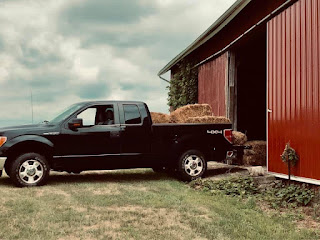
Wednesday, I took my travel companion on its last trip, from which it didn't come home with me. I took it for a drive the day before, to...